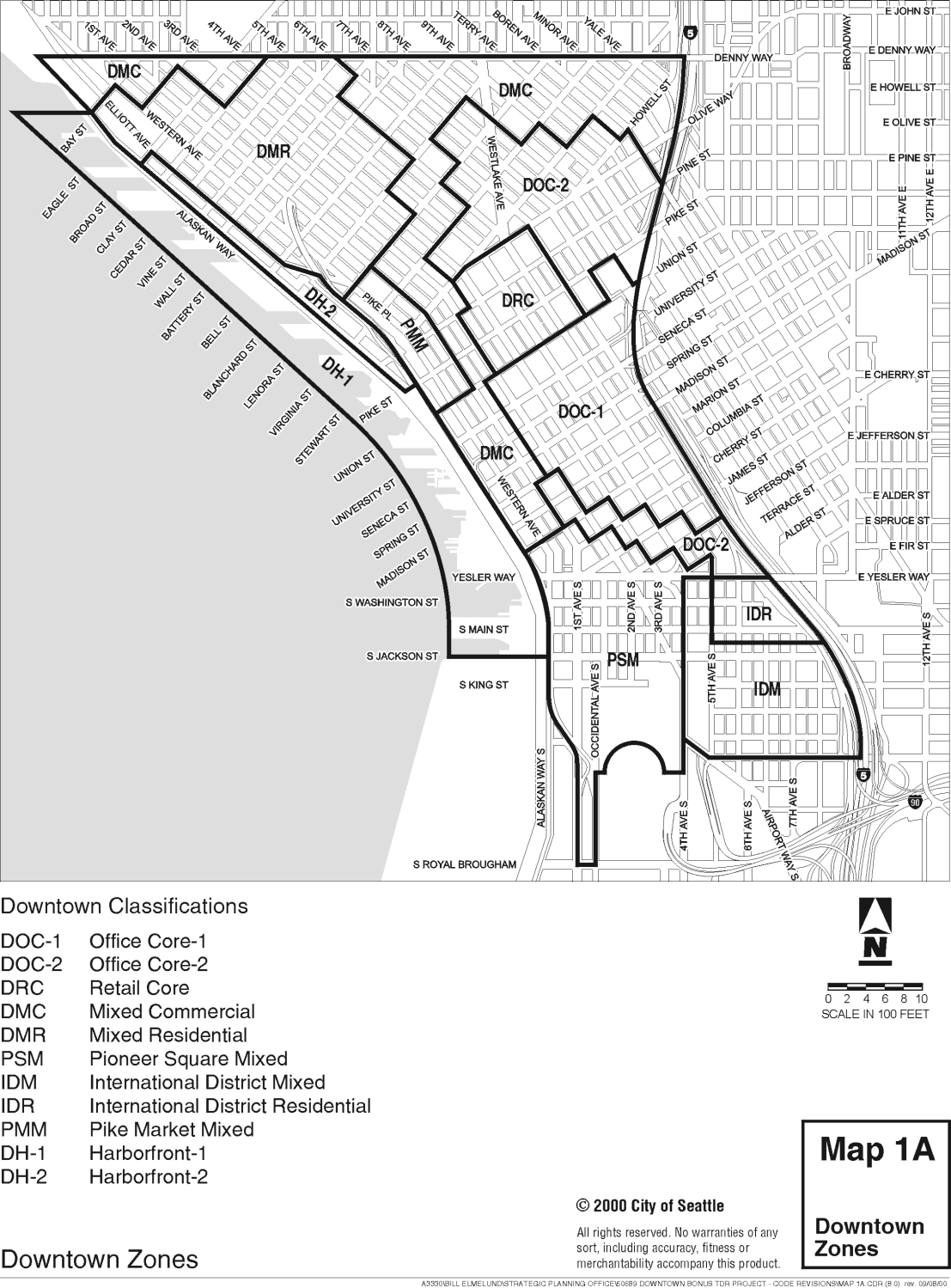
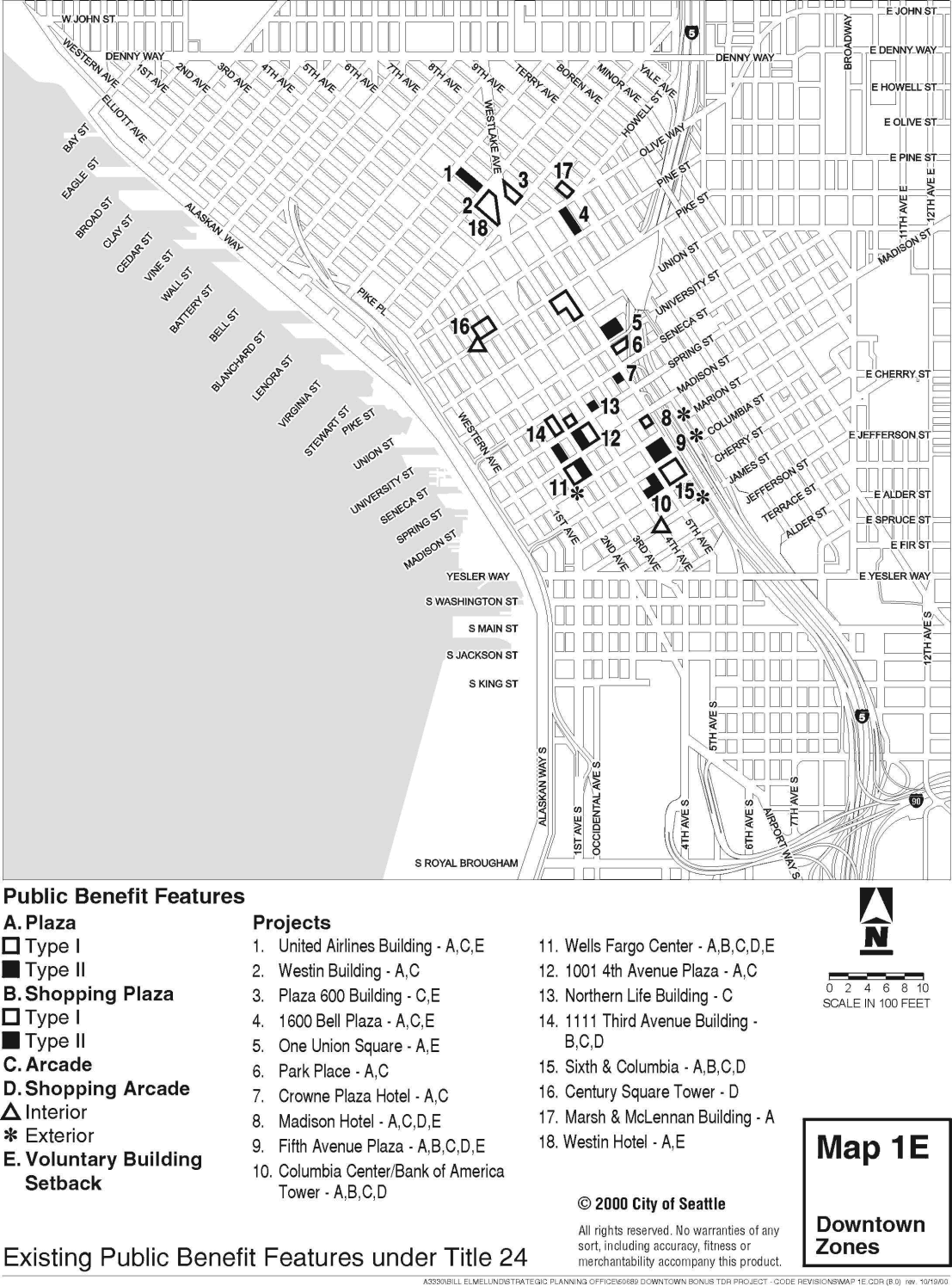
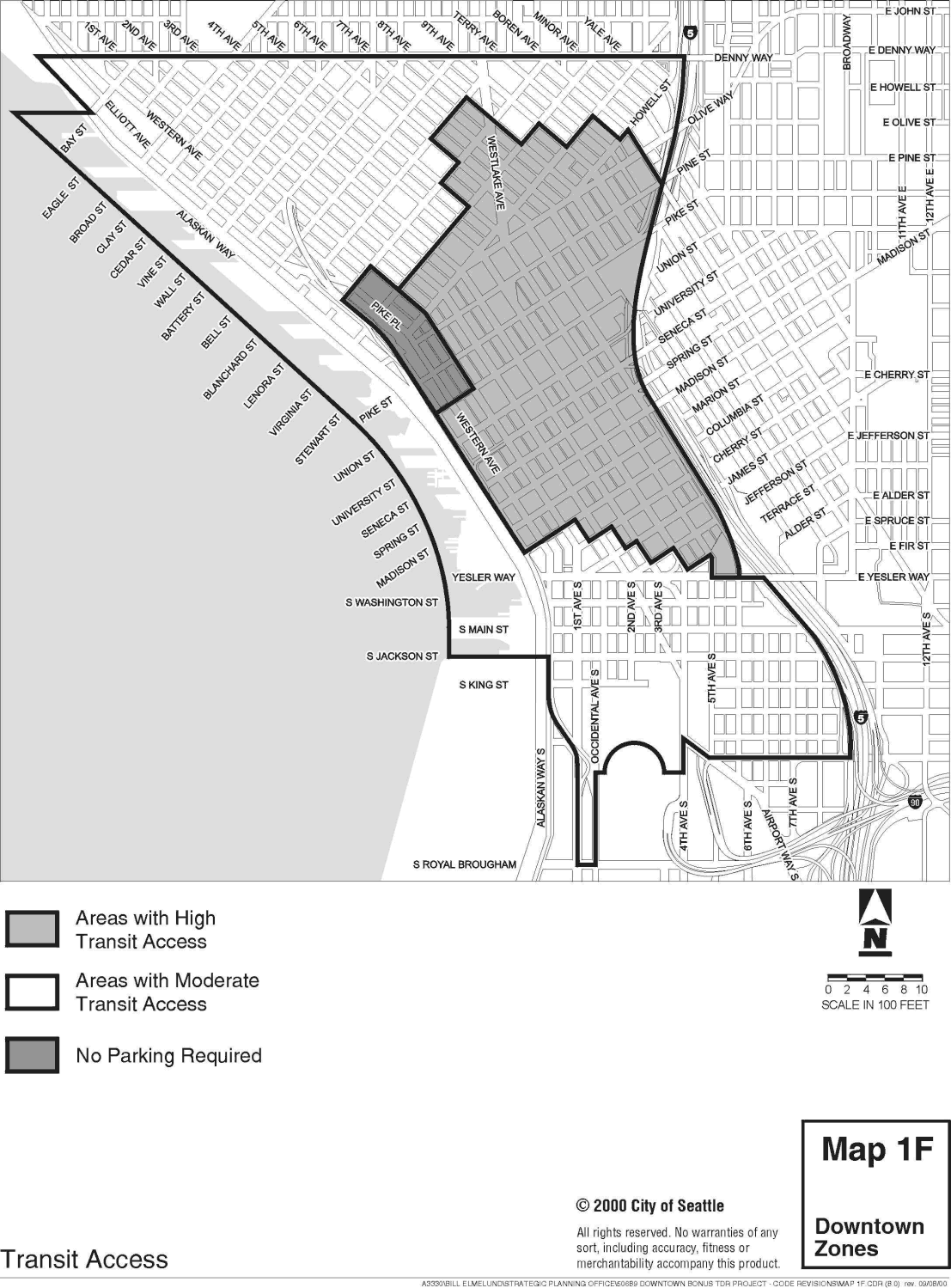
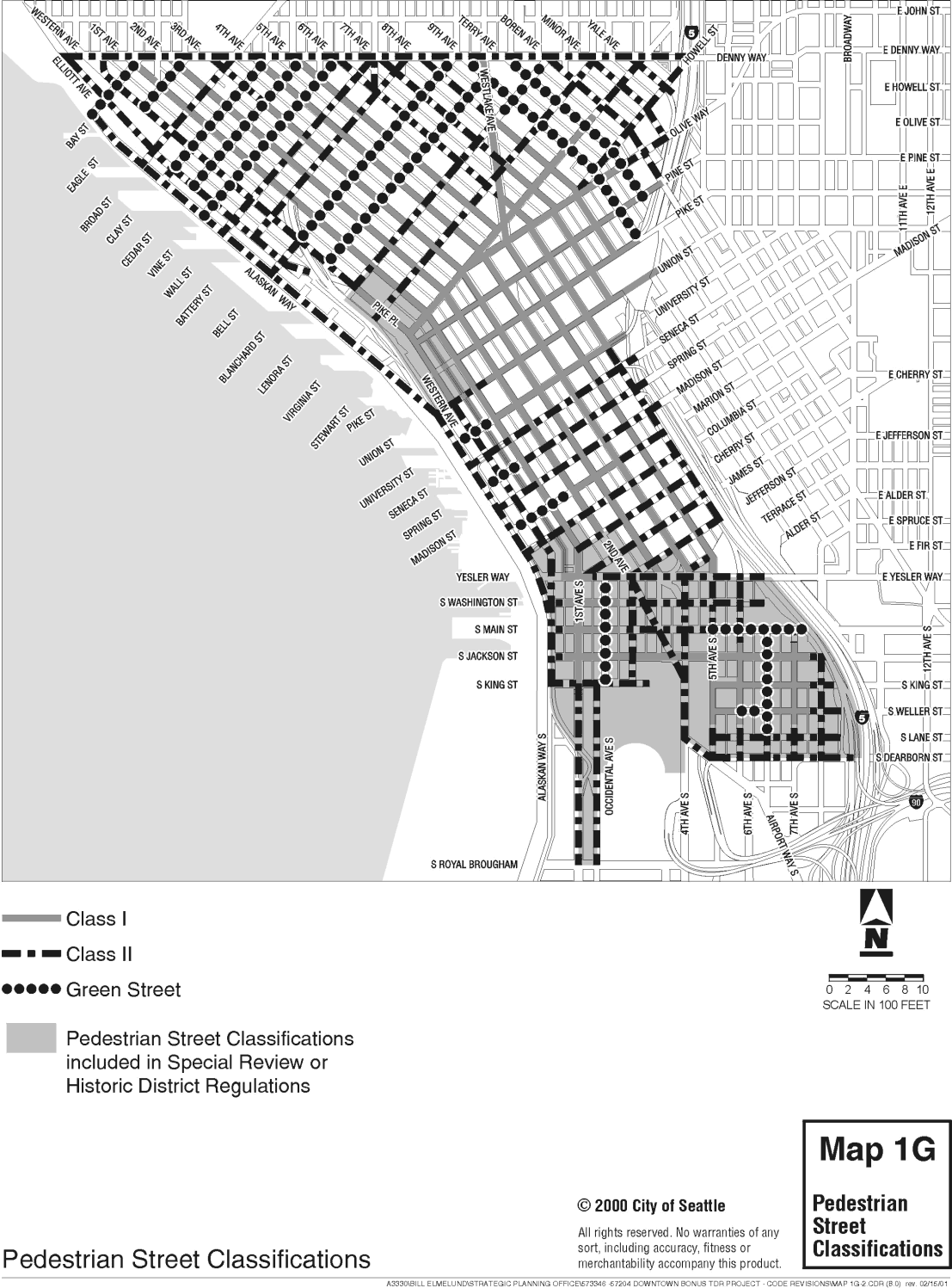
![[HOME]](/netaicon/homeicon.gif)
![[SEARCH]](/netaicon/srchpage.gif)

![[CURR_LIST]](/netaicon/curlist.gif)


![[BOTTOM]](/netaicon/bottom.gif)
![[HELP]](/netaicon/help.gif)
Seattle City Council Bills and Ordinances
Information modified on March 23, 2005; retrieved on December 14, 2025 2:08 PM
Ordinance 120443
Introduced as Council Bill 113615
Title | |
|---|---|
| AN ORDINANCE relating to land use and zoning, amending Chapters 23.41, 23.49 and 23.84 of the Seattle Municipal Code, modifying development regulations for downtown zones and responding to certain recommendations from the Downtown Urban Center Planning Group (DUCPG). | |
Description and Background | |
|---|---|
| Current Status: | Passed |
| Index Terms: | LAND-USE-CODE, LAND-USE-REGULATIONS, LAND-USE-PERMITS, ZONING, MASTER-USE-PERMITS, LAND-USE-PLANNING, NEIGHBORHOOD-PLANS, DEPARTMENT-OF-CONSTRUCTION-AND-LAND-USE, DOWNTOWN, DENNY-REGRADE, BELLTOWN, MIXED-USE-DEVELOPMENT, MIXED-INCOME-HOUSING |
| Notes: | TDR, TRANSFER-OF-DEVELOPMENT |
Legislative History | |
|---|---|
| Sponsor: | CONLIN |
| Date Introduced: | April 1, 2001 |
| Committee Referral: | Committee of the Whole |
| City Council Action Date: | July 23, 2001 |
| City Council Action: | Passed |
| City Council Vote: | 9-0 |
| Date Delivered to Mayor: | July 24, 2001 |
|
Date Signed by Mayor: (About the signature date) | July 27, 2001 |
| Date Filed with Clerk: | July 27, 2001 |
| Signed Copy: | PDF scan of Ordinance No. 120443 |
Text | |
|---|---|
|
AN ORDINANCE relating to land use and zoning, amending Chapters 23.41, 23.49 and 23.84 of the Seattle Municipal Code, modifying development regulations for downtown zones and responding to certain recommendations from the Downtown Urban Center Planning Group (DUCPG). WHEREAS, on May 24, 1999, the City Council adopted Resolution 29900, recognizing the Downtown Urban Center Planning Group (DUCPG) Neighborhood Plan, and approving the City's work program in response to the DUCPG Neighborhood Plan; and WHEREAS, on June 19, 2000, the City Council adopted Resolution 30192, accepting the TDR/Bonus Program Review Advisory Committee Report and establishing a schedule for policy and code changes necessary to revise and update the TDR/Bonus Programs; and WHEREAS, on December 11, 2000, the City Council enacted Ordinance 120201, amending the Comprehensive Plan to include policies for Downtown Seattle; NOW THEREFORE, BE IT ORDAINED BY THE CITY OF SEATTLE AS FOLLOWS: Section 1. The City Council finds that: A. This ordinance is consistent with the policies contained in the Comprehensive Plan as amended and will promote the health, safety and welfare of the general public. B. Housing. 1. Large-scale office and hotel developments in downtown Seattle have attracted and continue to attract additional employees to the City, and create the need for additional housing in the downtown area, particularly housing affordable to households of lower and moderate income. Office and hotel uses in the City are benefited by the availability of affordable housing for persons employed in such offices and hotels close to their place of employment. 2. There is a low vacancy rate for housing affordable to persons of lower and moderate income. This low vacancy rate is due in part to large office and hotel developments that have attracted and will continue to attract additional employees and residents to downtown Seattle. Consequently, some of the employees attracted to these large office and hotel developments are competing with present residents for scarce, vacant affordable housing units in downtown Seattle. Competition for housing generates the greatest pressure on the supply of housing affordable to households of lower and moderate income. In downtown Seattle, office or hotel uses of land generally yield higher income to the owner than housing. Because of these market forces, the supply of non-publicly-subsidized affordable housing units will not be expanded. Furthermore, federal, state and local subsidy programs are not sufficient by themselves to satisfy lower and moderate income housing requirements of downtown, as they will be expanded by higherdensity office and hotel development. 3. To allow total downtown office and hotel development at substantially higher densities than the base floor area ratios established in this ordinance, without provision for a significant portion of the additional affordable housing needed to support such development, would result in adverse effects including, without limitation, excessive demands on transportation networks from additional downtown workers; upward pressure on rents for modest housing in and near downtown; displacement of existing occupants of such housing; households paying large percentages of income on housing and unable to provide for other necessities, causing further strains on public and private resources available for social services and other support of lower income households. An increase in affordable housing units downtown sufficient to accommodate approximately one-third of the low-income and lowmoderate income workers in the new office and hotel projects would be required to offset the housing impacts identified above. 4. The State Growth Management Act calls for jurisdictions planning under it to utilize innovative management techniques including, but not limited to, density bonuses and transfer of development rights to achieve the planning goals established under that Act, which include making provision for housing needs of all economic segments of the community. 5. The City of Seattle's Comprehensive Plan calls for the provision of additional housing to accommodate the demands of new residents attracted here by expanding employment opportunity made available by growth of office and hotel use in downtown Seattle. Land Use Policy L123 calls for the use of bonuses and TDR downtown to increase development potential where it is desirable to accommodate growth, while providing for mitigation of impacts associated with higher densities. 6. The City should provide floor area bonuses conditioned on voluntary agreements by developers to mitigate the adverse effects of the expanded employment facilitated by such projects. 7. The amounts of additional affordable housing downtown for households at different income levels that are necessary to accommodate higher density office and hotel development are approximately as set forth in the Housing Nexus Analysis, prepared by Keyser Marston Associates. The Housing Nexus Analysis describes the nexus between new office and hotel development and the increased demand for housing in the City, and provides the numerical relationship between new office and hotel development and the formulas for provision of housing set forth in this ordinance. The housing to be produced to qualify for bonus floor area under this ordinance therefore represents less than the full impact of the additional floor area. 8. In order for development of housing affordable to households with incomes below 80 percent of median family income to be feasible downtown, capital subsidies are required in approximately the amounts set forth in the Housing Nexus Analysis, according to the income levels to be served. Therefore, the amounts of the voluntary cash contribution to the City's downtown housing fund that would be equivalent to providing floor area of affordable housing units as a condition of bonus floor area are as set forth in the Nexus Analysis. These dollar amounts may be expected to increase. 9. Because the additional demand for affordable housing created by office development in the City can be expected to continue for many years, it is necessary to maintain the affordability of the housing units constructed by office developers under this program. In order to maintain the long-term affordability of such housing, mechanisms such as recorded covenants are necessary. C. Child Care. 1. Large scale office and hotel developments in downtown Seattle add thousands of employees to the downtown workforce and thus result in an increased demand for licensed child care space for children of employees working in the downtown. Office and hotel uses benefit from the availability of child care accessible to workers. 2. There is currently a scarcity of child care in the downtown for all income groups. Because child care costs in the downtown exceed costs elsewhere, low and moderate income workers are especially impacted. The supply of child care in the downtown has not kept pace with the demand for child care created by increased development in the downtown. As densities continue to increase, the supply of child care in the downtown is expected to become increasingly scarce. 3. The Child Care Nexus Analysis prepared by Keyser Marston Associates describes the relationship between large scale office and hotel development and the increased demand for child care in the downtown. Based on this analysis, the City finds that at least 39 additional child care spaces are needed in the downtown for each addition of 1,000 employees, and that the private market will not provide for this need in the absence of conditions on bonuses for high-density development. The analysis includes a formula for calculating the amount of additional child care space needed, costs associated with construction of child care space, and subsidy needs to ensure affordability for low and moderate income workers. Based on that analysis, the City finds that the amount of child care space per square foot of bonus floor area of commercial development established in this ordinance, if provided on terms that ensure a sufficient portion of that space will be used to provide child care affordable to low-income families, will mitigate a substantial portion, though not all, of the increased child care needs from that floor area, and that in the alternative the payment to the City of the cash option amount for child care set forth in this ordinance will allow the City to provide for mitigation of a similar portion of those increased needs. D. Open Space. 1. The City of Seattle has experienced substantial commercial and residential development recently in the downtown neighborhoods without development of open space or space for the display of art and cultural resources. 2. Further commercial and residential development activity in downtown is anticipated in the next decade, which will decrease opportunities for acquisition and development of open space and space for the arts accessible to the general public. 3. The City of Seattle Comprehensive Plan, the Downtown Urban Center Plan and other downtown neighborhood plans identify the desire for additional open space and space for the arts accessible to the general public free of charge. 4. The Open Space Policies of the Comprehensive Plan for the Downtown Urban Center specifically support an expansion of the open space system through an open space bonus and/or allowing development rights to transfer from open space sites. 5. The open space bonus and allowing development rights to be transferred from open space meeting certain standards as provided in this ordinance will achieve the goals of the Comprehensive Plan and will help mitigate the impacts of increased commercial and residential development. 6. Allowing the transfer of development rights from usable, attractive, open space downtown will promote the public health, safety and welfare by, among other things, increasing access to light and air at street level and contributing to a varied pattern of use and development that makes downtown more attractive and desirable to residents, workers and visitors. However, allowing transfer of development rights from a vacant site without regard to its development, maintenance or use as public open space could adversely affect the public health, safety and welfare by contributing to blight and potential public safety problems, causing downtown to be a less desirable place for workers, residents and visitors than it would be if development rights could be used only on-site. Therefore, allowance of TDR from open space should be conditioned upon the dedication of such open space for public access and the development and maintenance of such open space in a safe, attractive and accessible condition. Section 2. Subsection B of Section 23.41.012 of the Seattle Municipal Code, which Section was last amended by Ordinance 120410, is amended as follows: 23.41.012 Development standard departures. B. Departures may be granted from the following requirements: 1. Structure width and depth limits; 2. Setback requirements; 3. Modulation requirements; 4. SCM zone facade requirements, including transparency and blank facade provisions; 5. Design, location and access to parking requirements; 6. Open space or common recreation area requirements; 7. Lot coverage limits; 8. Screening and landscaping requirements; 9. Standards for the location and design of nonresidential uses in mixed use buildings; 10. Within Urban Centers, in L3 zones only, the pitched roof of a structure, as provided in Section 23.45.009C, may incorporate additional height of up to twenty (20) percent of the maximum height permitted, as provided in Section 23.45.009 A, subject to the following limitations:
a. A pitched roof may not incorporate the additional height if the structure is on a b. The proposed structure must be compatible with the general development potential anticipated within the zone, c. The additional height must not substantially interfere with views from up-slope properties, and d. No more than one (1) project on one (1) lot within each Urban Center may incorporate additional height in the pitched roofs of its structures pursuant to this subsection unless development regulations enacted pursuant to a neighborhood planning process allow other projects to incorporate such additional height;
11. Building height within the Roosevelt Commercial Core (up to an additional three (3) feet for properties zoned NC3-65', (Exhibit 23.41.012 A, Roosevelt Commercial Core)
12. Building height within the Ballard Municipal Center Master Plan area, up to an additional 9 feet, for properties zoned NC3 65', (Exhibit 23.41.012B, Ballard Municipal Center Master Plan
area)
13. Reduction in required parking for ground level retail uses that abut established mid-block pedestrian connections through private property as identified in the "Ballard Municipal Center Master Plan Design Guidelines, 2000". The
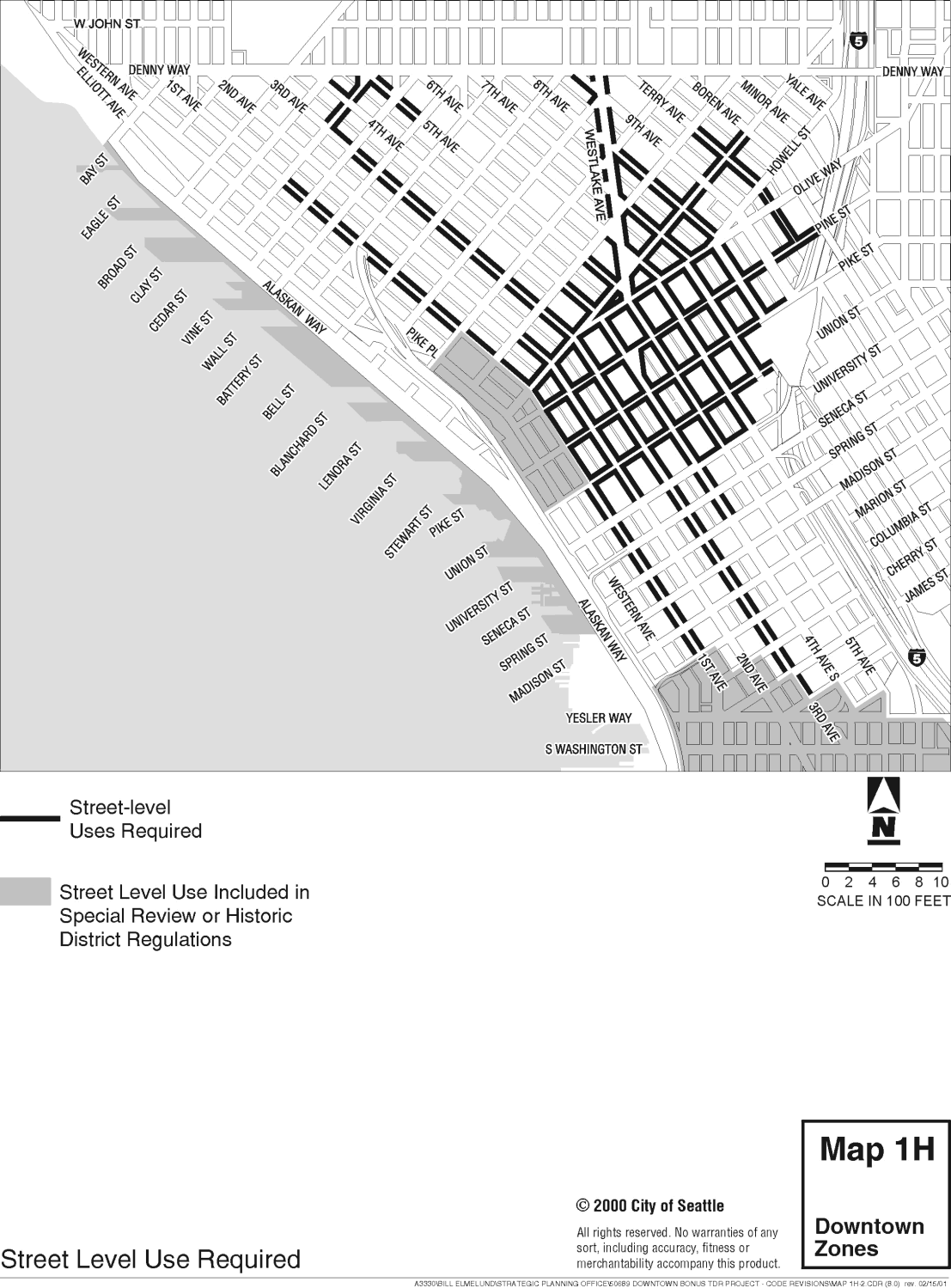
parking requirement must be no less than the required parking for Pedestrian 1 designated areas shown in Section 23.47.004 Chart E 14. Downtown or Stadium Transition Overlay District street facade requirements; 15. Downtown upper-level development standards; 16. Downtown coverage and floor size limits; 17. Downtown maximum wall dimensions; 18. Downtown street level use requirements; 19. Combined coverage of all rooftop features in downtown zones subject to the limitations in Section 23.49.008 C2;
20. Certain conditions to allowance of additional height in DOC 1 and DOC 2 zones pursuant to subsection 23.49.008A 2, as follows:
a. limits on gross floor area of stories under subsection 23.49.008 A2a(2); and
b. percentages of lot area that must be occupied by open space or by structures no greater than thirty-five (35) or sixty-five (65) feet in height, under subsection 23.49.008 A2b(1); and
21 * * * Section 3. Subsection A of Section 23.49.008 of the Seattle Municipal Code, which Section was last amended by Ordinance 120117, is amended as follows: 23.49.008 Structure height. The following provisions regulating structure height apply to all property in downtown zones except the DH1, PSM, IDM, and IDR zones.
A. Maximum structure heights for downtown zones are
2. Any lot that meets the provisions of this subsection may gain additional structure height using one, but not both of subsections 2a and 2b below:
a. A structure in a DOC 1 zone, or in a DOC 2 zone, may gain additional height of ten (10) percent of the maximum structure height, when
(1) the gross floor area of each story wholly or partly above the maximum structure height is no greater than 80 percent of the gross floor area of at least one story below the maximum structure height, which story must have gross floor area no
greater than that of each story lower than it that is wholly above a height of one hundred twenty-five (125) feet. For structures with separate towers, the limits on area apply to each tower individually; and
(2) the above-grade gross floor area in all structures on the lot, including all floor area exempt from FAR limits, except exempt street-level uses and bonused housing, does not exceed the sum of the maximum FAR for the lot established by Section
23.49.011 plus any credit floor area above the maximum structure height allowed under Section 23.49.041, City/County Transfer of Development Credits Program.
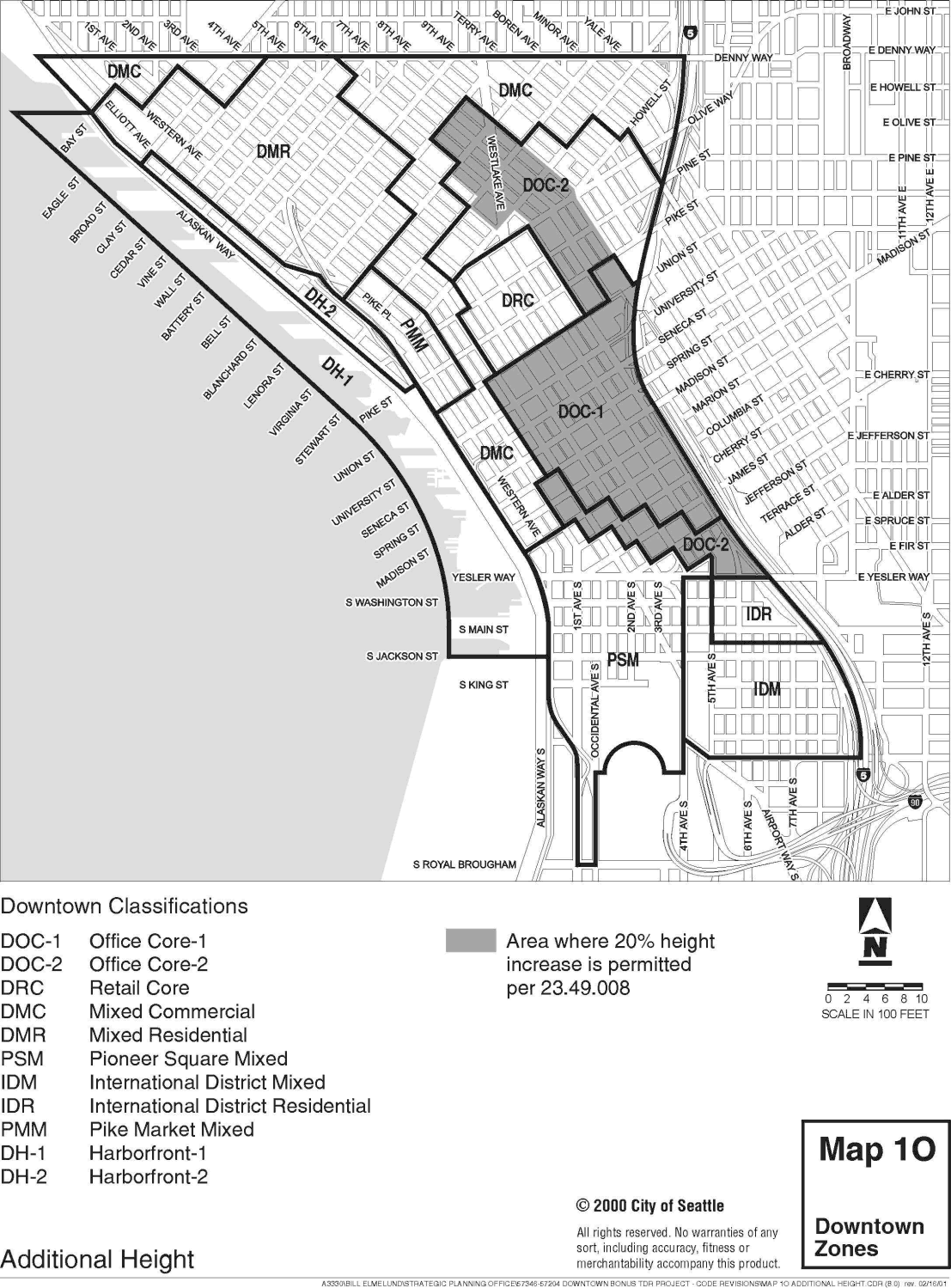
b. A structure within the area shown on Map 1O may gain additional height of twenty (20) percent of the maximum structure height, when the conditions in subsection A2a of this Section are satisfied, and either:
(1) the lot has either (A) at least twenty-five (25) percent of the lot area at street level in open space use or occupied by structures, or portions of structures, no greater than thirty-five (35) feet in height, or any combination thereof; or (B) at
least fifty (50) percent of the lot area at street level in open space use or occupied by structures, or portions of structures, no greater than sixty-five (65) feet in height, or any combination thereof; or
(2) the lot contains a Landmark structure and satisfies all conditions to the transfer of Landmark TDR from such lot under this Chapter and the Public Benefit Features Rule, other than conditions related to the availability of unused base floor area.
3. On any lot in the DRC a height of one hundred fifty (150) feet is permitted subject to the restrictions in subsection 4 of this Section in the following cases:
a. When all portions of a structure above eighty-five (85) feet contain only residential use; or
b. When at least twenty-five (25) percent of the gross floor area of all structures on a lot is in residential use; or
c. When a minimum of 1.5 FAR of retail sales and service or entertainment uses, or any combination thereof, is provided on the lot; or
d. For residential floor area created by infill of a light well on a Landmark structure. For the purpose of this subsection a light well is defined as an inward modulation on a non-street facing facade that is enclosed on at least three sides by walls
of the same structure, and infill is defined as an addition to that structure within the light well. The maximum height allowed under this subsection A3d shall be the lesser of one hundred fifty (150) feet or the highest level at which the light well
is enclosed by the full length of walls of the structure on at least three sides.
4. Restrictions on Demolition and Alteration of Existing Structures.
a. Any structure in a DRC zone that would exceed the eighty-five (85) foot maximum height limit shall incorporate the existing exterior street front facade(s) of each of the structures listed below, if any, located on the lot of that project. The City
Council finds that these structures are significant to the architecture, history and character of downtown. The Director may permit changes to the exterior facade(s) to the extent that significant features are preserved and the visual integrity of the
design is maintained. The degree of exterior preservation required will vary, depending upon the nature of the project and the characteristics of the affected structure(s).
b. The Director shall evaluate whether the manner in which the facade is proposed to be preserved meets the intent to preserve the architecture, character and history of the Retail Core. If a structure on the lot is a Landmark structure, approval by
the Landmarks Preservation Board for any proposed modifications to controlled features is required prior to a decision by the Director to allow or condition additional height for the project. The Landmarks Preservation Board's decision shall be
incorporated into the Director's decision. Inclusion of a structure on the list below is solely for the purpose of conditioning additional height under this subsection, and shall not be interpreted in any way to prejudge the structure's merit as a
Landmark.
Sixth and Pine Building 523 Pine Street Decatur 1513 6th Avenue Coliseum Theater 5th and Pike Seaboard Building 1506 Westlake Avenue Fourth and Pike Building 1424 4th
Avenue Pacific First Federal Savings 1400 4th Avenue Joshua Green Building 1425 4th Avenue Equitable Building 1415 4th Avenue 1411 Fourth Avenue Building 1411 4th Avenue Mann Building 1411
3rd Avenue Olympic Savings Tower 217 Pine Street Fischer Studio Building 1519 3rd Avenue Bon Marche 3rd and Pine Melbourne House 1511 3rd Avenue Former Woolworth's Building 1512
3rd Avenue
c. The restrictions in this subsection 4 are in addition to, and not in substitution for, the requirements of the Landmarks Ordinance, SMC Ch. 25.12.
5.
7. Rooftop features, as provided in subsection C, are allowed in addition to the extra height permitted under this subsection. * * * Section 4. Subsections C and D of 23.49.009 of the Seattle Municipal Code, which Section was adopted by Ordinance 117430, are amended as follows: 23.49.009 Open space. * * * C. Standards for Open Space. To satisfy this requirement, open space may be provided on-site or off-site, as follows: 1. Private Open Space. Private open space on the project site or on an adjacent lot directly accessible from the project site may satisfy the requirement of this section. Such space shall not be eligible for public benefit feature bonuses. Private open space shall be open to the sky and shall be consistent with the general conditions contained in the Public Benefit Features Rule related to landscaping, seating and furnishings. Private open space satisfying this requirement must be accessible to all tenants of the building and their employees. 2. On-site Public Open Space.
a. Open space provided on the project site under this requirement shall be eligible for public benefit feature bonuses, as allowed for each zone, provided the open space is open to the public without charge and meets the standards of
Parcel park; Green street on an abutting right-of-way;
b. On-site open space satisfying the requirement of subsection C2a of this section may achieve a bonus as a public benefit feature not to exceed 3. Off-site Public Open Space. a. Open space satisfying the requirement of this section may be on a site other than the project site, provided that it is within a Downtown zone, within one-quarter (1/4) mile of the project site, open to the public without charge, and at least five thousand (5,000) square feet in contiguous area.
b. Public open space on a site other than the project site shall be a bonusable feature if the open space meets the standards of 4. Easement for Off-site Open Space. The owner of any lot on which off-site open space is provided to meet the requirements of this section shall execute and record an easement in a form acceptable to the Director assuring compliance with the requirements of this section, including applicable conditions of the Public Benefit Features Rule.
D. Payment in Lieu. In lieu of providing open space under this requirement, an owner may make a payment to the City
2. An in-lieu-of payment that includes the cost to develop bonusable open space shall be eligible for up to one (1) FAR bonus as a public benefit feature at the same ratios described in subsection C3b above.
3. Funds received in lieu of providing open space within Downtown shall be applied to acquisition or development of new open space in a Downtown zone, within one-quarter () mile of the contributing sites, except that when a contributor or contributors
agree with the City that a new open space within a Downtown zone but more than one-quarter () mile from the project site(s) would be an appropriate mitigation to the project impacts, the in-lieu-of payments from those projects may be used for that open
space. * * * Section 5. Section 23.49.011 of the Seattle Municipal Code, which Section was added by Initiative 31, is hereby repealed. Section 6. A new Section 23.49.011 is hereby added to the Seattle Municipal Code, as follows: 23.49.011 Floor area ratio. A. General Standards. 1. The base and maximum floor area ratio (FAR) for each zone is provided in Chart A as follows: 23.49.011 Chart A Base and Maximum Floor Area Ratios (FARs) Zone Designation Base FAR Maximum FAR* Downtown Office Core 1 6 14 (DOC1) Downtown Office Core 2 5 10 (DOC 2) Downtown Retail Core 3 5 (DRC) Downtown Mixed 4 in 65' height district 4 in 65' height Commercial (DMC) 4.5 in 85' height district district 6 in 85' height 5 in height districts district above 85' 7 in height districts above 85' Downtown Mixed 1 in 85/65' height 1 in 85/65' height Residential/Residential district district (DMR/R) 1 in 125/65' height 2 in 125/65' height district district 1 in 240/65' height 2 in 240/65' height district district Downtown Mixed 1 in 85/65' height 4 in 85/65' height Residential/Commercial district district (DMR/C) 1 in 125/65' height 4 in 125/65' height district district 2 in 240/125 height 5 in 240/125 height district district Pioneer Square Mixed N.A. N.A. (PSM) International District 3, except hotels. 3, except hotels. Mixed (IDM) 6 for hotels. 6 for hotels. International District 1 2 when 50% or more of Residential (IDR) the total gross floor area on the lot is in residential use. Downtown Harborfront 1 N.A. N.A. (DH1) Downtown Harborfront 2 2.5 Development standards (DH2) regulate maximum FAR. Pike Market Mixed (PMM) 7 7 *Provisions for how to gain floor area above the base FAR are found in subsection 2 of this Section and in Sections 23.49.012, 23.49.013 and 23.49.014. N.A. = Not Applicable. 2. Chargeable floor area shall not exceed the applicable base FAR except as expressly authorized pursuant to the provisions of this Chapter. a. In DOC1 and DOC2 zones the first one (1) FAR above the base FAR may be gained, at the applicant's option, by any combination of the following: providing one of the amenity features listed in Section 23.49.013, subject to the limits and conditions in that section; providing short-term parking meeting the basic standards in the Public Benefit Features Rule, where such parking is eligible pursuant to Map 1N; providing retail sales and service or entertainment uses as street-level uses meeting the requirements of Section 23.49.025, where such uses are eligible as indicated on Map 1N; or using development rights transferred from an open space TDR site or Landmark TDR site pursuant to Section 23.49.014. An applicant using the option allowed under this subsection A2a may achieve additional chargeable floor area consistent with subsections A2c through A2f of this Section. b. In the DMC zone chargeable floor area above the base FAR may be achieved, at the applicant's option, by qualifying for bonuses pursuant to Section 23.49.126, Downtown Mixed Commercial ratios for public benefit features. Such option may be exercised only by election in writing by the applicant as part of the original application for a Master Use Permit, or within sixty (60) days of the effective date of this ordinance, for the project that will use such bonus. An applicant making such election shall not be granted bonus floor area for the lot pursuant to Sections 23.49.012 or 23.49.013, but may use TDR consistent with Section 23.49.014. An applicant making such election thereby also elects to have the optional exemptions under subsection B3 of this Section, and not those in subsection B1, apply in determining chargeable floor area. c. Except as provided in subsection A2a and A2b of this Section, additional chargeable floor area above the base FAR may be achieved only by qualifying for bonuses pursuant to Sections 23.49.012 or 23.49.013, or by the transfer of development rights pursuant to Section 23.49.014, or both, subject to the limits of this Chapter and to any other applicable conditions and limitations. d. In no event shall the use of bonuses or TDR be allowed to result in chargeable floor in excess of the maximum as set forth in Chart A. e. Except as otherwise provided in this subsection A2e, not less than five percent of all floor area above the base FAR to be gained on any lot, excluding any floor area gained under subsection A2a of this Section, shall be gained through the transfer of Landmark TDR, to the extent that Landmark TDR is available. Landmark TDR shall be considered "available" only to the extent that, at the time of the Master Use Permit application to gain the additional floor area, the City of Seattle is offering Landmark TDR for sale, at a price per square foot no greater than the total bonus contribution under Section 23.49.012 for a project using the cash option for both housing and childcare facilities. An applicant may satisfy the minimum Landmark TDR requirement in this section by purchases from private parties, by transfer from an eligible sending lot owned by the applicant, by purchase from the City, or by any combination of the foregoing. This subsection A2e does not apply to any lot in a DMR zone, or to any lot in a DMC zone for which an election has been made under subsection A2b of this Section f. On any lot except a lot in a DMR zone or a lot in a DMC zone for which an election has been made under subsection A2b of this Section, the total amount of chargeable floor area gained through bonuses under Section 23.49.012, together with any housing TDR used for the same project, shall equal seventy-five (75) percent of the amount, if any, by which the total chargeable floor area to be permitted on the lot exceeds the sum of (i) the base FAR, as determined under this Section and Section 23.49.032 if applicable, plus (ii) any chargeable floor area gained on the lot pursuant to subsection A2a of this Section. The remaining twenty-five (25) percent shall be gained through other bonuses or other TDR, or both, consistent with this Chapter. g. In order to gain chargeable floor area on any lot in a DMR zone, an applicant may (i) use any types of TDR eligible under this Chapter in any proportions, or (ii) use bonuses under Section 23.49.012 or 23.49.013, or both, subject to the limits for particular types of bonus under Section 23.49.013, or (iii) combine such TDR and bonuses in any proportions. h. Bonuses for street-level uses may be allowed only pursuant to subsection A2a or A2b of this Section. Bonuses for short-term parking may be allowed only pursuant to subsection A2a of this Section. The bonus ratio for street-level uses is three square feet of floor area granted per one square foot (3:1) of bonus feature. The bonus ratio for short-term parking is one (1) square foot of floor area granted per one (1) square foot (1:1) of bonus feature up to a maximum of 200 parking spaces for above grade parking and is two (2) square feet of floor area granted per one (1) square foot (2:1) of bonus feature for below grade parking up to a maximum of 200 parking spaces. Ratios and limits for the other features for which a bonus may be granted under subsection A2a are in Section 23.49.013. B. Exemptions and Deductions from FAR Calculations. 1. The following are not included in chargeable floor area, except as specified below in this section: a. Retail sales and service uses and entertainment use in the DRC zone up to a maximum FAR of 2; b. Street level uses meeting the requirements of Section 23.49.025, Street-level use requirements, whether or not streetlevel use is required pursuant to Map 1H, if the uses and structure also satisfy the following standards: (1) The street level of the structure containing the exempt space must have a minimum floor to floor height of thirteen (13) feet; (2) The street level of the structure containing the exempt space must have a minimum depth of fifteen (15) feet; (3) Overhead weather protection is provided satisfying the provisions of 23.49.025B5. c. In the DRC zone, shopping corridors and retail atriums; d. Child care; e. Human service use; f. Residential use, except in the PMM and DH2 zones; g. Museums; h. Performing arts theaters; i. Floor area below grade; j. Floor area that is used only for short-term parking or parking accessory to residential uses, or both, subject to a limit on floor area used wholly or in part as parking accessory to residential uses of one parking space for each dwelling unit on the lot with the residential use served by the parking; and k. Floor area of a public benefit feature that would be eligible for a bonus on the lot where the feature is located. The exemption applies regardless of whether a floor area bonus is obtained, and regardless of maximum bonusable area limitations. l. Public restrooms. 2. As an allowance for mechanical equipment, three and one-half (3-1/2) percent of the gross floor area of a structure shall be deducted in computing chargeable gross floor area. The allowance shall be calculated on the gross floor area after all exempt space permitted under subsection B1, or B3 if applicable, has been deducted. Mechanical equipment located on the roof of a structure, whether enclosed or not, shall be calculated as part of the total gross floor area of the structure, except that for structures existing prior to June 1, 1989, new or replacement mechanical equipment may be placed on the roof and will not be counted in gross floor area calculations. 3. In lieu of the exemptions allowed in subsection B1 of this Section, an applicant may elect in writing, at the time of filing of an original Master Use Permit application that involves the proposed addition or change of use of floor area on any lot wholly within a DMC zone on which no bonus floor area has been or is proposed to be gained under Section 23.49.012 or Section 23.49.013, that the following areas on such lot shall be exempt from base and maximum FAR calculations: a. All gross floor area in residential use, except on lots from which development rights have been or are transferred; b. All gross floor area below grade; c. All gross floor area used for accessory parking; d. The gross floor area of public benefit features, other than housing, that satisfy the requirements of Section 23.49.126, ratios for public benefit features, or that satisfy the requirements for a FAR bonus amenity allowable to a structure in a DOC1 or DOC2 zone for an off-site public benefit feature, and, in either case, satisfy the Public Benefit Features Rule, whether granted a floor area bonus or not, regardless of the maximum bonusable area limitation. Section 7. Section 23.49.012, Noise standards, of the Seattle Municipal Code is hereby recodified as Section 23.49.019. Section 8. A new Section 23.49.012 of the Seattle Municipal Code is hereby added, as follows: 23.49.012 Bonus floor area for Voluntary Agreements for Housing and Child Care. A. General Provisions. 1. The purpose of this Section is to allow chargeable floor area above the base FAR when the applicant, by voluntary agreement provides, funds or partially funds public benefit features or capital projects that mitigate a portion of the impacts of higherdensity development. The City has determined that a major impact of such development is the increased need for low-income and lowmoderate income housing downtown to serve workers in lower-paid jobs and their families attracted by the development. The general intent of this section is that voluntary agreements for bonus floor area shall mitigate impacts, with primary emphasis on housing. 2. There shall be a voluntary agreement between the applicant and the City with respect to all floor area earned pursuant to this Section. The agreement commits the applicant to provide eligible bonus features ("performance option"), or to make payments to the City to fund such features ("cash option"), or a combination of both the cash option and the performance option, in amounts sufficient to qualify for the amount of floor area desired. 3. No floor area beyond the base FAR shall be granted for any project that would cause significant alteration to any designated feature of a Landmark structure, unless a Certificate of Approval is granted by the Landmarks Preservation Board. B. Voluntary Agreements for Housing and Child Care. For each square foot of chargeable floor area above the base FAR to be earned under this Section, the voluntary agreement shall commit the developer to provide or contribute to the following facilities in the following amounts: 1. Housing. a. For each square foot of bonus floor area, housing serving specified income levels, or an alternative cash contribution, must be provided according to Chart A: 23.49.012 Chart A Income Level Gross Square Feet Cash of Housing Contributions* Up to 30% of median income 0.01905335 $3.20 Up to 50% of median income 0.06058827 $9.28 Up to 80% of median income 0.07614345 $6.27 Total 0.15578507 $18.75 * The Director of the Office of Housing may adjust the alternative cash contribution, no more frequently than annually, approximately in proportion to the change in the Consumer Price Index, All Urban Consumers, Seattle-Tacoma metropolitan area, All Items (1982 84= 100), as determined by the U.S. Department of Labor, Bureau of Labor Statistics, or successor index, or any other cost index that such Director may deem appropriate. In the alternative, the Director of the Office of Housing may adjust the cash contribution amounts based on changes to commercial and/or housing development costs estimated in such manner as the Director deems appropriate. Any such adjustment to the cash contribution amounts may be implemented through a rule-making process. b. For purposes of this subsection, a housing unit serves households up to an income level only if all of the following are satisfied for a period of fifty years beginning upon the issuance of a certificate of acceptance by the Director of the Office of Housing in accordance with subsection 23.49.012 B1i: (1) the housing unit is used as rental housing solely for households with incomes, at the time of each household's initial occupancy, not exceeding that level; and (2) the rent charged for the housing unit together with a reasonable allowance for any basic utilities that are not included in the rent, does not exceed one-twelfth of 30% of that income level as adjusted for the estimated size of household corresponding to the size of unit, in such manner as the Director of the Office of Housing shall determine; (3) there are no charges for occupancy other than rent; and (4) the housing unit and the structure in which it is located are maintained in decent and habitable condition, including adequate basic appliances, for such fifty-year period. c. For purposes of this section, housing may be considered to be provided by the applicant seeking bonus floor area if it is committed to serve one or more of the income groups referred to in this section pursuant to an agreement between the housing owner and the City executed and recorded prior to the issuance of the building permit for the construction of such housing or conversion of nonresidential space to such housing, but no earlier than three (3) years prior to the issuance of a master use permit for the project using the bonus floor area, and either: i. the housing unit is newly constructed, is converted from nonresidential use, or is renovated space that was vacant as of the date of this ordinance, on the lot using the bonus floor area, pursuant to the same master use permit as the project using the bonus floor area; or ii. the housing is newly constructed, is converted from nonresidential use, or is renovated in a residential building that was vacant as of the date of this ordinance on a lot in a Downtown zone in compliance with the Public Benefit Features Rule, and: -the housing is owned by the applicant seeking to use the bonus, or -the owner of the housing has signed, and there is in effect, a linkage agreement approved by the Director of the Office of Housing allowing the use of the housing bonus in return for necessary and adequate financial support to the development of the housing, and either the applicant has, by the terms of the linkage agreement, the exclusive privilege to use the housing to satisfy conditions for bonus floor area; or the applicant is the assignee of the privilege to use the housing to satisfy conditions for bonus floor area, pursuant to a full and exclusive assignment, approved by the Director of the Office of Housing, of the linkage agreement, and all provisions of this section respecting assignments are complied with. If housing is developed in advance of a linkage agreement, payments by the applicant used to retire or reduce interim financing may be considered necessary and adequate support for the development of the housing. d. Housing that is not yet constructed, or is not ready for occupancy, at the time of the issuance of a building permit for the project intending to use bonus floor area, may be considered to be provided by the applicant if, within 3 years of the issuance of the first building permit for such project, Director of the Office of Housing issues a certificate of acceptance for such housing. Any applicant seeking to qualify for bonus floor area based on such housing shall provide to the City, prior to the date when a contribution would be due for the cash option under subsection C of this Section, an irrevocable bank letter of credit or other sufficient security approved by the Director of the Office of Housing, and a related voluntary agreement, so that at the end of the 3-year period, if the housing does not qualify or is not provided in a sufficient amount to satisfy the terms of this section, the City shall receive (i) a cash contribution for housing in the amount determined pursuant to this section after credit for any qualifying housing then provided, plus (ii) an amount equal to interest on such contribution, at the rate equal to the prime rate quoted from time to time by Bank of America, or its successor, plus three (3) percent per annum, from the date of issuance of the first building permit for the project using the bonus. If and when the City becomes entitled to realize on any such security, the Director of the Office of Housing shall take appropriate steps to do so, and the amounts realized, net of any costs to the City, shall be used in the same manner as cash contributions for housing made under this section. In the case of any project proposing to use bonus floor area for which no building permit is required, references to the building permit in this subsection shall mean the master use permit allowing establishment or expansion of the use for which bonus floor area is sought. e. Only the party named in the linkage agreement with the owner of the housing as having the privilege to use the housing to satisfy bonus conditions may assign that privilege, and any assignment must be absolute and irrevocable. No assignment by an assignee, whether to a new party or back to the assignor or housing owner, is permitted. The Director of the Office of Housing may require, as conditions to recognizing any assignment, that i. the applicant obtain a written acknowledgment from the owner of the housing that the linkage agreement, as so assigned, is valid and effective; ii. the assignor execute any documents deemed necessary by the Director of the Office of Housing to ensure that no party other than the permitted assignee has used, or will have any claim to use, the same housing to qualify for any floor area or development potential of any kind under any ordinance or other provision of law; and iii. the owner and such assignor agree to indemnify and hold harmless the City and its officers and employees from any claims of the type described in subsection ii above and any damages from the City's refusal to honor such claims. f. Nothing in this Chapter shall be construed to confer on any owner or developer of housing, any party to a linkage agreement, or any assignee, any development rights or property interests. Because the availability and terms of allowance of bonus floor area depend upon the regulations in effect at the relevant time for the project proposing to use such bonus floor area, pursuant to SMC Section 23.76.026, any approvals or agreements by the Director of the Office of Housing regarding the eligibility of actual or proposed housing as to satisfy conditions of a bonus, and any approval of a linkage agreement and/or assignment, do not grant any vested rights, nor guarantee that any bonus floor area will be permitted based on such housing. g. The Director of the Office of Housing shall review the design and proposed management plan for any housing proposed under the performance option to determine whether it will comply with the terms of this Section. h. The Director of the Office of Housing is authorized to accept a voluntary agreement for the provision of housing and related agreements and instruments consistent with this Section. The Director of the Office of Housing is further authorized to issue a certificate of acceptance with respect to any housing units developed to satisfy the conditions of this rule, when the construction or rehabilitation of such housing units and the structure in which they are located has been completed; any necessary certificate of occupancy or final permit approval has been issued for the housing units; and either are rented consistent with this section or are vacant, ready for occupancy and offered for rent consistent with this section; and the owner of the housing provides such evidence of compliance with the requirements of this section and the Public Benefit Features Rule as the Director of the Office of Housing may require. i. Any provision of any Director's Rule notwithstanding, it shall be a continuing permit condition, whether or not expressly stated, for each project obtaining bonus floor area based on the provision of housing under this subsection, that the housing units shall continue to satisfy the requirements of this subsection throughout the required fifty-year period and that such compliance shall be documented annually to the satisfaction of the Director of the Office of Housing, and the owner of any project using such bonus floor area shall be in violation of this Title if any such housing unit does not satisfy such requirements, or if satisfactory documentation is not provided to the Director of the Office of Housing, at any time during such period. The Director of the Office of Housing may provide by rule for circumstances in which housing units may be replaced if lost due to casualty or other causes, and for terms and conditions upon which a cash contribution may be made in lieu of continuing to provide housing units under the terms of this subsection. j. Housing units that are provided to qualify for a bonus shall be generally comparable in their average size and quality of construction to other housing units in the same structure, in the judgment of the Housing Director. k. Housing units provided to qualify for a bonus, or produced with voluntary contributions made under this section, should comprise a range of unit sizes, including units suitable for families with children. The Housing Director is authorized to prescribe by rule minimum requirements for the range of unit sizes, by numbers of bedrooms, in housing provided to qualify for a bonus. The Housing Director shall take into account, in any such rule, estimated distributions of household sizes among low-income and low-moderate income households. The Housing Director is further authorized to adopt policies for distribution of unit sizes in housing projects funded by contributions received under this section. 2. Child Care. a. For each square foot of bonus floor area allowed under this Section, in addition to providing housing or an alternative cash contribution pursuant to subsection B1, the applicant shall provide fully improved child care facility space sufficient for 0.000127 of a child care slot, or a cash contribution to the City of $3.25, to be administered by the Human Services Department. The Director of the Human Services Department may adjust the alternative cash contribution, no more frequently than annually, approximately in proportion to the change in the Consumer Price Index, All Urban Consumers, Seattle-Tacoma metropolitan area, All Items (1982 84= 100), as determined by the U.S. Department of Labor, Bureau of Labor Statistics, or successor index, or any other cost index that such Director may deem appropriate. The minimum interior space in the child care facility for each child care slot is 100 net rentable square feet. Child care facility space shall be deemed provided only if the applicant causes the space to be newly constructed or newly placed in child care use after the submission of a permit application for the project intended to use the bonus floor area, except as provided in subsection B2b(6) below. If any contribution or subsidy in any form is made by any public entity to the acquisition, development, financing or improvement of any child care facility, then any portion of the space in such facility determined by the Director of the Human Services Department to be attributable to such contribution or subsidy shall not be considered as provided by any applicant other than that public entity. b. Child care space shall be provided on the same lot as the project using the bonus floor area or on another lot in a downtown zone and shall be contained in a child care facility satisfying the following standards: (1) The child care facility and accessory exterior space must be approved for licensing by the State of Washington Department of Social and Health Services. (2) At least 20% of the number of child care slots for which space is provided as a condition of bonus floor area must be reserved for, and affordable to, families with annual incomes at or below the federal department of Housing and Urban Development Low Income Standard for Section 8 Housing based on family size (or, if such standard shall no longer be published, a standard established by the Human Services Director based generally on 80% of the median family income of the Metropolitan Statistical Area that includes Seattle, adjusted for family size). Child care slots shall be deemed to meet these conditions if they serve, and are limited to, (A) children receiving child care subsidy from the City of Seattle, King County or State Department of Social and Health Services, and/or (B) children whose families have annual incomes no higher than the above standard that are charged according to a sliding fee scale such that the fees paid by any family do not exceed the amount it would be charged, exclusive of subsidy, if the family were enrolled in the City of Seattle Child Care Subsidy Program. (3) Child care space provided to satisfy bonus conditions shall be dedicated to child care use, consistent with the terms of this section, for twenty years. The dedication shall be established by a recorded covenant, running with the land, and enforceable by the City, signed by the owner of the lot where the child care facility is located and by the owner of the lot where the bonus floor area is used, if different from the lot of the child care facility. The child care facility shall be maintained in operation, with adequate staffing, at least 11 hours per day, 5 days per week, 48 weeks per year. (4) The minimum area of the child care facility shall be six thousand (6,000) square feet of net rentable floor area plus two thousand (2,000) square feet of exterior space suitable as recreation area accessory to the interior child care space and dedicated to such use during daytime hours on all days when the child care facility is in operation, or is required to be open. Exterior space for which a bonus is or has been allowed under any other section of this Title or under former Title 24 shall not be eligible to satisfy the conditions of this Section. The Director of the Human Services Department may approve exceptions to the minimum space requirement based on review of the management plan and an assessment of the economic feasibility of operating a smaller child care facility. (5) Unless the applicant is the owner of the child care space and is a duly licensed and experienced child care provider approved by the Director of the Human Services Department, the applicant shall provide to the Director of the Human Services Department a signed agreement, acceptable to such Director, with a duly licensed child care provider, under which the child care provider agrees to operate the child care facility consistent with the terms of this Section and of the recorded covenant, and to provide reports and documentation to the City to demonstrate such compliance. The agreement shall have an initial term of no less than three (3) years and shall require both parties to notify the Director of the Human Services Department at least ninety (90) days in advance of the its expiration, if not renewed, or any termination. (6) One child care facility may fulfill the conditions for a bonus for more than one project if it includes sufficient space, and provides sufficient slots affordable to limited income families, to satisfy the conditions for each such project without any space or child care slot being counted toward the conditions for more than one project. If the child care facility is located on the same lot as one of the projects using the bonus, then the owner of that lot shall be responsible for maintaining compliance with all the requirements applicable to the child care facility; otherwise responsibility for such requirements shall be allocated by agreement in such manner as the Director of the Human Services Department may approve. If a child care facility developed to qualify for bonus floor area by one applicant includes space exceeding the amount necessary for the bonus floor area used by that applicant, then to the extent that the voluntary agreement accepted by the Director of the Human Services Department from that applicant so provides, such excess space may be deemed provided by the applicant for a later project pursuant to a new voluntary agreement signed by both such applicants and by any other owner of the child care facility, and a modification of the recorded covenant, each in form and substance acceptable to such Director. c. The Director of the Human Services Department shall review the design and proposed management plan for any child care facility proposed to qualify for bonus floor area to determine whether it will comply with the terms of this Section. The allowance of bonus floor area is conditioned upon approval of the design and proposed management plan by the Director of the Human Services Department. The child care facility shall be constructed consistent with the design approved by such Director and shall be operated for the minimum 20-year term consistent with the management plan approved by such Director, in each case with only such modifications as shall be approved by such Director. If the proposed management plan includes provisions for payment of rent or occupancy costs by the provider, the management plan must include a detailed operating budget, staffing ratios, and other information requested by the Director to assess whether the child care facility may be economically feasible and able to deliver quality services. d. The Director of the Human Services Department is authorized to accept a voluntary agreement for the provision of a child care facility to satisfy bonus conditions, and related agreements and instruments consistent with this Section. The voluntary agreement may provide, in case a child care facility is not maintained in continuous operation consistent with this subsection B2 at any time within the minimum 20-year period, for the City's right to receive payment of a prorated amount of the alternative cash contribution that then would be applicable to a new project seeking bonus floor area. Such Director may require security or evidence of adequate financial responsibility, or both, as a condition to acceptance of an agreement under this subsection. C. Cash Option Payments. Cash payments under voluntary agreements for bonuses shall be made prior to issuance of any building permit after the first building permit for a project, and in any event before any permit for any construction activity other than excavation and shoring is issued, or if the bonus is for use of existing floor area, the cash payment shall be made prior to issuance of any permit or modification allowing for use of such space as chargeable floor area. Such payments shall deposited in special accounts established solely to fund capital expenditures for the public benefit features for which the payments are made as set forth in this section. Housing units that are funded with cash contributions under this section shall be generally comparable in their average size and quality of construction to other housing units in the same structure, in the judgment of the Housing Director. D. No Subsidies for Bonused Housing; Exception. 1. Intent. Housing provided through the bonus system is intended to mitigate a portion of the additional housing needs resulting from increased density, beyond those needs that would otherwise exist, which the City and other governmental and charitable entities attempt to meet through various subsidy programs. Allowing bonus floor area under the performance option for housing that uses such subsidy programs therefore could undermine the intent of this Section. 2. Agreement Concerning Subsidies. The Director of the Office of Housing may require, as a condition of any bonus floor area for housing under the performance option, that the owner of the lot upon which the housing is located agree not to seek or accept any subsidies, including without limitation those items referred to in subsection D3 of this Section, related to the housing, except for any subsidies that may be allowed by the Director of the Office of Housing under that subsection. The Director of the Office of Housing may require that such agreement provide for the payment to the City, for deposit in the Downtown Housing Bonus Account, of the value of any subsidies received in excess of any amounts allowed by such agreement. 3. No Bonus for Subsidized or Restricted Housing. In general, no bonus may be earned by providing housing if a. any person is receiving or will receive with respect to the housing any charitable contributions or public subsidies for housing development or operation, including, but not limited to, tax exempt bond financing, tax credits, federal loans or grants, City of Seattle housing loans or grants, County housing funds, State of Washington housing funds, or property tax exemptions or other special tax treatment; or b. the housing is or would be, independent of the requirements for the bonus, subject to any restrictions on the use, occupancy or rents. 4. Exceptions by Rule. The Director of the Office of Housing may provide, by rule promulgated after the effective date of this ordinance, for terms and conditions on which exceptions to the restriction on subsidies in this subsection may be allowed. Such rule may provide that, as a condition to any exception, the Director of the Office of Housing shall increase the amount of housing floor area per bonus square foot, as set forth in subsection B1 of this Section, to an amount that allows credit for only the Director's estimate of the incremental effect, in meeting the City's housing needs for the next fifty (50) years, of the net financial contribution that is being made by the applicant pursuant to the voluntary agreement and not funded or reimbursed, directly or indirectly, from any other source. Section 9. A new Section 23.49.013 is hereby added to the Seattle Municipal Code as follows: 23.49.013 Bonus Floor Area for Amenity Features. A. An applicant may achieve a portion of the chargeable floor area to be built over base FAR through bonuses for amenities, subject to the limits in this Chapter. Amenities for which bonuses may be allowed are limited to: 1. Public open space amenity, including hillside terrace, urban plaza, parcel park, public atrium, green street improvement, green street setback; 2. Hillclimb assist, shopping corridor, or transit tunnel station access may be provided on sites shown as eligible for these respective bonuses on Map 1K; 3. Human services uses as follows: a. Information and referral for support services; b. Health clinics; c. Mental health counseling services; d. Substance abuse prevention and treatment services; e. Consumer credit counseling; f. Day care services for adults; g. Jobs skills training services; and 4. Public restrooms. 5. For a project in a DOC 1 or DOC 2 zone, restoration and preservation of Landmark performing arts theaters. B. Standards for Amenity Features. 1. Location of Amenity Features. Amenity features must be located on the lot using the bonus, except as follows: a. Green street improvements may be located within an abutting right-of-way subject to applicable Directors' Rules. b. An open space feature, other than green street improvements, may be on a lot other than the lot using the bonus, provided that it is within a Downtown zone and all of the following conditions are satisfied: (1) The open space must be open to the public without charge, must meet the standards of the Public Benefit Features Rule, and must be one of the open space features cited in subsection A1 of this section. (2) The open space must be within one-quarter (1/4) mile of the lot using the bonus. (3) The open space must have a minimum contiguous area of five thousand (5,000) square feet. (4) The owner of any lot on which off-site open space is provided to meet the requirements of this section shall execute and record an easement or other instrument in a form acceptable to the Director assuring compliance with the requirements of this section, including applicable conditions of the Public Benefit Features Rule. c. Public restrooms shall be on a ground floor; shall satisfy all codes and accessibility standards; shall be open to the general public during hours that the structure is open to the public, although access may be monitored by a person located at the restroom facility; shall be maintained by the owner of the structure for the life of the structure that includes the bonused space; and shall be designated by signs sufficient so that they are readily located by pedestrians on an abutting street or public open space. The Director is authorized to establish standards for the design, construction, operation, and maintenance of public restrooms qualifying for a bonus, consistent with the intent of this subsection to encourage the provision of accessible, clean, safe and environmentally sound facilities. 2. Options for Provision of Amenity Features. a. Amenity features other than green street improvements must be provided by performance. The Director may accept a cash payment for green street improvements subject to the provisions of this section, the Public Benefit Features Rule and the Green Street Director's Rule, DR 11-93, if the Director determines that improvement of a green street abutting or in the vicinity of the lot within a reasonable time is feasible. The cash payment must be in an amount sufficient to improve fully one (1) square foot of green street space for each five (5) square feet of bonus floor area allowed for such payment. b. Restoration and preservation of a Landmark performing arts theater may consist of financial assistance provided by the applicant for rehabilitation work on a Landmark performing arts theater, or for retirement of the cost of improvements made after February 5, 1993, if: (1) the assistance is provided pursuant to a linkage agreement between the applicant and the owner of the Landmark performing arts theater satisfactory to the Director, in which such owner agrees to use such financial assistance to complete such rehabilitation and agrees that the applicant is entitled to all or a portion of the bonus floor area that may be allowed therefor; (2) the owner of the Landmark performing arts theater executes and records covenants enforceable by the City, agreeing to maintain the structure and the performing arts theater use, consistent with the Public Benefits Features Rule; and (3) prior to the issuance of any building permit after the first building permit for the project using the bonus, and in any event before any permit for any construction activity other than excavation and shoring is issued for that project, unless the rehabilitation work has then been completed, the applicant posts security for completion of that work, consistent with the Public Benefits Features Rule. 3. Ratios and limits. Public benefit features may be used to gain floor area according to the applicable ratios, and subject to the limits, in Section 23.49.011 and in this section. a. Bonuses for open space amenities smaller than five thousand (5,000) square feet each, including hillside terrace, urban plaza, parcel park, green street improvement, or public atrium, plus any bonuses for green street setbacks, shall not exceed in the aggregate one (1) FAR or 15% of the total chargeable floor area to be added above the base FAR, whichever is less. b. Bonuses for open space amenities meeting the provisions of this Chapter and the Public Benefit Features Rule and having an area of five thousand (5,000) square feet or greater shall not exceed in the aggregate twenty-five (25) percent of the total chargeable floor area to be added above the base FAR. The maximum bonusable area is fifteen thousand (15,000) square feet per open space amenity. c. A hillclimb assist, shopping corridor or transit tunnel station access may be provided on sites shown on Map 1K to gain 0.5 FAR for each amenity, regardless of the area of such amenity provided. The total bonus used on any lot from each of such types of amenity shall not exceed 0.5 FAR. d. Bonuses for human service use may be allowed at a ratio of seven (7) square feet of floor area granted per one (1) square foot (7:1) of human service feature up to a maximum bonusable human service amenity of ten thousand (10,000) square feet in area. e. The bonus ratio for open space amenities other than green street setbacks is five (5) square feet of floor area granted per one (1) square foot (5:1) of open space feature. Green street setback may be allowed at a ratio of one (1) square foot of floor area granted per one (1) square foot (1:1) of open space feature. f. The bonus ratio for restrooms shall be seven (7) square feet of floor area granted per one (1) square foot (7:1) of restroom. g. Any bonus for restoration and preservation of a Landmark performing arts theater shall not exceed the sum of any amount allowed pursuant to Section 23.49.011 A2a, plus a maximum of one (1) FAR. Such bonus may be allowed at a variable ratio, as described in the Public Benefit Features Rule, of up to twelve (12) square feet of floor area granted per one (1) square foot (12:1) of performing arts theater space rehabilitated by the applicant, or previously rehabilitated so as to have a useful life at the time the bonus is allowed of no less than twenty (20) years, in each case consistent with any controls applicable to the Landmark performing arts theater and any certificates of approval issued by the Landmarks Preservation Board. For purposes of this subsection, performing arts theater space shall consist only of the following: stage; audience seating; theater lobby; backstage areas such as dressing and rehearsal space; the restrooms for audience, performers, and staff; and areas reserved exclusively for theater storage. For any Landmark performing arts theater from which TDR has been or may be transferred, or that has received any public funding or subsidy for rehabilitation or improvements, the bonus ratio shall be limited, pursuant to a subsidy review, to the lowest ratio, as determined by the Housing Director, such that the benefits of the bonus, together with the value of any TDR and any public finding or subsidy, are no more than the amounts reasonably necessary to make economically feasible: (1) The rehabilitation and preservation of the Landmark performing arts theater, and (2) Any replacement by the owner of such theater of low income housing or low-to-moderate income housing that is reasonably required to be eliminated from the lot of the Landmark performing arts theater to make rehabilitation, preservation and operation of the performing arts theater economically feasible. 4. Public Benefit Features Rule. Amenity features must satisfy the applicable provisions of the Public Benefit Features Rule in order to generate a bonus, except that the Director may allow departures from the provisions of the Public Benefit Features Rule if the applicant can demonstrate that the feature provides at least an equivalent public benefit and better achieves the intent of the feature as described in this Chapter and the Public Benefit Features Rule. 5. Open Space Amenity Features. Open Space amenity features must be newly constructed on a lot in a Downtown zone in compliance with the applicable provisions of this Chapter and the Public Benefit Features Rule. 6. Declaration. When amenity features are to be provided on-site for purposes of obtaining bonus floor area, the owner shall execute and record a declaration in a form acceptable to the Director identifying the features and the fact that the right to develop and occupy a portion of the gross floor area on the site is based upon the long-term provision and maintenance of those features. Section 10. Section 23.49.014 of the Seattle Municipal Code is hereby recodified as Section 23.49.017. Section 11. A new Section 23.49.014 of the Seattle Municipal Code is added as follows: 23.49.014 Transfer of Development Rights (TDR). A. General standards. 1. The following types of TDR may be transferred to the extent permitted in Chart A, subject to the limits and conditions in this Chapter: a. housing TDR; b. Landmark TDR; and c. open space TDR. 2. In addition to transfers permitted under subsection A1, TDR may be transferred from any lot to another lot on the same block, to the extent permitted in Chart A, subject to the limits and conditions in this Chapter. 3. Location of Sending and Receiving Lots. A lot's eligibility to be either a sending or receiving lot is regulated by 23.49.014 Chart A. 23.49.014 Chart A. TDR Types of TDR transferable between blocks. transferable within-block. Transfer from any lot within the same Zones* Downtown Block. Housing TDR Landmark TDR Open Space TDR DOC 1 and 2 S, R S, R S, R S, R DRC S, R** S, R** S, R** S, R** DMC zones X S, R S, R S, R with a height limit of 85' or greater. DMC 65' X S S S DMR X S, R*** S, R*** S, R*** IDM, IDR and X S X X PSM. S = Eligible sending lot. R = Eligible receiving lot. X = Not permitted. *Development rights may not be transferred to or from lots in the following zones: PMM; DH1 or DH2. **Transfers to lots in the DRC zone are permitted only from lots that also are zoned DRC. ***Transfers to lots in the DMR zone are permitted only from lots that also are zoned DMR. 4. Except as expressly permitted pursuant to this Chapter, development rights or potential floor area may not be transferred from one lot to another. 5. No permit after the first building permit, and in any event no permit for any construction activity other than excavation and shoring or for occupancy of existing floor area by any use based upon TDR, will be issued for development that includes TDR until the applicant's possession of TDR is demonstrated according to rules promulgated by the Director to implement this section. B. Standards for Sending Lots. 1. The maximum amount of floor area that may be transferred, except as open space TDR, from an eligible sending lot, except a sending lot in the PSM or IDM zones, is the amount by which the product of the eligible lot area times the base FAR of the sending lot, as provided in 23.49.011, exceeds the sum of any existing chargeable gross floor area on the sending lot plus any TDR previously transferred from the sending lot. The maximum amount of floor area that may be transferred from an eligible open space TDR site is the amount by which the product of the eligible lot area times the base FAR of the sending lot, as provided in 23.49.011, exceeds the sum of (a) any existing chargeable gross floor area that is built on or over the eligible lot area on the sending lot, plus (b) the amount, if any, by which the total of any other chargeable floor area on the sending lot exceeds the product of the base FAR of the sending lot, as provided in 23.49.011, multiplied by the difference between the total lot area and the eligible lot area, plus (c) any TDR previously transferred from the sending lot. The eligible lot area is the total area of the sending lot, reduced by the excess, if any, of the total of accessory surface parking over one-quarter (1/4) of the total area of the footprints of all structures on the sending lot; and for an open space TDR site, further reduced by any portion of the lot ineligible under Section 23.49.027. 2. When the sending lot is located in the PSM or IDM zones, the gross floor area that may be transferred is 6 FAR, minus the sum of any existing chargeable gross floor area and any floor area in residential use on the sending lot, and further reduced by any TDR previously transferred from the sending lot. 3. When TDR are transferred from a sending lot in a zone with a base FAR limit, the amount of chargeable gross floor area that may then be built on the sending lot shall be equal to the area of the lot multiplied by the applicable FAR limit set in Section 23.49.011, minus the total of: a. The existing chargeable floor area on the lot; plus b. The amount of gross floor area transferred from the lot. 4. When TDR are sent from a sending lot in a PSM zone, the combined maximum chargeable floor area and residential floor area that may then be built on the sending lot shall be equal to the total gross floor area that could have been built on the sending lot consistent with applicable development standards as determined by the Director, had no TDR been transferred, less the sum of: a. The existing chargeable floor area on the lot; plus b. The amount of gross floor area that was transferred from the lot. 5. Gross floor area allowed above base FAR under any bonus provisions of this Title or the former Title 24, or allowed under any exceptions or waivers of development standards, may not be transferred. TDR may be transferred from a lot that contains chargeable floor area exceeding the base FAR only to the extent, if any, that: a. TDR were previously transferred to such lot in compliance with the Land Use Code provisions and applicable rules then in effect; b. Those TDR, together with the base FAR under Section 23.49.011, exceed the chargeable floor area on the lot and any additional chargeable floor area for which any permit has been issued or for which any permit application is pending; and c. The excess amount of TDR previously transferred to such lot would have been eligible for transfer from the original sending lot under the provisions of this section at the time of their original transfer from that lot. 6. Landmark structures on sending lots from which Landmark TDR are transferred shall be restored and maintained as required by the Landmarks Preservation Board, according to the procedures in the Public Benefit Features Rule. 7. Housing on lots from which housing TDR are transferred shall be restored to the extent required to provide decent, sanitary, and habitable conditions, in compliance with applicable codes, and so as to have an estimated minimum useful life of at least fifty (50) years from the time of the TDR transfer, all as approved by the Director of the Office of Housing. If housing TDR are proposed to be transferred prior to the completion of work necessary to satisfy this subsection B7, the Director of the Office of Housing may require, as a condition to such transfer, that security be deposited with the City to ensure the completion of such work. 8. The housing units on a lot from which housing TDR are transferred, and that are committed to low-income housing or low-moderate income housing use as a condition to eligibility of the lot as a housing TDR site, shall be generally comparable in their average size and quality of construction to other housing units in the same structure, in the judgment of the Housing Director, after completion of any rehabilitation undertaken in order to qualify as a housing TDR site. C. Limit on Variable Scale of Development TDR. Any receiving lot is limited to a gain of one (1) FAR or fifteen (15) percent of the floor area above the base FAR, whichever is less, from TDR from sending lots that are eligible to send TDR solely because they are on the same block as the receiving lot. D. Transfer of Development Rights Deeds and Agreements. 1. The fee owners of the sending lot shall execute a deed with the written consent of all holders of encumbrances on the sending lot, unless (in the case of TDR from a housing TDR site) such consent is waived by the Director of the Office of Housing for good cause, which deed shall be recorded in the King County real property records. When TDR are conveyed to the owner of a receiving lot described in the deed, then unless otherwise expressly stated in the deed or any subsequent instrument conveying such lot or the TDR, the TDR shall pass with the receiving lot whether or not a structure using such TDR shall have been permitted or built prior to any conveyance of the receiving lot. Any subsequent conveyance of TDR previously conveyed to a receiving lot shall require the written consent of all parties holding any interest in or lien on the receiving lot from which the conveyance is made. If the TDR are transferred other than directly from the sending lot to the receiving lot using the TDR, then after the initial transfer, all subsequent transfers also shall be by deed, duly executed, acknowledged and recorded, each referring by King County recording number to the prior deed. 2. Any person may purchase any TDR that are eligible for transfer by complying with the applicable provisions of this section, whether or not the purchaser is then an applicant for a permit to develop downtown real property. Any purchaser of such TDR (including any successor or assignee) may use such TDR to obtain FAR above the applicable base on a receiving lot to the extent such use of TDR is permitted under the Land Use Code provisions in effect on the date of vesting, under applicable law, of such person's rights with respect to the issuance of permits for development of the project intended to use such TDR. The Director may require, as a condition of processing any permit application using TDR or for the release of any security posted in lieu of a deed for TDR to the receiving lot, that the owner of the receiving lot demonstrate that the TDR have been validly transferred of record to the receiving lot, and that such owner has recorded in the real estate records a notice of the filing of such permit application, stating that such TDR are not available for retransfer. 3. For transfers of housing TDR, the owner of the sending lot shall execute and record an agreement, with the written consent of all holders of encumbrances on the sending lot, unless such consent is waived by the Director of the Office of Housing for good cause, to provide for the maintenance of the required housing on the sending lot for a minimum of fifty (50) years. Such agreement shall commit to limits on rent and occupancy, consistent with the definition of housing TDR site and acceptable to the Director of the Office of Housing. 4. For transfers of Landmark TDR, the owner of the sending lot shall execute and record an agreement in form and content acceptable to the Landmarks Preservation Board providing for the restoration and maintenance of the historically significant features of the structure or structures on the lot. 5. A deed conveying TDR may require or permit the return of the TDR to the sending lot under specified conditions, but notwithstanding any such provisions: a. The transfer of TDR to a receiving lot shall remain effective so long as any portion of any structure for which a permit was issued based upon such transfer remains on the receiving lot; and b. The City shall not be required to recognize any return of TDR unless it is demonstrated that all parties in the chain of title have executed, acknowledged and recorded instruments conveying any interest in the TDR back to the sending lot and any lienholders have released any liens thereon. 6. Any agreement governing the use or development of the sending lot shall provide that its covenants or conditions shall run with the land and shall be specifically enforceable by The City of Seattle. E. TDR Sales Before Base FAR Increases and Changes in Exemptions. Transfers of TDR from any lot from which a TDR transfer was made prior to the effective date of this ordinance are limited to the amount of TDR available from such lot immediately prior to such date. F. Projects Developed Under Prior Code Provisions. 1. Any project that is developed pursuant to a Master Use Permit issued under the provisions of this Title as in effect prior to the effective date of this ordinance, which permit provides for the use of TDR, may use TDR that were transferred from the sending lot consistent with such prior provisions prior to such effective date. 2. In addition or in the alternative, such a project may use TDR that are transferred from a sending lot after the effective date of this ordinance. 3. The use of TDR by any such project must be consistent with the provisions of this Title applicable to the project, including any limits on the range of FAR in which a type of TDR may be used, except that open space TDR may be used by such a project in lieu of any other TDR or any bonus, or both, allowable under such provisions. G. TDR Satisfying Conditions to Transfer Under Prior Code. If the conditions to transfer Landmark TDR, as in effect immediately prior to the effective date of this ordinance, are satisfied on or before December 31, 2001, such TDR may be transferred from the sending lot in the amounts eligible for transfer as determined under the provisions of this Title in effect immediately prior to the effective date of this ordinance. If the conditions to transfer of housing TDR or TDR from Major Performing Arts Facilities are satisfied prior to the effective date of this ordinance under the provisions of this Title then in effect, such TDR may be transferred from the sending lot in the amounts eligible for transfer immediately prior to that effective date. For purposes of this subsection, conditions to transfer include, without limitations, the execution by the owner of the sending lot, and recording in the King County real property records, of any agreement required by the provisions of this Title or the Public Benefit Features Rule in effect immediately prior to the effective date of this ordinance, but such conditions do not include any requirement for a Master Use Permit application for a project intending to use TDR, or any action connected with a receiving lot. TDR transferable under this subsection G are eligible either for use consistent with the terms of Section 23.49.011 or for use by projects developed pursuant to permits issued under the provisions of this Title in effect prior to the effective date of this ordinance. The use of TDR transferred under this subsection G on the receiving lot shall be subject only to those conditions and limits that apply for purposes of the Master Use Permit decision for the project using the TDR. H. Time of Determination of TDR Eligible for Transfer. Except as stated in subsection G, the eligibility of a sending lot to transfer TDR, and the amount transferable from a sending lot, shall be determined as of the date of transfer from the sending lot and shall not be affected by the date of any application, permit decision or other action for any project seeking to use such TDR. I. Use of Previously Transferred TDR by New Projects. Any project using TDR according to applicable limits on types and amounts of TDR in Section 23.49.011 may use TDR that were transferred from the sending lot consistent with the provisions of this Title in effect at the time of such transfer. Section 12. Subsection A of Section 23.49.016 of the Seattle Municipal Code, which Section was last amended by Ordinance 120117, is amended as follows: 23.49.016 Parking quantity requirements. The regulations in this section shall not apply to Pike Market Mixed zones. A. General Standards.
1. Long-term parking requirements shall be established for all new uses, except as provided in subsection A2. The long-term requirement shall be determined by the accessibility of the area to transit, according to Map 2. Exceptions to the parking requirement shall be permitted as follows: a. No parking shall be required for new uses to be located in existing structures, or when existing structures are remodeled. b. No parking shall be required for residential uses.
c. No parking, either long-term or short-term, shall be required for the first thirty thousand (30,000) square feet of retail sales and service use on lots in areas with high transit access, as identified on Map
d. No parking shall be required for the first two thousand five hundred (2,500) square feet of any nonresidential use that e. No parking shall be required when an existing structure is expanded by up to two thousand five hundred (2,500) square feet or less, provided that this exemption may be used only once by any individual structure.
f. No parking shall be required for any gross floor area in human service or g. In Pioneer Square Mixed zones, the Director of the Department of Neighborhoods, upon the recommendation of the Pioneer Square Preservation Board, may waive or reduce required parking according to the provisions of Section 23.66.170, Parking and access. h. In International District Mixed and International District Residential zones, the Director of the Department of Neighborhoods, upon the recommendation of the International District Special Review District Board, may waive or reduce required parking according to the provisions of Section 23.66.342, Parking and access. In these zones, the parking requirements for restaurants, motion picture theaters, and other entertainment uses and places of public assembly shall be established pursuant to the requirements of Section 23.66.342, rather than the provisions of this section. 3. Location of Required Parking. a. Required parking may be provided on the lot, and/or within eight hundred (800) feet of the lot on which the use is located, and/or within sixteen hundred (1,600) feet of the lot for lots in DH1 zones, provided that: (1) The parking is located in a downtown zone in conformance with the accessory parking regulations for that zone; and (2) When parking is provided on a lot other than the lot of the use for which it is required, the owner of the parking spaces shall be responsible for notifying the Director should the use of the lot for the required parking cease. In this event, the principal use must be discontinued, other parking meeting the requirements of this code must be provided within thirty (30) days, or a variance must be applied for within fourteen (14) days, and subsequently granted. A covenant between the owner of the parking spaces, the owner or operator of the principal use, and The City of Seattle stating the responsibilities of the parties shall be executed. This covenant and accompanying legal descriptions of the principal use lot and the lot upon which the spaces are to be located shall be recorded with the King County Department of Records and Elections and a copy with the recording number and parking layouts shall be submitted as part of any permit application for development requiring parking. b. In lieu of providing required long-term parking, payment may be made to the Downtown Parking Fund, according to the provisions of subsection B4. 4. For the purposes of determining parking requirements, institutions shall be considered "other nonresidential" uses on Chart 23.49.016A. The parking requirements for nonresidential public projects and City facilities shall be determined on a caseby-case basis. * * * Section 13. A new Section 23.49.025 of the Seattle Municipal Code is added as follows: 23.49.025 Street-level use requirements. One or more of the uses listed in subsection A are required at street level on all lots abutting streets designated on Map 1H. Required street-level uses shall meet the standards of this section. A. Types of Uses. The following uses qualify as required streetlevel uses: 1. Retail sales and services, except lodging; 2. Human service uses and child care centers; 3. Customer service offices; 4. Entertainment uses; 5. Museums and libraries; and 6. Public atriums. B. General Standards. 1. A minimum of seventy-five (75) percent of each street frontage at street-level where street-level uses are required must be occupied by uses listed in subsection A. The remaining twenty-five (25) percent of the street frontage at street-level may contain other permitted uses and/or pedestrian or vehicular entrances. The frontage of any exterior public open space that qualifies for a floor area bonus, whether it receives a bonus or not, any eligible lot area of an open space TDR site, and any outdoor common recreation area required for residential uses, shall not be counted in street frontage. 2. In the DRC zone, no more than twenty (20) percent of the total street frontage of the lot may be occupied by human service uses, child care centers, customer service offices, entertainment uses, or museums. 3. Required street-level uses shall be located within ten (10) feet of the street property line or shall abut a bonused public open space. When sidewalk widening is required by Section 23.49.022, the ten (10) feet shall be measured from the line established by the new sidewalk width. 4. Except for child care centers, pedestrian access to required streetlevel uses shall be provided directly from the street or a bonused public open space. Pedestrian entrances shall be located no more than three (3) feet above or below sidewalk grade or shall be at the same elevation as the abutting public open space. 5. Overhead weather protection. The entire length of facade where street-level uses are required must include overhead weather protection at street level meeting the following standards: a. Overhead weather protection must have a minimum dimension of six (6) feet measured horizontally from the building wall or must extend to a line two (2) feet from the curb line, whichever is less; b. A minimum of one half (1/2) of the overhead weather protection, for the entire length of facade where protection is required, must be over the public right-of-way or a widened sidewalk on private property; c. The applicant will not install any obstructions in the sidewalk area as part of the structure of the overhead weather protection; d. The lower edge of the overhead weather protection must be a minimum of eight (8) feet and a maximum of twelve (12) feet above the sidewalk for projections of up to six (6) feet measured horizontally from the facade and a minimum of ten (10) feet and a maximum of fifteen (15) feet for projections greater than six (6) feet measured horizontally from the facade; e. Overhead weather protection must be continuous where feasible. Section 14. Subsection A of Section 23.49.026 of the Seattle Municipal Code, which Section was last amended by Ordinance 119728, is amended as follows: 23.49.026 General requirements for residential uses.
A. Reserved * * * Section 15. A new Section 23.49.027 is hereby added to the Seattle Municipal Code, as follows: 23.49.027 Open space TDR site eligibility. A. Intent. The intent of open space TDR is to provide opportunities for establishing a variety of usable public open space generally distributed to serve all areas of downtown. B. Application and Approval. The owner of a lot shall apply to the Director for approval of the lot as a sending lot for open space TDR. The application shall include a design in such detail as the Director shall require and a maintenance plan. The Director shall review the application pursuant to the provisions of this Section, and shall approve, disapprove or conditionally approve the application. Conditions may include, without limitation, assurance of funding for long-term maintenance and dates when approvals shall expire if the open space is not developed. C. Area Eligible for Transfer. For purposes of calculating the amount of TDR transferable under Section 23.49.014, Transfer of Development Rights (TDR), eligible area does not include any portion of the lot occupied above grade by a structure or use unless the structure or use is accessory to the open space. D. Basic requirements. In order to qualify as a sending lot for open space TDR, the lot must include open space that satisfies the basic requirements of this subsection, unless an exception is granted by the Director pursuant to Section 23.49.039. A sending lot for open space TDR must: 1. include a minimum area as follows: a. contiguous open space with a minimum area of fifteen thousand (15,000) square feet; or b. a network of adjacent open spaces, which may be separated by a street right-of-way, that are physically and visually connected with a minimum area of thirty thousand (30,000) square feet; 2. be directly accessible from the sidewalk or another public open space, including access for persons with disabilities; 3. be at ground level, except that in order to provide level open spaces on steep lots, some separation of multiple levels may be allowed, provided they are physically and visually connected; 4. not have more than twenty (20) percent of the lot area occupied by any above grade structures; and 5. be located a minimum of one quarter (1/4) mile from the closest lot approved by the Director as a separate open space TDR sending lot. E. Open Space Guidelines. The Director shall consider the following guidelines, and may disapprove or condition an application based on one or more of them. If the Director determines that the design for the open space will substantially satisfy the intent of the guidelines as a whole, the Director need not require that every guideline be satisfied as a condition to approval. Open space should be designed to: 1. be well integrated with downtown's pedestrian and transit network; 2. be oriented to promote access to sun and views and protection from wind, taking into account potential development on adjacent lots built to the maximum limits zoning allows; 3. enhance user safety and security and ease of maintenance; 4. be highly visible because of the relation to the street grid, topographic conditions, surrounding development pattern, or other factors, thereby enhancing public access and identification of the space as a significant component of the urban landscape; 5. incorporate various features, such as seating and access to food service, that are appropriate to the type of area and that will enhance public use of the area as provided by the guidelines for an urban plaza in the Public Benefit Features Rule; 6. provide such ingress and egress as will make the areas easily accessible to the general public along street perimeters; 7. be aesthetically pleasing space that is well integrated with the surrounding area through landscaping and special elements, which should establish an identity for the space while providing for the comfort of those using it; 8. increase activity and comfort while maintaining the overall open character of public outdoor space; and 9. include artwork as an integral part of the design of the public space. F. Public Access. 1. Recorded Documents. The open space must be subject to a recorded easement, or other instrument acceptable to the Director, to limit any future development on the lot and to ensure general public access and the preservation and maintenance of the open space, unless such requirement is waived by the Director for open space in public ownership. 2. Hours of Operation. The open space must be open to the general public without charge for a reasonable and predictable hours, such as those for a public park, for a minimum of six (6) hours each day of every week. 3. Plaque requirement. A plaque indicating the nature of the site and its availability for general public access must be placed in a visible location at the entrances to the site. The text on the plaque is subject to the approval of the Director. G. Maintenance. The property owner and/or another responsible party who shall have assumed obligations for maintenance on terms approved by the Director, shall maintain all elements of the site, including but not limited to landscaping, parking, seating and lighting, in a safe and clean condition as provided for in a maintenance plan to be approved by the Director. Section 16. Section 23.49.032 of the Seattle Municipal Code, which Section was adopted by Ordinance 112303, is amended as follows:
23.49.032 Additions of
A.
B. When mechanical equipment or C. When subsection A or B applies, any existing public benefit features for which increased floor area was granted under Title 24 shall, to the extent possible in the opinion of the Director, be modified to satisfy the requirements of Section 23.49.034, Modification of plazas and other features bonused under Title 24. Section 17. Section 23.49.033 of the Seattle Municipal Code, which Section was last amended by Ordinance 119273, is hereby repealed. Section 18. Subsection C of Section 23.49.037 of the Seattle Municipal Code, which Section was last amended by Ordinance 118012, is amended as follows: * * *
C. Vested Projects. A holder of a permit for a project
1. Floor Area. If the holder of a permit for such a vested project applies for PCD approval, the proposed PCD is entitled to the floor area that
2. Credit for Impact Mitigation. To the extent a vested project has provided mitigation for an impact that
3.
a. If the holder of a vested permit wishes to apply for approval of a PCD under this section, the running of the expiration period for the vested permit shall be tolled from the date the notice of intent to apply for PCD approval is received by the Director, until the date the City Council makes a final decision to approve or deny the PCD application, or until the earlier date of PCD withdrawal or cancellation as described below. Tolling shall also terminate if the holder fails to submit an application for PCD approval within sixty (60) days of the date the parks report prescribed by subsection B3 of this section is provided to the holder. b. Within thirty (30) days of the date the Director establishes guidelines pursuant to subsection B4 of this section, the applicant shall elect to proceed with the PCD application or withdraw the application. If the applicant fails to elect within thirty (30) days, the vested right shall expire on the thirty-first day and the PCD application shall be cancelled. The applicant may withdraw the PCD application any time prior to the expiration of the thirty (30) day period. If the application is withdrawn, the running of the expiration period for the vested permit shall resume at the time of withdrawal. c. If the PCD applicant elects to proceed with the PCD application, the permit for the vested project may not be used unless: (1) The PCD is denied by the City Council; or (2) The PCD is approved with conditions additional to those recommended in the Director's guidelines under subsection B4 of this section, which significantly increase the cost of the park to the applicant relative to the cost estimate contained in the Director's guidelines, or which significantly change the location or footprint of buildings from those contained in the guidelines; (3) The PCD is denied as a result of a lawsuit. If the vested project is resumed as a result of the denial or conditioning under paragraphs (1) through (3), the running of the expiration period for the vested permit shall resume at the date of the Council decision or final decision by a court, including an appellate court, whichever occurs later. d. The PCD approval shall expire as provided in SMC Section 23.76.060. If the holder proceeds under the vested permit, that permit shall expire as provided in the applicable code, subject to the tolling authorized by this section. * * * Section 19. A new Section 23.49.039 is hereby added to the Seattle Municipal Code, as follows: 23.49.039 Special exception for open space TDR sites. The Director may authorize an exception to the requirements for open space TDR sites, Section 23.49.027, as a special exception pursuant to Chapter 23.76, Procedures for Master Use Permit and Council Land Use Decisions. A. The provisions of this section will be used by the Director in determining whether to grant, grant with condition or deny a special exception. The Director will grant exceptions only to the extent such exceptions further the provisions of this Section. B. In order for the Director to grant, or grant with conditions, an exception to the requirements for open space TDR sites, one or more of the following must be satisfied: 1. The exception allows the design of the open space to take advantage of unusual site characteristics or conditions in the surrounding area, such as views and relationship to surroundings; or 2. The applicant demonstrates that the exceptions would result in an open space that better meets the intent of the provisions for open space TDR sites in 23.49.027. Section 20. Subsection E of Section 23.49.041 of the Seattle Municipal Code, which Section was last amended by Ordinance 119728, is amended as follows: 23.49.041 Transfer of Development Credits (TDCs). * * * E. King County Certification and Security. No permit after the first building permit, and in any event no permit for any construction activity other than excavation and shoring, will be issued for development that includes credit floor area until (1) the applicant's possession of necessary rural development credits is certified by King County; and (2) either security is provided for the provision of amenities or an optional cash contribution is made, sufficient to generate the amount of amenity credits necessary under the terms of this section and any rules promulgated by the Director to implement this Section. * * * Section 21. Subsection A of Section 23.49.045 of the Seattle Municipal Code, which Section was adopted by Ordinance 112303, is amended as follows: 23.49.045 Downtown Office Core 1, principal and accessory parking. A. Principal Use Parking.
1. Principal use parking garages for long-term parking in areas shown on Map
2. Principal use parking garages for short-term parking
a. Permitted outright when the garage contains short-term parking spaces for which additional floor area is granted pursuant to Section 23.49.050; or
b. Conditional uses in all other cases, pursuant to Section 23.49.046. 3. Principal use surface parking areas shall be prohibited, except that temporary principal use surface parking areas may be permitted as conditional uses pursuant to Section 23.49.046. * * * Section 22. Subsection B of Section 23.49.046 of the Seattle Municipal Code, which Section was last amended by Ordinance 119484, is amended as follows: 23.49.046 Downtown Office Core 1, conditional uses and Council decisions.
B. Principal use parking garages for long-term parking in areas designated on Map 1. Traffic from the garage will not have substantial adverse effects on peak hour traffic flow to and from Interstate 5, or on traffic circulation in the area around the garage; and 2. The vehicular entrances to the garage are located so that they will not disrupt traffic or transit routes; and 3. The traffic generated by the garage will not have substantial adverse effects on pedestrian circulation. * * * Section 23. Section 23.49.048 of the Seattle Municipal Code, which Section was last amended by Ordinance 119484, is hereby repealed. Section 24. Section 23.49.050 of the Seattle Municipal Code, which Section was last amended by Ordinance 119484, is hereby repealed. Section 25. Section 23.49.052 of the Seattle Municipal Code, which Section was last amended by Ordinance 119484, is hereby repealed. Section 26. Section 23.49.054 of the Seattle Municipal Code, which Section was last amended by Ordinance 120117, is hereby repealed. Section 27. The introductory subsection and Subsections A and B of Section 23.49.056 of the Seattle Municipal Code, which Section was last amended by Ordinance 118409, are amended as follows: 23.49.056 Downtown Office Core 1, street facade requirements. Standards for the street facades of structures are established for the following elements: Minimum facade heights; Setback limits; Facade transparency; Blank facade limits; Screening of parking; Street trees.
These standards shall apply to each lot line A. Minimum Facade Height. 1. Minimum facade height shall be as described in the chart below, and Exhibit 23.49.056 A, but minimum facade heights shall not apply when all portions of the structure are lower than the elevation of the required minimum facade height listed below. Class I Pedestrian Streets and All Streets Where Property Line Facades are Required Class II Pedestrian Streets Minimum Facade Height* Minimum Facade Height* 35 feet 25 feet
* Except as
2. On designated view corridors specified in Section 23.49.024, the minimum facade height shall be the maximum height permitted in the required B. Facade Setback Limits.
1. Setback Limits for Property Line Facades. The following setback limits shall apply to all streets designated on Map a. The facades of structures fifteen (15) feet or less in height shall be located within two (2) feet of the street property line. b. Structures greater than fifteen (15) feet in height shall be governed by the following criteria: (1) No setback limits shall apply up to an elevation of fifteen (15) feet above sidewalk grade. (2) Between the elevations of fifteen (15) and thirty-five (35) feet above sidewalk grade, the facade shall be located within two (2) feet of the street property line, except that:
i. Any exterior public open space that (( ii. Setbacks between the elevations of fifteen (15) and thirtyfive(35) feet above sidewalk grade at the property line shall be permitted according to the following standards, as depicted in Exhibit 23.49.056 B: -The maximum setback shall be ten (10) feet.
-The total area of a facade that -No setback deeper than two (2) feet shall be wider than twenty(20) feet, measured parallel to the street property line. -The facade of the structure shall return to within two (2) feet of the street property line between each setback area for a minimum of ten (10) feet. Balcony railings and other nonstructural features or walls shall not be considered the facade of the structure. c. When sidewalk widening is required by Section 23.49.022, setback standards shall be measured to the line established by the new sidewalk width rather than the street property line.
2. General Setback Limits. The following setback limits shall apply on streets not requiring property line facades, as shown on Map a. The maximum area of all setbacks between the lot line and facade along each street frontage of a lot shall not exceed the area derived by multiplying the averaging factor by the width of the street frontage of the structure along that street (see Exhibit 23.49.056 D). The averaging factor shall be five (5) on Class I pedestrian streets and ten (10) on Class II Pedestrian streets. b. The maximum width, measured along the street property line, of any setback area exceeding a depth of fifteen (15) feet from the street property line shall not exceed eighty (80) feet, or thirty (30) percent of the lot frontage on that street, whichever is less. (See Exhibit 23.49.056 D.) c. The maximum setback of the facade from the street property lines at intersections shall be ten (10) feet. The minimum distance the facade must conform to this limit shall be twenty (20) feet along each street. (See Exhibit 23.49.056 E.)
d. Any exterior public open space that e. When sidewalk widening is required by Section 23.49.022, setback standards shall be measured to the line established by the new sidewalk width rather than the street property line. * * * Section 28. Subsections A and B of Section 23.49.058 of the Seattle Municipal Code, which Section was last amended by Ordinance 119728, are amended as follows: 23.49.058 Downtown Office Core 1, upper-level development standards. * * *
A. Coverage Limits. On streets designated on Map 1. Between an elevation of one hundred twenty-five (125) feet and two hundred forty (240) feet above the adjacent sidewalk, the area within twenty (20) feet of each street property line and sixty (60) feet of intersecting street property lines (see Exhibit 23.49.058 A), is established as the coverage limit area. 2. Above an elevation of two hundred forty (240) feet above the adjacent sidewalk, the area within forty (40) feet of each street property line and sixty (60) feet of intersecting street property lines (see Exhibit 23.49.058 A), is established as the coverage limit area. 3. The percentage of the coverage limit area that may be covered by a portion of a structure is as follows: Lots With Two or More Street Frontages Lots With Lots 40,000 Lots Greater One Street Sq. Ft. or Than 40,000 Elevation Frontage Less in Size Sq. Ft. in Size 126' to 240' 60% 40% 20% Above 240' 50% 40% 20% 4. To qualify as uncovered area, at least half the area required to be uncovered shall be contiguous and shall have a minimum depth of fifteen (15) feet. 5. To meet the coverage limits, a lot may be combined with one or more abutting lots, whether occupied by existing structures or not, provided that: a. The coverage of all structures on the lots meets the limits set in this subsection A; and b. The fee owners of the abutting lot(s) execute a deed or other agreement, that is recorded with the title to the lots, that restricts future development so that in combination with the other lots, the coverage limits shall not be exceeded.
B. Maximum Facade Lengths. Maximum facade lengths shall be established for facades above an elevation of one hundred twentyfive (125) feet above the adjacent sidewalk. This maximum length shall be measured parallel to each street property line of
streets designated on Map 1. The maximum length of facades above an elevation of one hundred twenty-five (125) feet shall be as follows: Lots With Two or More Street Frontages Lots With Lots 40,000 Lots Greater One Street Sq. Ft. or Than 40,000 Elevation Frontage Less in Size Sq. Ft. in Size 126' to 240' 120' 120' 120' Above 240' 90'* 120' 90' * Above a height of two hundred forty (240) feet, for each half percent (1/2%) reduction of coverage in the coverage limit area from the requirements established in subsection A of this section, the maximum facade length may be increased by one (1) foot up to a maximum of one hundred twenty (120) feet.
2. To be considered a separate facade for the purposes of determining the maximum facade length established in subsection B1, any portion of a facade above an elevation of one hundred twentyfive (125) feet that
Section 29. Subsections A and B of Section 23.49.064 of the Seattle Municipal Code, which Section was last amended by Ordinance 112303, are amended as follows: 23.49.064 Downtown Office Core 2, principal and accessory parking. A. Principal Use Parking.
1. Principal use parking garages for long-term parking in areas shown on Map
2. Principal use parking garages for short-term parking
a. Permitted outright when the garage contains short-term parking spaces for which additional floor area is granted pursuant to Section 23.49.070; or
b. Conditional uses in all other cases,
3. Principal use surface parking areas shall be conditional uses in areas shown on Map B. Accessory Parking. 1. Accessory parking garages for either long-term or short-term parking shall be permitted outright, up to the maximum parking limit established by Section 23.49.016, Parking quantity requirements. 2. Accessory surface parking areas shall be:
a. Permitted outright when located in areas shown on Map
b. Permitted as a conditional use when located in areas shown on Map
c. Prohibited in areas not shown on Map Section 30. Subsection B of Section 23.49.066 of the Seattle Municipal Code, which Section was last amended by Ordinance 119484, is amended as follows: 23.49.066 Downtown Office Core 2, conditional uses and Council decisions. * * *
B. Principal use parking garages for long-term parking in areas designated on Map 1. Traffic from the garage will not have substantial adverse effects on peak hour traffic flow to and from Interstate 5, or on traffic circulation in the area around the lot; and 2. The vehicular entrances to garage are located so that they will not disrupt traffic or transit routes; and 3. The traffic generated by the garage will not have substantial adverse effects on pedestrian circulation. * * * Section 31. Section 23.49.068 of the Seattle Municipal Code, which Section was last amended by Ordinance 119728, is hereby repealed. Section 32. Section 23.49.070 of the Seattle Municipal Code, which Section was last amended by Ordinance 119484, is hereby repealed. Section 33. Section 23.49.072 of the Seattle Municipal Code, which Section was last amended by Ordinance 119484, is hereby repealed. Section 34. Section 23.49.074 of the Seattle Municipal Code, which Section was last amended by Ordinance 120117, is hereby repealed. Section 35. The introductory subsection and Subsections A and B of Section 23.49.076 of the Seattle Municipal Code, which Section was last amended by Ordinance 119728, are amended as follows: 23.49.076 Downtown Office Core 2, street facade requirements. Standards for the street facades of structures are established for the following elements: Minimum facade heights; Setback limits; Facade transparency; Blank facade limits; Screening of parking; Street trees.
These standards shall apply to each lot line A. Minimum Facade Height. 1. Minimum facade height shall be as described in the chart below, and Exhibit 23.49.076 A, but minimum facade heights shall not apply when all portions of the structure are lower than the elevation of the required minimum facade height listed below. Class I Pedestrian Streets and All Streets Where Property Line Facades are Required Minimum Class II Pedestrian Streets Facade Height* Minimum Facade Height* 35 feet 25 feet
* Except as provided in subsection A2 regarding
2. On designated view corridors specified in Section 23.49.024, the minimum facade height shall be the maximum height permitted in the required B. Facade Setback Limits.
1. Setback Limits for Property Line Facades. The following setback limits shall apply to all streets designated on Map a. The facades of structures fifteen (15) feet or less in height shall be located within two (2) feet of the street property line. b. Structures greater than fifteen (15) feet in height shall be governed by the following criteria: (1) No setback limits shall apply up to an elevation of fifteen (15) feet above sidewalk grade. (2) Between the elevations of fifteen (15) and thirty-five (35) feet above sidewalk grade, the facade shall be located within two (2) feet of the street property line, except that:
i. Any exterior public open space that ii. Setbacks between the elevations of fifteen (15) and thirtyfive(35) feet above sidewalk grade at the street property line shall be permitted according to the following standards, as depicted in Exhibit 23.49.076 B: -The maximum setback shall be ten (10) feet.
-The total area of a facade that -No setback deeper than two (2) feet shall be wider than twenty (20) feet, measured parallel to the street property line. -The facade of the structure shall return to within two (2) feet of the street property line between each setback area for a minimum of ten (10) feet. Balcony railings and other nonstructural features or walls shall not be considered the facade of the structure. c. When sidewalk widening is required by Section 23.49.022, setback standards shall be measured to the line established by the new sidewalk width rather than the street property line.
2. General Setback Limits. The following setback limits shall apply on streets not requiring property line facades, as shown on Map a. The maximum area of all setbacks between the lot line and facade along each street frontage of a lot shall not exceed the area derived by multiplying the averaging factor by the width of the street frontage of the structure along that street (see Exhibit 23.49.076 D). The averaging factor shall be five (5) on Class I pedestrian streets and ten (10) on Class II Pedestrian streets. b. The maximum width, measured along the street property line, of any setback area exceeding a depth of fifteen (15) feet from the street property line shall not exceed eighty (80) feet, or thirty (30) percent of the lot frontage on that street, whichever is less. (See Exhibit 23.49.076 D.) c. The maximum setback of the facade from the street property lines at intersections shall be ten (10) feet. The minimum distance the facade must conform to this limit shall be twenty (20) feet along each street. (See Exhibit 23.49.076 E.)
d. Any exterior public open space that e. When sidewalk widening is required by Section 23.49.022, setback standards shall be measured to the line established by the new sidewalk width rather than the street property line. * * * Section 36. Subsection A and B of Section 23.49.078 of the Seattle Municipal Code, which Section was last amended by Ordinance 119728, are amended as follows: 23.49.078 Downtown Office Core 2, upper-level development standards. * * *
A. Coverage Limits. On streets designated on Map 1. Between an elevation of one hundred twenty-five (125) feet and two hundred forty (240) feet above the adjacent sidewalk, the area within twenty (20) feet of each street property line and sixty (60) feet of intersecting street property lines (see Exhibit 23.49.078 A), is established as the coverage limit area. 2. Above an elevation of two hundred forty (240) feet above the adjacent sidewalk, the area within forty (40) feet of each street property line and sixty (60) feet of intersecting street property lines (see Exhibit 23.49.078 A), is established as the coverage limit area, except as stated in subsection A3 below. 3. For projects participating in the TDC Program pursuant to SMC Section 23.49.041, the coverage limit areas above an elevation of two hundred forty (240) feet for structures three hundred (300) feet in height or less are the same as the coverage limit areas under subsection A1 above for the entire height of the structure above one hundred twenty-five (125) feet above the adjacent sidewalk. 4. The percentage of the coverage limit area that may be covered by a portion of a structure shall be as follows: a. Projects, except those described in subsection A4b below: Lots With Two or More Street Frontages Lots With Lots 45,000 Lots Greater One Street Sq. Ft. or Than 45,000 Elevation Frontage Less in Size Sq. Ft. in Size 126' to 240' 60% 40% 20% Above 240' 50% 40% 20% b. Certain Projects Participating in the TDC Program. For projects participating in the TDC Program pursuant to SMC 23.49.041, on lots that either (i) have at least 25% of the lot area at street level in open space use or occupied by structures, or portions of structures, no greater than 35' in height, or any combination thereof; or (ii) have at least 50% of the lot area at street level in open space use or occupied by structures, or portions of structures, no greater than 65' in height, or any combination thereof: Lots With Two or More Street Frontages Lots With Lots 45,000 Lots Greater One Street Sq. Ft. or Than 45,000 Elevation Frontage Less in Size Sq. Ft. in Size 126' to 240' 60% 50% 25% Above 240' 50% 50% 25% 5. To qualify as uncovered area, at least half the area required to be uncovered shall be contiguous and shall have a minimum depth of fifteen (15) feet. 6. To meet the coverage limits, a lot may be combined with one or more abutting lots, whether occupied by existing structures or not, provided that: a. The coverage of all structures on the lots meets the limits set in this subsection A; and b. The fee owners of the abutting lot(s) execute a deed or other agreement, that is recorded with the title to the lots, that restricts future development so that in combination with the other lots, the coverage limits shall not be exceeded.
B. Maximum Facade Lengths. Maximum facade lengths shall be established for facades above an elevation of one hundred twentyfive (125) feet above the adjacent sidewalk. This maximum length shall be measured parallel to each street property line of
streets designated on Map 1. The maximum length of facades above an elevation of one hundred twenty-five (125) feet shall be as follows: Lots With Two or More Street Frontages Lots With Lots 45,000 Lots Greater One Street Sq. Ft. or Than 45,000 Elevation Frontage Less in Size Sq. Ft. in Size 126' to 240' 120' 120' 120' Above 240' 90'* 120' 90' * Above a height of two hundred forty (240) feet, for each half percent (1/2%) reduction of coverage in the coverage limit area from the requirements established in subsection A of this section, the maximum facade length may be increased by one (1) foot up to a maximum of one hundred twenty (120) feet.
2. To be considered a separate facade for the purposes of determining the maximum facade length established in subsection B1, any portion of a facade above an elevation of one hundred twentyfive (125) feet that
Section 37. Subsection C of Section 23.49.090 of the Seattle Municipal Code, which Section was last amended by Ordinance 118672, is amended as follows: 23.49.090 Downtown Retail Core, permitted uses. * * * C. Public Facilities.
1. Except as provided in Section 23.49.096 2. Essential Public Facilities. Permitted essential public facilities shall also be reviewed according to the provisions of Chapter 23.80, Essential Public Facilities. * * * Section 38. Subsection B of 23.49.096 of the Seattle Municipal Code, which Section was last amended by Ordinance 119484, is amended as follows: 23.49.096 Downtown Retail Core, conditional uses and Council decisions. * * *
B. Reserved
1. Standards for Major Retail Store.
a. Type of Store. Major retail stores shall be operated by an established concern with a reputation for quality and service, which is not located in the Downtown Retail Core when the conditional use is sought and shall provide a range of merchandise
and services.
b. Size Standards and Bonus Ratio.
(1) Minimum lot size shall be twenty-five thousand (25,000) square feet.
(2) The minimum size of a major retail store shall be eighty thousand (80,000) square feet. Major retail stores shall be under the management of a single retail firm and shall function as a single business establishment. Storage area, store offices,
and other support space necessary for the operation of the retail sales area shall also be bonused.
(3) For each square foot of major retail store, two and one-half (2-1/2) square feet of additional floor area shall be granted, up to the maximum set in subsection B1b(4).
(4) Up to two hundred thousand (200,000) square feet of the store shall be eligible for a floor area bonus.
c. Access. The store should be oriented to activity on the street and should, wherever possible, provide opportunities for through block circulation.
(1) At least one (1) major pedestrian entrance shall be provided directly from the sidewalk of each street frontage of the store. All entrances shall be at the same elevation as the sidewalk.
(2) Bonused major retail store space may be provided above and below street level as long as all areas are connected and function as a single retail establishment.
d. Hours of Operation. Major retail stores shall be open to the general public during established shopping hours for a minimum of eight (8) hours a day, six (6) days per week.
2. Standards for Performing Arts Theater.
a. Type of Theater. Theaters shall provide a place for live performances of drama, dance and music. The auditorium area should be specifically de-signed for the presentation of live performances under optimum viewing and acoustical conditions. Theaters
principally intended for nightclub or cabaret type entertainment or adult entertainment will not qualify for conditional use approval. The developer shall commit to manage the theater or shall secure a lease for at least ten (10) years from a theater
operator or resident theater group with acceptable credentials.
b. Area, Dimensions and Bonus Ratio. Theaters eligible for conditional use approval may include a wide variety of theater sizes and types to encourage a broad range of live entertainment offerings downtown.
(1) The minimum theater size eligible for a bonus shall have a seating area of at least two hundred (200) seats and the necessary support areas.
(2) For each square foot of performing arts theater, twelve (12) square feet of additional floor area shall be granted.
(3) The maximum area eligible for a bonus shall be established as part of the review process. The process shall include an assessment of existing theaters and the sizes of future theaters needed to provide a range of performing arts facilities in the
downtown.
(4) The arrangement of seating and stage areas of the theater shall be expressly designated for the presentation of performing arts. The size of the stage area, floor slopes, ceiling heights and acoustical and lighting systems shall be adequate to meet
the viewing requirements of the audience relative to the size of the auditorium.
c. Access and Street Orientation. The theater shall be designed to promote activity on the street and add visual interest. It shall be highly accessible and visible from a street or public open space.
(1) A lighted marquee, display signs, and/or banners related to the theater operation shall be located above the main street entrance. Lobby areas with transparent walls located on the street front are desirable.
(2) To avoid creating large expanses of street frontage with limited visual interest or activity, theater street frontage shall be limited. Theater frontage shall be limited to sixty (60) feet; any street-level area of the theater exceeding this limit
must be separated from the street by another use. Departure from these standards may be permitted to address special conditions of the lot which may affect the theater's street orientation or to accommodate specific needs related to the theater's
operation.
(3) A covered queuing area shall be provided; interior lobby space may satisfy this requirement.
(4) Direct access shall be provided to the theater lobby from the street or a bonused public open space. The theater itself, however, may be above or below street level.
(5) Truck loading/unloading space shall be provided off-street, preferably off an alley.
3. Restrictions on Demolition and Alteration of Existing Structures.
a. The design of projects including a major retail store or performing arts theater shall incorporate the existing exterior street front facade(s)of the structures listed below which are significant to the architecture, history and character of
downtown. Changes may be permitted to the exterior facade(s) to the extent that significant features are preserved and the visual integrity of the design is maintained. The degree of exterior preservation required will vary, depending upon the nature of
the project and the characteristics of the affected structure(s).
b. The Director shall evaluate whether the manner in which the facade is proposed to be preserved meets the intent to preserve the architecture, character and history of the Retail Core. If the listed structures are also Landmark structures, approval
by the Landmarks Board shall be required prior to consideration of the project by the Director. The Landmarks Board's recommendation shall be incorporated into the Director's decision. Inclusion of a structure on the list below is solely for the
purpose of approving additional height and FAR under Section 23.49.096 B, and shall not be interpreted in any way to prejudge the structure's merit as a Landmark.
Sixth and Pine Building 523 Pine Street Decatur Building 1513 6th Avenue Coliseum Theater 5th and Pike Seaboard Building 1506 Westlake Avenue Fourth and Pike Building 1424 4th
Avenue Pacific First Federal Savings 1400 4th Avenue Joshua Green Building 1425 4th Avenue Equitable Building 1415 4th Avenue 1411 Fourth Avenue Building 1411 4th Avenue Mann Building 1411
3rd Avenue Olympic Savings Tower 217 Pine Street Fischer Studio Building 1519 3rd Avenue Bon Marche 3rd and Pine Melbourne House 1511 3rd Avenue Former Woolworth's Building 1512
3rd Avenue
4. Height and Scale. In determining the amount of change permitted in development standards for height and setbacks, the primary objective shall be the preservation of the existing sense of openness and the human scale environment in the Downtown
Retail Core. The acceptability of negative impacts associated with departure from the base regulations shall depend on the priority of the streets adjacent to the proposed project, according to Map IVB.(Note 1)
a. An increase in the height up to one hundred fifty (150) feet may be permitted when the primary objective described above will be furthered and:
(1) The additional height and bulk will not result in substantial wind impacts on public open spaces and sidewalks; and
(2) The shadows cast on the Westlake Park south of Pine Street, and all Priority 1 Streets shown on Map IVB,(Note 1) from eleven a.m. to two p.m. on March 21st and September 21st will not be increased beyond those cast by existing structures.
b. When an increase in the height limit is permitted, upper-level setbacks shall be provided. The applicant may choose to provide the upper-level setbacks pursuant to the provisions of subsection B of Section 23.49.106, or as follows:
(1) Coverage limit areas shall be established at two (2) elevations:
i. Between an elevation of sixty-five (65) feet and two hundred forty (240) feet above the adjacent sidewalk, the area within twenty (20) feet of each street property line and sixty (60) feet of intersecting street property lines shall be the coverage
limit area. (See Exhibit 23.49.096 A.)
ii. Above an elevation of two hundred forty (240) feet above the adjacent sidewalk, the area within forty (40) feet of each street property line and sixty (60) feet of intersecting street property lines shall be the coverage limit area. (See Exhibit
23.49.096 A.)
iii. Within the coverage limit area, coverage and maximum facade lengths shall be as follows:
Structure Elevation
Less than 65' 65' and Above
Priority 1 streets shown on Map IVB Maximum coveragein 100% 20% coverage limit area Maximum facade length no limit 90'
Priority 2 streets shown on Map IVB Maximum coverage in 100% 30% coverage limit area Maximum facade length no limit 90'
Priority 3 streets shown on Map IVB Maximum coverage in Upper -level coverage limit development area standards of abutting zones shall apply
Maximum facade length. Facade length limited only within fifteen (15) feet of street property line. The minimum distance between facades within fifteen (15) feet of street property lines shall be sixty (60) feet.
(2) All existing structures retained as part of the proposed project shall be calculated together with the new structure to determine permitted coverage.
c. To contribute to a sense of openness and increase opportunities for light and air to streets, portions of facades of new structures which exceed an elevation of one hundred twenty-five (125) feet shall be separated from all other portions of facades
on the same block front which exceed that elevation, both on the project lot and abutting lots, by a minimum distance of sixty (60) feet above an elevation of one hundred (100) feet.(See Exhibit 23.49.096 B.) The depth of the separation shall be at
least sixty (60) feet, measured from the street property line.
5. Design Treatment. The materials, scale and details of new development using the major retail store or performing arts theater bonus shall harmonize with existing development in the area and contribute to the visual interest of the pedestrian
environment.
a. In addition to the street facade requirements of Section 23.49.106, large expanses of blank walls above street level which are visible from any street or public open space are prohibited. Below an elevation of sixty-five (65) feet, all street
facades shall be articulated and contain architectural design features such as windows, columns or other structural features, belt courses, cornices, setbacks, ornamentation, awnings or canopies, that reflect the character of nearby structures.
b. Building materials shall be compatible with those of existing structures in the Downtown Retail Core. Large areas of dark or reflective materials are prohibited.
c. Overhead weather protection is required on all street frontages of the project. Coverings that are transparent and allow sunlight to reach the sidewalk are preferred.
6. Scale of Surrounding Development. Project proposals using the major retail store or performing arts theater bonus shall be considered with respect to similar scale developments in the Downtown Retail Core. The bonus shall not be granted if it would
result in additional large-scale development which, considered together with other projects of similar scale, would create traffic and pedestrian circulation problems and would conflict with the desired scale and pedestrian character of the area.
7. Combined Lot Option.
a. Two (2) lots located in the DRC zone may be combined for the purpose of calculating the density for a total project incorporating a major retail store or a performing arts theater. The lots may be located on the same block or on different blocks.
The administrative conditional use process shall apply to both lots.
b. The density for all development shall be calculated as if both lots were a single lot and shall conform to the permitted FAR set forth in Section 23.49.098 B. In no circumstance shall the FAR for the two (2) lots taken together exceed the permitted
density.
c. The height limits and development standards of subsection B4 of this section shall apply to each lot.
d. The fee owners of each of the combined lots shall execute a deed or other agreement which shall be recorded with the titles to both lots. In the agreement or deed, the owners shall acknowledge that development on the combined lots shall not exceed
the combined FAR limits for both lots and, should development on one (1) lot exceed the FAR limit for that lot, then development on the other lot shall be restricted by the amount of excess FAR used on the more developed lot, for the life of the
improvement on the more developed lot. The deed or agreement shall also provide that its covenants and conditions shall run with the land and shall be specifically enforceable by the parties and by The City of Seattle. * * * Section 39. Section 23.49.098 of the Seattle Municipal Code, which Section was last amended by Ordinance 120117, is hereby repealed. Section 40. Section 23.49.100 of the Seattle Municipal Code, which Section was last amended by Ordinance 119484, is hereby repealed. Section 41. Section 23.49.102 of the Seattle Municipal Code, which Section was last amended by Ordinance 119484, is hereby repealed. Section 42. Section 23.49.104 of the Seattle Municipal Code, which Section was last amended by Ordinance 120117, is hereby repealed. Section 43. Section 23.49.106 of the Seattle Municipal Code, which Section was last amended by Ordinance 118409, is further amended as follows: 23.49.106 Downtown Retail Core, street facade requirements. Standards for the street facades of structures are established for the following elements:
Minimum facade height Setback limits
These standards apply to each lot line
A. Minimum Facade Height. Minimum facade height shall be thirtyfive (35) feet
1. As depicted in Exhibit 23.49.106 B, upper-level setbacks and maximum facade heights shall be established for all structures greater than one hundred twenty-five (125) feet in height as follows:
Setback From Street Property Line
Height of Above Maximum Maximum Street Structure Street Facade Facade Height
126' -170' 15' 95' Greater than Setback = 125' 2x 170' Height 125' (where x = 3 setback in feet)
2. The required upper-level setback shall be at the elevation of the maximum street facade height, and shall continue for the full height of the structure. (See Exhibit 23.49.106 B.)
1. The facades of structures less than or equal to fifteen (15) feet in height shall be located within two (2) feet of the street property line. 2. Structures greater than fifteen (15) feet in height shall be governed by the following criteria: a. No setback limits shall apply up to an elevation of fifteen (15) feet above sidewalk grade. b. Between the elevations of fifteen (15) and thirty-five (35) feet above sidewalk grade, the facade shall be located within two (2) feet of the street property line, except that setbacks between the elevations of fifteen (15) and thirty-five (35) feet above sidewalk grade at the street property line shall be permitted according to the following standards (see Exhibit 23.49.106A): (1) The maximum setback shall be ten (10) feet. (2) The total area of the portion of the facade between the elevations of fifteen (15) feet and thirty-five (35) feet above sidewalk grade at the street property line that is set back more than two (2) feet from the street property line shall not exceed forty (40) percent of the total facade area between these elevations. (3) No setback deeper than two (2) feet shall be wider that twenty (20) feet, measured parallel to the street property line. (4) The facade of the structure shall return to within two (2) feet of the street property line between each setback area for a minimum of ten (10) feet. Balcony railings and other nonstructural features or walls shall not be considered the facade of the structure. Exhibit 23.49.106A 3. When sidewalk widening is required by Section 23.49.022, setback standards shall be measured to the line established by the new sidewalk width rather than the street property line.
1. Facade transparency requirements apply to the area of the facade between two (2) feet and eight (8) feet above the sidewalk. Only clear or lightly tinted glass in windows, doors, and display windows shall be considered transparent. Transparent areas shall allow views into the structure or into display windows from the outside. 2. When the transparency requirements of this subsection are inconsistent with the glazing limits in the Energy Code, this subsection shall apply. 3. On all streets, a minimum of sixty (60) percent of the street level facade shall be transparent.
1. Blank facade limits shall apply to the area of the facade between two (2) feet and eight (8) feet above the sidewalk. 2. Any portion of the facade that is not transparent shall be considered to be a blank facade. 3. Blank facades shall be limited to segments fifteen (15) feet wide, except for garage doors, which may be wider than fifteen (15) feet. Blank facade width may be increased to thirty (30) feet if the Director determines that the facade is enhanced by architectural detailing, artwork, landscaping, or similar features that have visual interest. The width of garage doors shall be limited to the width of the driveway plus five (5) feet. 4. Any blank segments of the facade shall be separated by transparent areas at least two (2) feet wide. 5. The total of all blank facade segments, including garage doors, shall not exceed forty (40) percent of the street facade of the structure on each street frontage.
1. Parking shall not be permitted at street level unless separated from the street by other uses, provided that garage doors need not be separated. 2. The perimeter of each floor of parking garages above street level shall have an opaque screen at least three and one-half (3 1/2) feet high.
Section 44. A new Section 23.49.108 of the Seattle Municipal Code is hereby added as follows: 23.49.108 Downtown Retail Core, upper-level development standards. A. Structure setbacks of fifteen (15) feet from the street property line are required for all portions of a building at or above a height of eighty-five (85) feet above the adjacent sidewalk, except for structures that are subject to the limits in subsection B. (See Exhibit 23.49.108A.) Exhibit 23.49.108A B. Structures on either of the two half blocks abutting the east side of 2nd Avenue, between Pine and Union Streets, that exceed 150 feet in height pursuant to 23.49.008A, are subject to the following: 1. Maximum Coverage Limit. A maximum coverage limit of seventy (70) percent of the area of the lot applies to all portions of structures above a height of eighty-five (85) feet above the adjacent sidewalk. 2. Structure Setbacks. Structure setbacks of fifteen (15) feet from the street property line are required for all portions of a building at or above a height of eighty-five (85) feet above the adjacent sidewalk on east/west streets only. 3. Maximum Facade Length. Along 2nd Avenue all portions of the structure facade within fifteen (15) feet of the street property line and above eighty-five (85) feet in height above the adjacent sidewalk are subject to maximum facade length provisions as follows: a. The maximum length of a facade is ninety (90) feet. b. To be considered a separate facade for the purposes of determining the maximum facade length established in this subsection, any portion of an applicable facade must be separated by at least sixty (60) feet of facade, measured parallel to the Second Avenue street property line, that is set back at least fifteen (15) feet from the Second Avenue street property line (See Exhibit 23.49.108B.) Exhibit 23.49.108B. Section 45. Subsections A and B of Section 23.49.120 of the Seattle Municipal Code, which Section was adopted by Ordinance 112303, are amended as follows: 23.49.120 Downtown Mixed Commercial, principal and accessory parking. A. Principal Use Parking.
1. Principal use parking garages for long-term parking in areas shown on Map
2. Principal use parking garages for short-term parking
a. Permitted outright when the garage contains short-term parking spaces for which additional floor area is granted pursuant to Section 23.49.126; or
b. Conditional uses in all other cases,
3. Principal use surface parking areas shall be conditional uses in areas shown on Map B. Accessory Parking. 1. Accessory parking garages for both long-term and short-term parking shall be permitted outright, up to the maximum parking limit established by Section 23.49.016, Parking quantity requirements.
2. Accessory surface parking areas shall
a. Permitted outright when located in areas shown on Map
b. Permitted as a conditional use when located in areas shown on Map
c. Prohibited in areas not shown on Map Section 46. Subsection B of Section 23.49.122 of the Seattle Municipal Code, which Section was last amended by Ordinance 119484, is amended as follows: 23.49.122 Downtown Mixed Commercial, conditional uses and Council decisions. * * *
B. Principal use parking garages for long-term parking in areas designated on Map 1. Traffic from the garage will not have substantial adverse effects on peak hour traffic flow to and from Interstate 5, or on traffic circulation in the area around the garage; and 2. The vehicular entrances to the garage are located so that they will not disrupt traffic or transit routes; and 3. The traffic generated by the garage will not have substantial adverse effects on pedestrian circulation. * * * Section 47. Section 23.49.124 of the Seattle Municipal Code, which Section was last amended by Ordinance 119484, is hereby repealed. Section 48. Subsection A and the subsection titled Public Benefit Feature Bonus Table of Section 23.49.126 of the Seattle Municipal Code, which Section was last amended by Ordinance 119484, are hereby amended as follows: 23.49.126 Downtown Mixed Commercial, ratios for public benefit features. A. General Provisions. 1. This Section shall apply only to a project for which a timely election shall have been made pursuant to Section 23.49.011 A2b.
2. No floor area beyond the base FAR shall be granted for any project that
Public Benefit Feature Bonus Table for Section 23.49.126 Bonus Ratio Maximum Area of Public Benefit Public Benefit Feature Feature Eligible for Bonus Human service use in new 66 10,000 square feet Structure Human service use in 36 10,000 square feet5 existing structure Child care in new 116 10,000 square feet5 structure Child care in existing 5.56 10,000 square feet structure Cinema 6 15,000 square feet
Shopping atrium in areas 6 or 82 15,000 square feet shown on Map Shopping corridor in 6 or 7.5 7,200 square feet areas shown on Map ((VB)) 1K Retail shopping 2.5 0.5 times the area in areas shown on of the lot, not Map ((VB)) 1N to exceed 15,000 square feet Parcel Park 4 7,000 square feet Green street 4 1.0 times the area of the lot Rooftop garden, 2 20% of the lot area street-accessible Rooftop garden, 1.5 30% of the lot area interior-accessible Hillclimb assist in 1.0 FAR4 Not applicable areas shown on Map ((IIB)) 1K Hillside terrace in area 3 6,000 square feet shown on Map ((VB)) 1K Sidewalk widening if 3 Area necessary to required by Section meet required 23.49.022 sidewalk width Small lot development in 1.0 FAR4 Not applicable view corridors if by Section 23.49.024 Small lot development on \ .5 FAR4 Not applicable blocks with DOC-1 zoning Overhead weather 3 or 4.53 10 times the street protection on frontage of the Pedestrian Class 1 lot streets designated on Map ((VD)) 1G Museum 5 30,000 square feet Housing Subject to Subject to the Public the Public Benefit Features Rule; Benefit maximum amount is 2 Featurea times the area of the Rule lot Off-site open space7 4 1 FAR Payment-in-lieu of open 4 1 FAR space 7 1 Ratio of additional square feet of floor area granted per square foot of public benefit feature provided. 2 Amount depends on height of the shopping atrium. 3 Higher bonus is granted when skylights are provided. 4 This is the amount of bonus granted when the public benefit feature is provided, regardless of its size. 5 Child care space from three thousand one (3,001) to ten thousand (10,000) square feet is bonused at same ratio as human service uses. 6 Human services and child care may be provided in another downtown zone; in that case, bonus ratio is subject to Public Benefit Features Rule. 7 See Section 23.49.009. **** Section 49. Section 23.49.128 of the Seattle Municipal Code, which Section was last amended by Ordinance 119484, is hereby repealed. Section 50. Section 23.49.132 of the Seattle Municipal Code, which Section was last amended by Ordinance 120117, is hereby repealed. Section 51. The introductory subsection and Subsections A and B of Section 23.49.134 of the Seattle Municipal Code, which Section was last amended by Ordinance 119728, are amended as follows: 23.49.134 Downtown Mixed Commercial, street facade requirements. Standards for the street facades of structures are established for the following elements: Minimum facade heights; Setback limits; Facade transparency; Blank facade limits; Screening of parking; Street trees.
These standards shall apply to each lot line A. Minimum Facade Height. 1. Minimum facade height shall be as described in the chart below, and Exhibit 23.49.134A, but minimum facade heights shall not apply when all portions of the structure are lower than the elevation of the required minimum facade height listed below. All Streets Class I Where Property Pedestrian Class II Line Facades Streets and Pedestrian Are Required Green Streets Streets Minimum Minimum Minimum Facade* Facade* Facade* Height Height Height 35 feet 25 feet 15 feet
* Except as provided in subsection A2 regarding
2. On designated view corridors specified in Section 23.49.024, the minimum facade height shall be the maximum height permitted in the required B. Facade Setback Limits.
1. Setback Limits for Property Line Facades. The following setback limits shall apply to all streets designated on Map a. The facades of structures fifteen (15) feet or less in height shall be located within two (2) feet of the street property line. b. Structures greater than fifteen (15) feet in height shall be governed by the following criteria: (1) No setback limits shall apply up to an elevation of fifteen (15)feet above sidewalk grade. (2) Between the elevations of fifteen (15) and thirty-five (35) feet above sidewalk grade, the facade shall be located within two (2) feet of the street property line, except that:
i. Any exterior public open space that ii. Setbacks between the elevations of fifteen (15) and thirtyfive(35) feet above sidewalk grade at the property line shall be permitted according to the following standards, as depicted in Exhibit 23.49.134B: -The maximum setback shall be ten (10) feet.
-The total area of a facade that -No setback deeper than two (2) feet shall be wider than twenty(20) feet, measured parallel to the street property line. -The facade of the structure shall return to within two (2) feet of the street property line between each setback area for a minimum of ten (10) feet. Balcony railings and other nonstructural features or walls shall not be considered the facade of the structure. c. When sidewalk widening is required by Section 23.49.022, setback standards shall be measured to the line established by the new sidewalk width rather than the street property line.
2. General Setback Limits. The following setback limits shall apply on streets not requiring property line facades, as shown on Map a. The maximum area of all setbacks between the lot line and facade along each street frontage of a lot shall not exceed the area derived by multiplying the averaging factor by the width of the street frontage of the structure along that street (see Exhibit 23.49.134D). The averaging factor shall be five (5) on Class I pedestrian streets and ten (10) on Class II Pedestrian streets. Parking shall not be located between the facade and the street lot line. b. The maximum width, measured along the street property line, of any setback area exceeding a depth of fifteen (15) feet from the street property line shall not exceed eighty (80) feet, or thirty (30) percent of the lot frontage on that street, whichever is less. (See Exhibit 23.49.134D.) c. The maximum setback of the facade from the street property lines at intersections shall be ten (10) feet. The minimum distance the facade must conform to this limit shall be twenty (20) feet along each street. (See Exhibit 23.49.134E.)
d. Any exterior public open space that e. When sidewalk widening is required by Section 23.49.022, setback standards shall be measured to the line established by the new sidewalk width rather than the street property line. * * * Section 52. Subsections A, B and C of Section 23.49.136 of the Seattle Municipal Code, which Section was last amended by Ordinance 119728, are amended as follows: 23.49.136 Downtown Mixed Commercial, upper-level development standards. * * *
A. Coverage Limits. On streets designated on Map 1. Above an elevation of one hundred twenty-five (125) feet above the adjacent sidewalk, the area within twenty (20) feet of each street property line and sixty (60) feet of intersecting street property lines (see Exhibit 23.49.136A), is established as the coverage limit area. 2. The percentage of the coverage limit area that may be covered by a portion of a structure is as follows: a. Certain Projects Participating in the TDC Program. For projects participating in the TDC Program pursuant to SMC Section 23.49.041, on lots that either (i) have at least twenty-five (25) percent of the lot area at street level in open space use or occupied by structures, or portions of structures, no greater than thirty-five (35) feet in height, or any combination thereof; or (ii) have at least fifty (50) percent of the lot area at street level in open space use or occupied by structures, or portions of structures, no greater than sixty-five (65) feet in height, or any combination thereof: Lots With Two or More Street Frontages Lots With Lots 45,000 Lots Greater One Street Sq. Ft. or Than 45,000 Elevation Frontage Less in Size Sq. Ft. in Size Above 125' 60% 50% 25% b. All other projects: Lots With Two or More Street Frontages Lots With Lots 45,000 Lots Greater One Street Sq. Ft. or Than 45,000 Elevation Frontage Less in Size Sq. Ft. in Size Above 125' 60% 40% 20% 3. To qualify as uncovered area, at least half the area required to be uncovered shall be contiguous and shall have a minimum depth of fifteen (15) feet. 4. To meet the coverage limits, a lot may be combined with one or more abutting lots, whether occupied by existing structures or not, provided that: a. The coverage of all structures on the lots meets the limits set in this subsection A; and b. The fee owners of the abutting lot(s) execute a deed or other agreement, that is recorded with the title to the lots, that restricts future development so that in combination with the other lots, the coverage limits shall not be exceeded.
B. Maximum Facade Lengths. Maximum facade lengths shall be established for facades above an elevation of one hundred twentyfive (125) feet above the adjacent sidewalk. This maximum length shall be measured parallel to each street property line of
streets designated on Map 1. The maximum length of facades above an elevation of one hundred twenty-five (125) feet shall be as follows: Lots With Two or More Street Frontages Lots With Lots 40,000 Lots Greater One Street Sq. Ft. or Than 40,000 Elevation Frontage Less in Size Sq. Ft. in Size 126' to 240' 120' 120' 120' Above 240' 90'* 120' 90' * Above a height of two hundred forty (240) feet, for each half percent (1/2%) reduction of coverage in the coverage limit area from the requirements established in subsection A of this section, the maximum facade length may be increased by one (1) foot up to a maximum of one hundred twenty (120) feet.
2. To be considered a separate facade for the purposes of determining the maximum facade length established in subsection B1, any portion of a facade above an elevation of one hundred twentyfive (125) feet that
C. When a lot in a DMC zone is across a street from the Pike PlaceMarket Historical District, Map Section 53. Section 23.49.150 of the Seattle Municipal Code, which Section was last amended by Ordinance 119484, is hereby repealed. Section 54. Section 23.49.152 of the Seattle Municipal Code, which Section was last amended by Ordinance 119484, is hereby repealed. Section 55. Section 23.49.154 of the Seattle Municipal Code, which Section was last amended by Ordinance 119484, is hereby repealed. Section 56. Section 23.49.160 of the Seattle Municipal Code, which Section was last amended by Ordinance 120117, is hereby repealed. Section 57. The introductory subsection and Subsection B of Section 23.49.162 of the Seattle Municipal Code, which Section was last amended by Ordinance 118409, are amended as follows: 23.49.162 Downtown Mixed Residential, street facade requirements. Standards for the facades of structures are established for the following elements: Minimum facade heights; Setback limits; Facade transparency; Blank facade limits; Screening of parking; Landscaping.
These standards shall apply to each lot line * * * B. Facade Setback Limits.
1. Setback Limits for Property Line Facades. The following setback limits shall apply to all streets designated on Map a. The facades of structures fifteen (15) feet or less in height shall be located within two (2) feet of the street property line. b. Structures greater than fifteen (15) feet in height shall be governed by the following criteria: (1) No setback limits shall apply up to an elevation of fifteen (15)feet above sidewalk grade. (2) Between the elevations of fifteen (15) and thirty-five (35) feet above sidewalk grade, the facade shall be located within two (2) feet of the street property line, except that:
i. Any exterior public open space that ii. Setbacks between the elevations of fifteen (15) and thirtyfive(35) feet above sidewalk grade at the property line shall be permitted according to the following standards. (See Exhibit 23.49.162 B.) -The maximum setback shall be ten (10) feet.
-The total area of a facade that -No setback deeper than two (2) feet shall be wider than twenty(20) feet, measured parallel to the street property line. -The facade of the structure shall return to within two (2) feet of the street property line between each setback area for a minimum of ten feet (10'). Balcony railings and other nonstructural features or walls shall not be considered the facade of the structure. c. When sidewalk widening is required by Section 23.49.022, setback standards shall be measured to the line established by the new sidewalk width rather than the street property line.
2. General Setback Limits. The following setback limits shall apply on streets not requiring property line facades as shown on Map a. The maximum area of all setbacks between the lot line and facade shall be limited according to an averaging technique. The maximum area of all setbacks along each street frontage of a lot shall not exceed the area determined by multiplying the averaging factor by the width of the street frontage of the structure along the street. (See Exhibit 23.49.162 D.) The averaging factor shall be five (5) on Class I pedestrian streets, twenty(20) on Class II pedestrian streets, and thirty (30) on green streets. Parking shall not be located between the facade and the street lot line. b. The maximum width, measured along the street property line, of any setback area exceeding a depth of fifteen feet (15') from the street property line shall not exceed eighty feet (80'), or thirty percent (30%) of the lot frontage on that street, whichever is less. (See Exhibit 23.49.162 D.) c. The maximum setback of the facade from the street property line at intersections shall be ten feet (10'). The minimum distance the facade must conform to under this limit shall be twenty feet (20') along each street.(See Exhibit 23.49.162 E.)
d. Any exterior public open space that e. When sidewalk widening is required by Section 23.49.022 , setback standards shall be measured to the line established by the new sidewalk width rather than the street property line. * * * Section 58. Subsection B of Section 23.49.166 of the Seattle Municipal Code, which Section was last amended by Ordinance 117263, is amended as follows: 23.49.166 Downtown Mixed Residential, side setback and green street setback requirements. * * *
B. Green Street Setbacks. Except on lots located in DMR/R eightyfive (85) foot height districts, a setback from the street property line shall be required on green streets designated on Map Elevation of Portion of Structure Required Setback 65' to 85' 10' 86' to 240' (H 85') x .2 + 10' where H equals the highest point of the portion of the structure located within one hundred twenty (120) feet of the green street lot line, in feet. Section 59. Section 23.49.180 of the Seattle Municipal Code, which Section was last amended by Ordinance 119484, is hereby repealed. Section 60. Section 23.49.210 of the Seattle Municipal Code, which Section was last amended by Ordinance 119370, is hereby repealed. Section 61. Section 23.49.212 of the Seattle Municipal Code, which Section was last amended by Ordinance 119618, is hereby repealed. Section 62. Section 23.49.214 of the Seattle Municipal Code, which Section was last amended by Ordinance 119273, is hereby repealed. Section 63. Section 23.49.238 of the Seattle Municipal Code, which Section was last amended by Ordinance 113279, is hereby repealed. Section 64. Section 23.49.240 of the Seattle Municipal Code, which Section was last amended by Ordinance 119484, is hereby repealed. Section 65. Subsection B of Section 23.49.248 of the Seattle Municipal Code, which Section was last amended by Ordinance 117263, is amended as follows: 23.49.248 International District Residential, side setback and green street setback requirements. * * *
B. Green Street Setbacks. A setback from the street property line shall be required on green streets, Map Elevation of Portion of Structure Required Setback 40' to 85' 10' 86' to 240' (H 85') x .2 + 10' where H = Total structure height in feet Section 66. Section 23.49.304 of the Seattle Municipal Code, which Section was last amended by Ordinance 112303, is hereby repealed. Section 67. Subsections A and B of Section 23.49.322 of the Seattle Municipal Code, which Section was enacted by Ordinance 112303, are amended as follows: 23.49.322 Downtown Harborfront 2, principal and accessory parking. A. Principal Use Parking. 1. Principal use parking garages for both long-term and short-term parking shall be conditional uses, according to Section 23.49.324.
2. Principal use surface parking areas shall be conditional uses in areas shown on Map B. Accessory Parking. 1. Accessory parking garages for both long-term and short-term parking shall be permitted outright. 2. Accessory surface parking areas shall either be:
a. Permitted outright when located in areas shown on Map
b. Permitted as a conditional use when located in areas shown on Map
c. Prohibited in areas not shown on Map * * * Section 68. Section 23.49.328 of the Seattle Municipal Code, which Section was last amended by Ordinance 119370, is hereby repealed. Section 69. Section 23.49.330 of the Seattle Municipal Code, which Section was last amended by Ordinance 117130, is hereby repealed. Section 70. Section 23.49.331 of the Seattle Municipal Code, which Section was last amended by Ordinance 112303, is hereby repealed. Section 71. The introductory subsection of Section 23.49.332 of the Seattle Municipal Code, which Section was last amended by Ordinance 118409, is amended as follows: 23.49.332 Downtown Harborfront 2, street facade requirements. Standards for the facades of structures at street level are established for the following elements: Minimum facade heights; Setback limits; Facade transparency; Blank facade limits; Screening of parking; Street trees.
These standards shall apply to each lot line * * * Section 72. Subsections A and B of Section 23.49.336 of the Seattle Municipal Code, which Section was last amended by Ordinance 118672, are amended as follows: 23.49.336 Pike Market Mixed, permitted uses.
A. Permitted uses within the Pike Place Market Historical District, shown on Map
B. In areas outside of the Pike Place Market Historical District in the Pike Market Mixed (PMM) zone, as shown on Map * * * Section 73. Subsections A and B of Section 23.49.338 of the Seattle Municipal Code, which Section was last amended by Ordinance 116295, are amended as follows:
A. The following uses are prohibited as both principal and accessory uses in areas outside of the Pike Place Market Historical District, Map 1. Drive-in businesses, except gas stations located in parking garages; 2. Outdoor storage; 3. Adult motion picture theaters and adult panorams; 4. Transportation facilities; 5. Communication utilities; 6. All general manufacturing uses; 7. All salvage and recycling uses, except recycling collection stations; 8. All industrial uses; 9. Jails; and 10. Work-release centers.
B. Within the Pike Place Market Historical District, Map * * * Section 74. Section 23.49.342 of the Seattle Municipal Code, which Section was last amended by Ordinance 119370, is hereby repealed. Section 75. Section 23.49.344 of the Seattle Municipal Code, which Section was adopted by Ordinance 112303, is hereby repealed. Section 76. Section 23.84.006 "C" of the Seattle Municipal Code, which Section was last amended by Ordinance 118720, is amended to add a new subsection, as follows: * * * "Chargeable floor area" means gross floor area of all structures on any lot in a downtown zone, except portions of structures or uses that are expressly exempt from floor area limits under the provisions of this Title, and after reduction by any applicable adjustment for mechanical equipment. Chargeable floor area is computed using the exemptions and adjustments in effect at the time the computation is made. Chargeable floor area includes any floor area, not otherwise exempt, that is in a structure in a downtown zone where floor area limits do not apply or that is permitted to be occupied by reason of the Landmark status of the structure in which it is located. * * * Section 77. The subsection entitled "Human service use" of Section 23.84.016 "H" of the Seattle Municipal Code, which Section was last amended by Ordinance 120117, is amended, and a new subsection is added to such section, as follows: * * * "Housing TDR site" means a lot meeting the following requirements : 1. The lot is located in any Downtown zone except PMM, DH-1 and DH-2 zones; 2. Each structure on the lot has a minimum of fifty (50) percent of total gross above grade floor area committed to low-income housing or low and low-moderate income housing use for a minimum of fifty (50) years; 3. The lot has above grade gross floor area equivalent to at least one (1) FAR committed to low-income housing use for a minimum of fifty (50) years; 4. The above grade gross floor area on the lot committed to satisfy the conditions in subsections 2 and 3 of this definition is contained in one or more structures existing as of the date of passage of this ordinance and such area was in residential use as of such date, as demonstrated to the satisfaction of the Director of the Office of Housing; and 5. The low-income housing or low and low-moderate income housing commitments on the lot provide for satisfaction of the standards in Section 23.49.012 B1b and are accepted by the Director of the Office of Housing. * * *
"Human service use" means Section 78. Section 23.84.024 "L" of the Seattle Municipal Code, which Section was last amended by Ordinance 120117, is amended by repealing and amending certain subsections, as follows: * * *
* * *
1. There is located on the lot a landmark performing arts theater as defined in this section; and
2. The owner of the lot satisfies all requirements for the transfer of landmark TDR; and
3. One (1) of the following conditions (a) or (b) is met, as applicable:
a. If one (1) or more housing units on the lot were occupied or habitable on January 1, 1990, then either:
(i) The equivalent of all floor area on such lot that was in use as housing or habitable at any time since January 1, 1990 is committed to low-income housing use on the terms required for the transfer of development rights from low-income housing TDR
sites by Chapter 23.49 and the Public Benefit Features Rule; or
(ii) The owner of such lot enters into a voluntary agreement satisfactory to the Director of Housing and Human Services that guarantees the provision of low-income housing in an amount equivalent to the difference between (A) all floor area on such lot
in use as housing or habitable at anytime since January 1, 1990 and (B) the floor area on the lot that is committed to low-income housing use as described in subsection 3a(i) above. The provision of low-income housing may include new construction,
substantial rehabilitation, or preservation of housing that the Director determines would otherwise be converted to uses other than lowincome housing. In each case there shall be recorded covenants limiting the rents and occupancy of the housing for a
period of at least twenty (20) years. The housing shall be provided in a Downtown zone, except that the Director may approve housing elsewhere in the downtown Special Objectives Area (SOA) in the City's Comprehensive Housing Affordability Strategy
(CHAS), consistent with the goals and policies of the CHAS (or successor document).
b. If no housing units were occupied or habitable on the lot on January 1,1990, then at least one (1) FAR of the sending site shall be committed to low-income housing use on the terms required for transfer of development rights from low-income housing
TDR sites by Chapter 23.49 and the Public Benefit Features Rules. * * * "Lot" means, except for the purposes of a TDR sending lot for Landmark TDR or housing TDR, a platted or unplatted parcel or parcels of land abutting upon and accessible from a private or public street sufficiently improved for vehicle travel or abutting upon and accessible from an exclusive, unobstructed permanent access easement. A lot may not be divided by a street or alley (Exhibit 23.84.024A). For purposes of a TDR sending lot for Landmark TDR, "lot" means the parcel described in the ordinance approving controls for the sending lot. For purposes of a sending lot for housing TDR, "lot" means the smallest parcel or combination of contiguous parcels, as described in the County real property records at any time after the date of passage of this ordinance, that contain the structure or structures that make the TDR eligible for transfer. * * *
1. The lot is located in any Downtown zone except PMM, DH-1 and DH-2 zones;
2. Each structure on the lot shall have a minimum of fifty (50) percent of total gross floor area committed to low income housing or low and low-moderate income housing use for a minimum of twenty (20) years in accordance with the Public Benefit
Features Rule, except that a lot in an IDM zone may meet the following alternative standards;
a. At least forty (40) percent of the combined gross floor area in all structures on the lot is committed to low income housing for twenty (20)years, and
b. A total of at least one thousand (1,000) square feet of combined gross floor area in all structures on the lot is committed to use for social services providing necessary support to a special population served by the low income housing on the
sending lot, on terms approved by the Director of the City Human Services Department (such services also may serve other persons);
3. The lot has gross floor area equivalent to at least one (1) FAR committed to low-income housing use for a minimum of twenty (20) years in accordance with the Public Benefit Features Rule; and
4. The low income housing or low and low-moderate income housing commitment on the lot has been certified by the Director of the Office of Housing as satisfying the Public Benefit Features Rule. * * * Section 79. Section 23.84.025 "M" of the Seattle Municipal Code, which Section was last amended by Ordinance 120117, is amended to add a new subsection, as follows: * * * "Maximum structure height" for any lot in a downtown zone means the height limit designated on the Official Land Use Map, Chapter 23.32, for such lot. If more than one limit is designated for the lot on such map, then "maximum structure height" means the lowest of the limits designated for the lot. * * * Section 80. Section 23.84.030 "P" of the Seattle Municipal Code, which Section was last amended by Ordinance 119273, is amended to add a new subsection as follows: * * * "Public Benefit Features Rule" means the DCLU Director's Rule 2093, subject heading Public Benefit Features: Guidelines for Evaluating Bonus and TDR Projects, Administrative Procedures and Submittal Requirements in Downtown Zones, to the extent the provisions thereof have not been superseded by amendments to, or repeal of, provisions of this Title. References to the "Public Benefit Features Rule" for provisions on a particular subject also shall include, where applicable, any successor rule or rules issued by the Director to incorporate provisions on that subject formerly included in Rule 20-93, with any appropriate revisions to implement amendments to this Title since the date of such Rule. * * * Section 81. Section 23.84.038 "T" of the Seattle Municipal Code, which Section was last amended by Ordinance 119974, is amended to add new subsections as follows: * * * "Transferable development rights" or "TDR," means development potential, measured in square feet of gross floor area, that may be transferred from a lot pursuant to provisions of this Title authorizing such transfer. Such terms do not include development credits transferable from rural King County. Such terms do not denote or imply that the owner of TDR has a legal or vested right to construct or develop any project or to establish any use. * * * "TDR, housing" means TDR that are eligible for transfer based on the status of the sending lot as a housing TDR site and, if they would be eligible for transfer on any other basis, are designated by the applicant seeking to use such TDR on a receiving lot as housing TDR. "TDR, Landmark" means TDR that are eligible for transfer based on the landmark status of the sending lot or a structure on such lot, except housing TDR. "TDR, open space" means development rights that may be transferred from a lot or lots based on the provision of public open space meeting certain standards on that lot. "TDR site, open space" means a lot that has been approved by the Director as a sending lot for open space TDR, which approval is still in effect, and for which all the conditions to transfer open space TDR have been satisfied. * * * Section 82. Twenty-six codified maps, IA, IB, IE, IIA, IIB, IIC, IID, IIIA, IIIB, IIIC, IIID, IVA, IVB, IVC, VA, VB, VC, VD, VE, VIA, VIB, VIC, VID, IXA, XIA and XIIA, located at the end of Chapter 23.49 of the Seattle Municipal Code, are repealed. Section 83. Thirteen codified maps, 1A Downtown Zones, 1B Street Classifications, 1E Existing Public Benefit Features Under Title 24, 1F Transit Access, 1G Pedestrian Street Classifications, 1H Street Level Use Required, 1I Property Line Facades, 1J Parking Uses Permitted, 1K Public Amenity Features, 1L Pike Place Market, 1M Downtown Retail Core, 1N Retail and Short-term Parking Public Amenity Features and 1O 20% Additional Height, as depicted in the Attachment to this ordinance, are added to Chapter 23.49 of the Seattle Municipal Code, to be codified at the end of such Chapter. Section 84. The provisions of this ordinance are declared to be separate and severable. The invalidity of any particular provision shall not affect the validity of any other provision. To the extent that sections of this ordinance recodify or incorporate into new or different sections provisions of the Seattle Municipal Code as previously in effect, this ordinance shall be construed to continue such provisions in effect. The repeal of various sections of Title 23 of the Seattle Municipal Code by this ordinance shall not relieve any person of the obligation to comply with the terms and conditions of any permit issued pursuant to the provisions of such Title as in effect prior to such repeal, nor shall it relieve any person or property of any obligations, conditions or restrictions in any agreement or instrument made or granted pursuant to, or with reference to, the provisions of such Title as in effect prior to such repeal. Section 85. This ordinance shall take effect and be in force thirty (30) days from and after its approval by the Mayor, but if not approved and returned by the Mayor within ten (10) days after presentation, it shall take effect as provided by Municipal Code Section 1.04.020. Passed by the City Council the ___ day of ____________, 2001, and signed by me in open session in authentication of its passage this ___ day of _____________, 2001. ___________________________________ President of the City Council Approved by me this _____ day of _________________, 2001. ___________________________________ Paul Schell, Mayor Filed by me this _____ day of ____________________, 2001. ___________________________________ City Clerk Attachment 1 Table of Contents: 1. Map 1A, Downtown Zones; 2. Map 1B, Street Classifications; (Maps 1C and 1D are existing and are not amended.); 3. Map 1E, Existing Public Benefit Features Under Title 24; 4. Map 1F, Transit Access; 5. Map 1G, Pedestrian Street Classifications; 6. Map 1H, Street Level Use Required; 7. Map 1I, Property Line Facades; 8. Map 1J, Parking Uses Permitted; 9. Map 1K, Public Amenity Features; 10. Map 1L, Pike Place Market; 11. Map 1M, Downtown Retail Core; 12. Map 1N, Retail and Short-term Parking Public Amenity Features; 13. Map 1O, 20% Additional Height. Version 18: 07/23/01 Attachment 1 Table of Contents: 1. Map 1A, Downtown Zones; 2. Map 1B, Street Classifications; (Maps 1C and 1D are existing and are not amended.); 3. Map 1E, Existing Public Benefit Features Under Title 24; 5. Map 1G, Pedestrian Street Classifications; 6. Map 1H, Street Level Use Required; 7. Map 1I, Property Line Facades; 8. Map 1J, Parking Uses Permitted; 9. Map 1K, Public Amenity Features; 10. Map 1L, Downtown Retail Core; 11. Map 1M, Pike Market Mixed; 12. Map 1N, Short-term Parking; 13. Map 1O, 20% Additional Height. 07/17/01 v. 15 Mark-up version showing technical changes. |
|
Attachments |
|---|
![[TOP]](/netaicon/toppg.gif)