![[HOME]](/netaicon/homeicon.gif)
![[SEARCH]](/netaicon/srchpage.gif)

![[CURR_LIST]](/netaicon/curlist.gif)


![[BOTTOM]](/netaicon/bottom.gif)
![[HELP]](/netaicon/help.gif)
Seattle City Council Bills and Ordinances
Information modified on January 27, 2010; retrieved on April 24, 2026 6:08 PM
Ordinance 122611
Introduced as Council Bill 116091
Title | |
|---|---|
| AN ORDINANCE related to land use and zoning, amending Chapters 23.48, 23.49, 23.50, 23.76, 23.84A and 23.90 of the Seattle Municipal Code; allowing additional height and density within a defined area of Industrial Commercial zones in the South Lake Union Urban Center; providing bonus floor area for affordable housing and child care in that area; allowing transfer of development rights to lots in that area from Landmarks and certain other properties; modifying exemptions from floor area limits for projects in the South Lake Union Urban Center; and making technical revisions. | |
Description and Background | |
|---|---|
| Current Status: | Passed |
| Fiscal Note: | Fiscal Note to Council Bill No. 116091 |
| Index Terms: | LAND-USE-CODE, LAND-USE-PERMITS, LAND-USE-PLANNING, SOUTH-LAKE-UNION, MIXED-INCOME-HOUSING, HOUSING, CHILD-CARE, INDUSTRIAL-DISTRICTS, LANDMARKS, HISTORIC-BUILDINGS-AND-SITES |
Legislative History | |
|---|---|
| Sponsor: | STEINBRUECK |
| Date Introduced: | November 26, 2007 |
| Committee Referral: | Urban Development and Planning |
| City Council Action Date: | December 17, 2007 |
| City Council Action: | Passed |
| City Council Vote: | 8-1 (No: Licata) |
| Date Delivered to Mayor: | December 18, 2007 |
|
Date Signed by Mayor: (About the signature date) | December 21, 2007 |
| Date Filed with Clerk: | December 21, 2007 |
| Signed Copy: | PDF scan of Ordinance No. 122611 |
Text | |
|---|---|
|
AN ORDINANCE related to land use and zoning, amending Chapters 23.48, 23.49, 23.50, 23.76, 23.84A and 23.90 of the Seattle Municipal Code; allowing additional height and density within a defined area of Industrial Commercial zones in the South Lake Union Urban Center; providing bonus floor area for affordable housing and child care in that area; allowing transfer of development rights to lots in that area from Landmarks and certain other properties; modifying exemptions from floor area limits for projects in the South Lake Union Urban Center; and making technical revisions. WHEREAS, the City adopted South Lake Union Urban Center goals and policies into the Comprehensive Plan in December 2006, supporting the growth of innovative industries in South Lake Union, incentives for housing, arts and historic preservation, and a diversity of building styles; and WHEREAS, opportunities to implement these goals and policies exist within a portion of the Industrial Commercial zone in South Lake Union; NOW, THEREFORE, BE IT ORDAINED BY THE CITY OF SEATTLE AS FOLLOWS: Section 1. The Council finds that that the provisions of this Ordinance will implement the Comprehensive Plan and protect and promote public health, safety and welfare. Section 2. Subsection B of Section 23.48.016 of the Seattle Municipal Code, which Section was last amended by Ordinance 122311, is amended as follows: 23.48.016 Standards applicable to specific areas. * * * B. Floor Area Ratios. In SM/85 and SM/125 zones, the following floor area ratios (FARs) apply:
1. In SM/85 zones, a FAR of four and one half (4.5) is the maximum
2. In SM/125 zones, a FAR of five (5) is the maximum
3. a. All gross floor area below grade;
b. All gross floor area used for accessory parking located above grade; and
c. All gross floor area in residential use
4. Up to three and one-half (3 1/2) percent of the gross floor area of a structure shall not be counted in
5. Within the South Lake Union Urban Center, gross floor area occupied by mechanical equipment, up to a maximum of fifteen (15) percent, is exempt from 6. To the extent provided in Section 23.50.053, the transfer of TDR from a lot reduces the limits on chargeable floor area set forth in this Section. On a lot in an SM/125 zone from which TDR is transferred, the FAR limit in this Section, as so reduced, applies regardless of the height of any structure. Section 3. Subsection G of Section 23.49.014 of the Seattle Municipal Code, which Section was last amended by Ordinance 122054, is amended as follows: 23.49.014 Transfer of development rights (TDR). * * * G. TDR Satisfying Conditions to Transfer Under Prior Code.
1. If the conditions to transfer Landmark TDR, as in effect immediately prior to the effective date of Ordinance 120443, 2. For purposes of this subsection, conditions to transfer include, without limitations, the execution by the owner of the sending lot, and recording in the King County real property records, of any agreement required by the provisions of this title or the Public Benefit Features Rule in effect immediately prior to the effective date of Ordinance 120443, but such conditions do not include any requirement for a master use permit application for a project intending to use TDR, or any action connected with a receiving lot. TDR transferable under this subsection G are eligible either for use consistent with the terms of Section 23.49.011 or Section 23.50.051 or for use by projects developed pursuant to permits issued under the provisions of this title in effect prior to the effective date of Ordinance 120443. The use of TDR transferred under this subsection G on the receiving lot shall be subject only to those conditions and limits that apply for purposes of the master use permit decision for the project using the TDR. * * * Section 4. Subsection A of Section 23.49.020 of the Seattle Municipal Code, which Section was enacted by Ordinance 122054, is amended as follows: 23.49.020 Demonstration of LEED Silver rating.
A. Applicability. This section applies whenever a commitment to earn a LEED Silver rating or substantially equivalent standard is a condition of a permit * * * Section 5. Section 23.50.020 of the Seattle Municipal Code, which Section was last amended by Ordinance 121359, is amended as follows: 23.50.020 All Industrial zones -Structure height exceptions and additional restrictions.
A. Rooftop Features. Where a height limit
1. Smokestacks
2. Open railings, planters, skylights, clerestories, greenhouses, parapets and firewalls may extend four (4) feet above the applicable
3. Solar collectors may extend up to seven (7) feet above the applicable
4. The following rooftop features may extend up to fifteen (15) feet above the a. Solar collectors; b. Stair and elevator penthouses; c. Mechanical equipment; and d. Minor communication utilities and accessory communication devices, except that height is regulated according to the provisions of Section 23.57.015.
5. Within the South Lake Union a. All mechanical equipment is screened; and b. No rooftop features are located closer than ten (10) feet to the roof edge. B. Forty-five (45) Foot Height Limit Areas-Additional Height Restrictions for Certain Structures.
2. S
C. Structures existing prior to October 8, 1987 Section 6. Section 23.50.026 of the Seattle Municipal Code, which Section was last amended by Ordinance 121359, is amended as follows: 23.50.026 Structure height in IC zones.
A. Except B. Water-dependent uses within the Shoreline District shall only be subject to the height limits of the applicable shoreline environment, Chapter 23.60.
C. Within the area shown on Exhibit 23.50.026 A, areas zoned IC/45
1.
2.
a. Provision is made for view corridors(s) looking from Elliott Avenue towards Puget Sound; (1) The location of the view corridor(s) shall be determined by the Director upon consideration of such factors as existing view corridors, the location of street rights-of-way, and the configuration of the lot, (2) The view corridor(s) shall have a width not less than thirty-five (35) percent of the width of the lot, (3) The minimum width of each required view corridor shall be thirty (30) feet measured at Elliott Avenue West, (4) Measurement, modification or waiver of the view corridor(s) shall be according to the Seattle Shoreline Master Program measurement regulations, Chapter 23.60. Where a waiver under these provisions is granted, the sixty-five (65) foot structure height shall still be permitted, (5) Parking for motor vehicles shall not be located in the view corridor unless the area of the lot where the parking would be located is four (4) or more feet below the level of Elliott Avenue West; b. Development shall be located so as to maximize opportunities for views of Puget Sound for residents and the general public; and c. The structure contains at least two (2) stories at least fifteen (15) feet in height; with the exception that no story in an accessory parking structure is required to be at least fifteen (15) feet in height.
D. Within the South Lake Union
1. T
2. The maximum structure height of structures qualifying for additional floor area under the provisions of section 23.50.051 is one hundred and sixty (160) feet. Section 7. Subsection A of Section 23.50.027 of the Seattle Municipal Code, which Section was last amended by Ordinance 121281, is amended as follows: 23.50.027 Maximum size of nonindustrial use. A. Applicability.
1. Except as otherwise provided in
2. The maximum size of use limits in Chart A do 3. There is no limit under this Section on the size of uses in projects that qualify for additional floor area under section 23.50.051. Chart A INDUSTRIAL ZONES Categories of Uses Subject IG1 IG2 and IB IC to Size of Use Limits Retail sales and service or 30,000 sq. ft. 75,000 sq. ft. 75,000 sq. entertainment except ft. spectator sports facilities Office 50,000 sq. ft. 100,000 sq. N.M.S.L. ft. N.M.S.L. = No Maximum Size Limits Chart B GENERAL INDUSTRIAL ZONES WITHIN DUWAMISH M/I CENTER Categories of Uses Subject IG1 IG2 to Size of Use Limits Office uses 50,000 sq. ft. 75,000 sq. ft. Retail sales and service 25,000 sq. ft. 50,000 sq. ft. (except for restaurants and drinking establishments) Restaurants 5,000 sq. ft. 5,000 sq. ft. Drinking establishments* 3,000 sq. ft. 3,000 sq. ft. Meeting halls N.M.S.L. 5,000 sq. ft. N.M.S.L. = No Maximum Size Limits* The maximum size limit for brew pubs applies to that portion of the pub that is not used for brewing purposes. * The maximum size limit for brew pubs applies to that portion of the pub that is not used for brewing purposes. * * * Section 8. Section 23.50.028 of the Seattle Municipal Code, which Section was last amended by Ordinance 121828, is amended as follows: 23.50.028 Floor area ratio.
The floor area ratio (FAR), as provided below,
A. General Industrial 1, Floor Area Ratio. The
B. General Industrial 2 and Industrial Buffer, Floor Area Ratio. The maximum FAR for all General Industrial 2 (IG2) and Industrial Buffer (IB) uses
C. Industrial Commercial, Floor Area Ratio. Except within the South Lake Union Urban Center,
D. Industrial Commercial/South Lake Union, Floor Area Ratio. Within the South Lake Union Urban Center,
1. In areas with a thirty (30) foot or forty-five (45) foot height limit, the FAR shall be two and one-half (2.5); and
2. In areas with a sixty-five (65) foot or eighty-five (85) foot height limit, the FAR shall be
E. All Industrial Zones, Exemptions from FAR Calculations. The following areas 1. All gross floor area below grade; 2. All gross floor area used for accessory parking , except as provided in subsection F;
3. All gross floor area located on the rooftop of a structure and used for any of the following: mechanical equipment, stair and elevator penthouses, and communication equipment and
antennas
4. All gross floor area uses for covered rooftop recreational space of a building existing as of December 31, 1998, when complying with the provisions of Section 23.50.012 D; and
a.
b. The following uses located at street level:
i. General sales and service uses;
ii. Eating and drinking establishments;
iii. Entertainment uses; and
iv. Public libraries.
F. Within the South Lake Union Urban Center, gross floor area used for accessory parking within stories that are completely above finished grade is not exempt.
G. Anything in Section 23.76.026 notwithstanding, the applicant for a Master Use Permit for a project in the South Lake Union Urban Center to which the Land Use Code in effect prior to the effective date of the ordinance enacting this subsection G
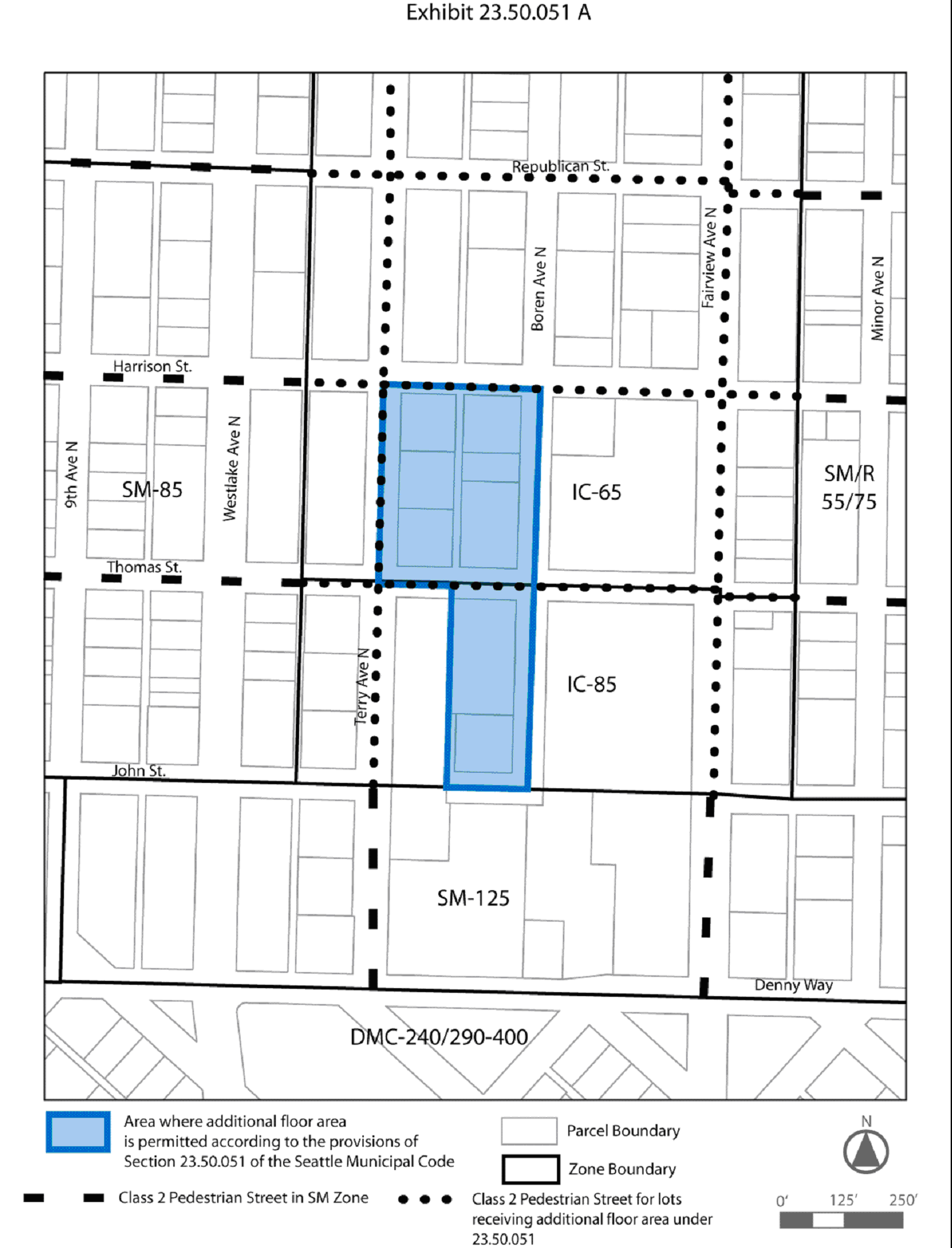
applies may, by written election, use the exemptions in subsection E5b of this section, provided that subsection F of this section also shall apply. Section 9. A new Section 23.50.051 of the Seattle Municipal Code is adopted to read as follows: 23.50.051 Additional floor area in certain IC-zoned areas in the South Lake Union Urban Center. A. Applicability; General Rules. This Section applies only to IC zones in the area shown on Exhibit 23.50.051 A. In IC zones in that area, floor area in addition to the FAR limit in Section 23.50.028 is permitted for projects that satisfy all the conditions in this section. For purposes of applying any section of Chapter 23.48 referred to in this section, Class 2 Pedestrian Streets are as designated on Exhibit 23.50.051A. For the purposes of this section, the applicable FAR limit in subsection 23.50.028D is called the "base FAR." As a condition to any floor area above the base FAR, a project must conform to all the provisions of subsections C through M of this section, inclusive. As a further condition, any floor area above four and a half (4.5) FAR is allowed only to the extent gained in accordance with the bonus and TDR provisions of subsection N of this section. B. Maximum FAR. The maximum chargeable floor area permitted on a lot pursuant to this section is seven (7) FAR. C. Alteration of Landmark. No floor area above the base FAR shall be granted to any proposed development that would result in a significant alteration to any designated feature of a Landmark structure, unless a Certificate of Approval for the alteration is granted by the Landmarks Preservation Board. D. LEED requirement. The applicant will strive to achieve a LEED Gold rating or better and make a commitment acceptable to the Director that the proposed development will earn at least a LEED Silver rating or meet a substantially equivalent standard, and shall demonstrate compliance with that commitment, all in accordance with the provisions of Section 23.49.020. E. Upper Level Setback. An upper level setback consistent with subsections B and C of Section 23.48.012 is provided along Thomas Street and Harrison Street for any portion of the structure above forty-five (45) feet in height. F. Facades. Each structure satisfies the general facade requirements of Section 23.48.014. G. Transparency. Each structure satisfies the transparency and blank facade requirements of Section 23.48.018. H. Solid Waste and Recycling. Each structure satisfies the solid waste and recyclable materials storage space requirements of Section 23.48.031. I. Parking and access. Each structure satisfies the parking and loading access requirements of Section 23.48.034. Parking for each structure is subject to the following limitations and requirements: (1) Parking is not permitted in stories that are completely above street level unless the parking is separated from the street by other uses: (2) Due to physical site conditions such as topographic or geologic conditions, parking is permitted in stories that are partially below street level and partially above street level without being separated from the street by other uses, if: a. the street front portion of the parking (excluding garage and loading doors and permitted access to parking) that is at or above street level is screened from view at the street level; and b. the street facade is enhanced by architectural detailing, artwork, landscaping, or similar visual interest features. J. Screening and Landscaping. Each structure satisfies the NC3 zone screening and landscaping requirements of Section 23.47A.016. K. Transportation Management Program. The Master Use Permit application shall include a Transportation Management Program (TMP) consistent with requirements for TMPs in Director's Rule 14-2002. The TMP shall be approved by the Director only if, after consulting with Seattle Department of Transportation, the Director determines that no more than forty (40) percent of trips to and from the project will be made using single-occupant vehicles (SOV). 1. For purposes of measuring attainment of single-occupant vehicle (SOV) goals contained in the TMP, the number of SOV trips shall be calculated for the p.m. hour in which an applicant expects the largest number of vehicle trips to be made by employees at the site (the p.m. peak hour of the generator). 2. Compliance with this section does not affect the responsibility of any employer to comply with Seattle's Commute Trip Reduction (CTR) Ordinance. L. Energy Management Plan. The Master Use Permit application shall include an energy management plan, approved by the Director of Seattle City Light, containing specific energy conservation or alternative energy generation methods or on-site electrical systems that together can ensure that the existing electrical system can accommodate the projected loads from the project. The Director, after consulting with the Director of Seattle City Light, may condition the approval of the Master Use Permit on the implementation of the energy management plan. M. Parking Quantity. For development permitted according to Sec. 23.50.051, the Director shall set a maximum number of parking spaces based on the expected number of employees in the project and the TMP goals for single-occupant vehicle use, with an allowance for additional short-term parking spaces to serve retail uses and visitors. N. Bonus floor area and TDR. A minimum of seventy-five (75) percent of floor area above five (5) FAR may be gained only through bonuses under Section 23.50.052. The remaining twenty-five (25) percent may be gained either through TDR consistent with Section 23.50.053 or bonuses under Section 23.50.052, provided that the condition in Subsection N is satisfied if applicable. The Master Use Permit application to establish any floor area above five (5) FAR under this section shall include a calculation of the amount of floor area and shall identify the manner in which the conditions to added floor area will be satisfied. O. Landmark TDR. If Landmark TDR is available, not less than five (5) percent of floor area on a lot above five (5) FAR shall be gained through the transfer of Landmark TDR. Landmark TDR shall be considered "available" if, at the time of the Master Use Permit application to gain the additional floor area, the City of Seattle is offering Landmark TDR eligible for use on the lot for sale at a price per square foot no greater than the total bonus contribution under Section 23.50.052 for a project using the cash option for both housing and childcare facilities. An applicant may satisfy the condition in this section by purchases of Landmark TDR from private parties, by transfer of Landmark TDR from an eligible sending lot owned by the applicant, by purchase of Landmark TDR from the City, or by any combination of the foregoing. Section 10. A new Section 23.50.052 of the Seattle Municipal Code is adopted to read as follows: 23.50.052 Bonus floor area for housing and child care. A. General Provisions 1. This Section applies only to projects seeking floor area above four and a half (4.5) FAR pursuant to Section 23.50.051. The purpose of this section is to encourage development in addition to that authorized by basic zoning regulations, provided that portions of certain adverse impacts from the additional development are mitigated. Two (2) impacts from such development are an increased need for housing in the South Lake Union Urban Center to house the families of workers having lower-paid jobs, and an increased need for child care for workers in the South Lake Union Urban Center. 2. The mitigation may be provided by building the requisite housing or child care facilities (the "performance option"), by making a contribution to be used by the City to build or provide the housing and child care facilities (the "payment option"), or by a combination of the performance and payment options. 3. For the purposes of this section, chargeable floor area that is earned under the provisions of this section is called "bonus floor area." B. Housing and Child Care Bonus. For each square foot of bonus floor area, the applicant shall provide or make payments for both housing and child care in amounts determined as follows: 1. Housing. a. For each square foot of bonus floor area, either 0.15575807 square feet of housing affordable to and serving households with incomes up to 80% of median King County household income based on household size (referred to as the "income limit" in this section), or an alternative voluntary cash contribution of $18.75 for such housing. The Housing Director may adjust the cash contribution alternative, no more frequently than annually, approximately in proportion to the change in the Consumer Price Index, All Urban Consumers, Seattle-Tacoma metropolitan area, All Items (1982 84 = 100), as determined by the U.S. Department of Labor, Bureau of Labor Statistics, or successor index, or any other cost index that such Director may deem appropriate. The base year for the first such adjustment shall be 2007. Any such adjustment to the cash contribution amounts may be implemented through a rule-making process. b. For purposes of this subsection, a housing unit serves households with incomes up to 80% of median King County household income only if all of the following are satisfied for a period of fifty (50) years beginning upon the issuance of a final certificate of occupancy for the housing unit by the Department of Planning and Development: (1) For rental units: i. The housing unit is used as rental housing solely for households with incomes, at the time of each household's initial occupancy, not exceeding the income limit; and ii. The monthly rent charged for the housing unit, together with a reasonable allowance for any basic utilities that are not included in the rent, does not exceed onetwelfth (1/12) of thirty (30) percent of the income limit for the estimated average size of household corresponding to the size of unit, as determined by the Housing Director; iii. There are no charges for occupancy other than rent; and iv. The housing unit and the structure in which it is located are maintained in decent and habitable condition, including adequate basic appliances, for such fifty (50) year period. (2) For homeownership units: i. The housing unit is used as homeownership housing solely for households with incomes at the time of each household's initial occupancy, not exceeding the income limit; ii. The sales price is restricted so that estimated monthly housing costs, according to a method prescribed or approved by the Housing Director, including mortgage payment, taxes, insurance, and condominium dues, do not exceed 40% of household monthly income at the income limit for the estimated average size of household corresponding to the size of unit as determined by the Housing Director; and iii. The housing unit is subject to recorded instruments satisfactory to the Housing Director providing for sales prices on any resale consistent with affordability on the same basis, for such fifty (50) year period. c. If housing provided under the performance option is not yet constructed, or is not ready for occupancy, at the time when a cash contribution would be due pursuant to subsection C of this Section if the applicant had elected the cash option, the applicant may commit to complete such housing on terms acceptable to the Housing Director, which terms shall require that within three (3) years of the issuance of the first building permit for the project using the bonus floor area, the applicant shall obtain a final certificate of occupancy for such housing. Any applicant seeking to qualify for bonus floor area based on such housing shall provide to the City, prior to the date when a contribution would be due for the cash option under subsection C of this section, an irrevocable bank letter of credit or other sufficient security approved by the Housing Director, and a related voluntary agreement, so that at the end of the three (3) year period, if the housing does not qualify or is not provided in a sufficient amount to satisfy the terms of this section, the City shall receive (i) a cash contribution for housing in the amount determined pursuant to this section after credit for any qualifying housing then provided, plus (ii) an amount equal to interest on such contribution, at the rate equal to the prime rate quoted from time to time by Bank of America, or its successor, plus three (3) percent per annum, from the date of issuance of the first building permit for the project using the bonus. If and when the City becomes entitled to realize on any such security, the Housing Director shall take appropriate steps to do so, and the amounts realized, net of any costs to the City, shall be used in the same manner as cash contributions for housing made under this section. In the case of any project proposing to use bonus floor area for which no building permit is required, references to the building permit in this subsection shall mean the master use permit allowing establishment or expansion of the use for which bonus floor area is sought. d. The Housing Director shall review the design and proposed management plan for any housing proposed under the performance option to determine whether it will comply with the terms of this section. e. The Housing Director is authorized to accept a voluntary agreement for the provision of housing and related agreements and instruments consistent with this section. f. It shall be a continuing permit condition, whether or not expressly stated, for each project obtaining bonus floor area based on the provision of housing under this subsection, that the housing units shall continue to satisfy the requirements of this subsection throughout the required fifty (50) year period and that such compliance shall be documented annually to the satisfaction of the Housing Director, and the owner of any project using such bonus floor area shall be in violation of this title if any such housing unit does not satisfy such requirements, or if satisfactory documentation is not provided to the Housing Director, at any time during such period. The Housing Director may provide by rule for circumstances in which housing units maybe replaced if lost due to casualty or other causes, and for terms and conditions upon which a cash contribution may be made in lieu of continuing to provide housing units under the terms of this subsection. g. Housing units provided to qualify for a bonus should include a range of unit sizes, including units suitable for families with children. The Housing Director is authorized to prescribe by rule minimum requirements for the range of unit sizes, by numbers of bedrooms, in housing provided to qualify for a bonus. The Housing Director shall take into account, in any such rule, estimated distributions of household sizes among households with incomes up to 80% of median King County household income. h. Housing units provided to qualify for a bonus shall be located within the South Lake Union Urban Center, except that if the Director, after consultation with the Housing Director, finds that it would be impracticable to provide the housing in the South Lake Union Urban Center within the time specified in this Section, the Director may allow the housing to be provided at one or more other locations within the City from which workers can easily commute by public transit to and from the lot using the bonus floor area. i. Housing units provided to qualify for a bonus shall be newly constructed, converted from nonresidential use, or renovated in a residential building that was vacant as of December 1, 2007. j. For purposes of this section, "median King County household income" for any household size means the estimated median income among households of that size in King County as most recently published or reported by a source considered reliable by the Housing Director. If such data are not published or reported for a household size, the Housing Director may estimate the median King County household income for that household size by adjusting available data in such manner as the Housing Director shall determine. For purposes of maximum rents or sale prices, if the estimated average household size corresponding to a unit size includes a fraction, the Housing Director shall estimate the median King County household income for that household size by interpolation using the next higher and lower integral household sizes. 2. Child Care. a. For each square foot of bonus floor area allowed under this section, in addition to providing housing or an alternative cash contribution pursuant to subsection B1, the applicant shall provide fully improved child care facility space sufficient for 0.000127 of a child care slot, or a cash contribution to the City of Three Dollars and Twenty-five Cents ($3.25), to be administered by the Human Services Department. The Director of the Human Services Department may adjust the alternative cash contribution, no more frequently than annually, approximately in proportion to the change in the Consumer Price Index, All Urban Consumers, Seattle-Tacoma metropolitan area, All Items (1982-84=100), as determined by the U.S. Department of Labor, Bureau of Labor Statistics, or successor index, or any other cost index that such Director may deem appropriate. The base year for the first such adjustment is 2007. The minimum interior space in the child care facility for each child care slot shall comply with all applicable state and local regulations governing the operation of licensed childcare providers. Child care facility space shall be deemed provided only if the applicant causes the space to be newly constructed or newly placed in child care use after the submission of a permit application for the project intended to use the bonus floor area, except as provided in subsection B2b(6). If any contribution or subsidy in any form is made by any public entity to the acquisition, development, financing or improvement of any child care facility, then any portion of the space in such facility determined by the Director of the Human Services Department to be attributable to such contribution or subsidy shall not be considered as provided by any applicant other than that public entity. b. Child care space shall be provided on the same lot as the project using the bonus floor area or on another lot in the South Lake Union Urban Center and shall be contained in a child care facility satisfying the following standards: (1) The child care facility and accessory exterior space must be approved for licensing by the State of Washington Department of Social and Health Services and any other applicable state or local governmental agencies responsible for the regulation of licensed childcare providers. (2) At least twenty (20) percent of the number of child care slots for which space is provided as a condition of bonus floor area must be reserved for, and affordable to, families with annual incomes at or below the U.S. Department of Housing and Urban Development Low Income Standard for Section 8 Housing based on family size (or, if such standard shall no longer be published, a standard established by the Human Services Director based generally on eighty (80) percent of the median family income of the Metropolitan Statistical Area, or division thereof, that includes Seattle, adjusted for family size). Child care slots shall be deemed to meet these conditions if they serve, and are limited to, (a) children receiving child care subsidy from the City of Seattle, King County or State Department of Social and Health Services, and/or (b) children whose families have annual incomes no higher than the above standard who are charged according to a sliding fee scale such that the fees paid by any family do not exceed the amount it would be charged, exclusive of subsidy, if the family were enrolled in the City of Seattle Child Care Subsidy Program. (3) Child care space provided to satisfy bonus conditions shall be dedicated to child care use, consistent with the terms of this section, for twenty (20) years. The dedication shall be established by a recorded covenant, running with the land, and enforceable by the City, signed by the owner of the lot where the child care facility is located and by the owner of the lot where the bonus floor area is used, if different from the lot of the child care facility. The child care facility shall be maintained in operation, with adequate staffing, at least eleven (11) hours per day, five (5) days per week, fifty (50) weeks per year. (4) Exterior space for which a bonus is or has been allowed under any other section of this title or under former Title 24 shall not be eligible to satisfy the conditions of this section. (5) Unless the applicant is the owner of the child care space and is a duly licensed and experienced child care provider approved by the Director of the Human Services Department, the applicant shall provide to the Director a signed agreement, acceptable to such Director, with a duly licensed child care provider, under which the child care provider agrees to operate the child care facility consistent with the terms of this section and of the recorded covenant, and to provide reports and documentation to the City to demonstrate such compliance. (6) One (1) child care facility may fulfill the conditions for a bonus for more than one (1) project if it includes sufficient space, and provides sufficient slots affordable to limited income families, to satisfy the conditions for each such project without any space or child care slot being counted toward the conditions for more than one (1) project. If the child care facility is located on the same lot as one of the projects using the bonus, then the owner of that lot shall be responsible for maintaining compliance with all the requirements applicable to the child care facility; otherwise responsibility for such requirements shall be allocated by agreement in such manner as the Director of the Human Services Department may approve. If a child care facility developed to qualify for bonus floor area by one applicant includes space exceeding the amount necessary for the bonus floor area used by that applicant, then to the extent that the voluntary agreement accepted by the Director of the Human Services Department from that applicant so provides, such excess space may be deemed provided by the applicant for a later project pursuant to a new voluntary agreement signed by both such applicants and by any other owner of the child care facility, and a modification of the recorded covenant, each in form and substance acceptable to such Director. c. The Director of the Human Services Department shall review the design and proposed management plan for any child care facility proposed to qualify for bonus floor area to determine whether it will comply with the terms of this section. The allowance of bonus floor area is conditioned upon approval of the design and proposed management plan by the Director. The child care facility shall be constructed consistent with the design approved by such Director and shall be operated for the minimum twenty (20) year term consistent with the management plan approved by such Director, in each case with only such modifications as shall be approved by such Director. If the proposed management plan includes provisions for payment of rent or occupancy costs by the provider, the management plan must include a detailed operating budget, staffing ratios, and other information requested by the Director to assess whether the child care facility may be economically feasible and able to deliver quality services. d. The Director of the Human Services Department is authorized to accept a voluntary agreement for the provision of a child care facility to satisfy bonus conditions and related agreements and instruments consistent with this section. The voluntary agreement may provide, in case a child care facility is not maintained in continuous operation consistent with this subsection B2 at any time within the minimum twenty (20) year period, for the City's right to receive payment of a prorated amount of the alternative cash contribution that then would be applicable to a new project seeking bonus floor area. Such Director may require security or evidence of adequate financial responsibility, or both, as a condition to acceptance of an agreement under this subsection. C. Cash Option Payments. 1. Cash payments under voluntary agreements for bonuses shall be made prior to issuance of any building permit after the first building permit for a project, and in any event before any permit for any construction activity other than excavation and shoring is issued, or if the bonus is for use of existing floor area, the cash payment shall be made prior to issuance of any permit or modification allowing for use of such space as bonus floor area. 2. Such payments shall be deposited in special accounts established solely to fund capital expenditures for child care facilities and housing as set forth in this section, including the City's costs to administer projects, not to exceed 10% of the contributions. 3. Housing that is funded with cash contributions shall be located within the South Lake Union Urban Center, except that if the Housing Director finds that it would be impracticable to provide the housing in the South Lake Union Urban Center within the time specified for the performance option under this Section or any time limit under applicable law, then the housing may be located at one or more other locations within the City from which workers can easily commute by public transit to and from the lot using the bonus floor area. 4. The Housing Director may allow contributions of property in lieu of cash payments if the Director finds that the value of the property equals or exceeds cash payment that otherwise would be made, subject to acceptance of any real property by ordinance. D. No Subsidies for Bonused Housing: Exception. 1. Intent. Housing provided through the bonus system is intended to mitigate a portion of the additional housing needs resulting from increased density, beyond those needs that would otherwise exist, which the City and other governmental and charitable entities attempt to meet through various subsidy programs. Allowing bonus floor area under the performance option for housing that uses such subsidy programs therefore could undermine the intent of this section. 2. Agreement Concerning Subsidies. The Housing Director may require, as a condition of any bonus floor area for housing under the performance option, that the owner of the lot upon which the housing is located agree not to seek or accept any subsidies, including without limitation those items referred to in subsection D3 of this section, related to the housing, except for any subsidies that may be allowed by the Housing Director under that subsection. The Director may require that such agreement provide for the payment to the City of the value of any subsidies received in excess of any amounts allowed by such agreement. 3. No Bonus for Subsidized or Restricted Housing. In general, no bonus may be earned by providing housing if: a. Any person is receiving or will receive with respect to the housing any charitable contributions or public subsidies for housing development or operation, including, but not limited to, tax exempt bond financing, tax credits, federal loans or grants, City of Seattle housing loans or grants, county housing funds, State of Washington housing funds, or property tax exemptions except as allowed pursuant to RCW Chapter 84.14, or other special tax treatment; or b. Independent of the requirements for the bonus, the housing is or would be subject to any restrictions on the use, occupancy or rents; or c. The housing was required to be built by the City of Seattle as a requirement of the purchase and sale of property or for any other purpose. 4. Exceptions by Rule. The Housing Director of may provide, by rule promulgated after December 31, 2007, for terms and conditions on which exceptions to the restriction on subsidies in this subsection may be allowed. Such rule may provide that, as a condition to any exception, the Housing Director shall increase the amount of housing floor area per bonus square foot, as set forth in subsection B1 of this section, to an amount that allows credit for only the Director's estimate of the incremental effect, in meeting the City's housing needs for the next fifty (50) years, of the net financial contribution that is being made by the applicant pursuant to the voluntary agreement and not funded or reimbursed, directly or indirectly, from any other source. Section 11. A new Section 23.50.053 of the Seattle Municipal Code is adopted to read as follows: 23.50.053 Transfer of development rights within the South Lake Union Urban Center. A. General Standards. 1. In order to achieve a portion of the floor area above five (5) FAR that may be allowed pursuant to Section 23.50.051, an applicant may use transferable development rights to the extent permitted in Chart 23.50.053A, subject to the limits and conditions in this Chapter: Zones Types of TDR Within-bl Landmark Arts Housing ock TDR TDR Facility TDR TDR IC S, R S, R S, R S, R SM with a mapped X X X X height limit lower than 85' SM/R X X X X SM/85 S S S S SM/125 S S S S S = Eligible sending lot, if in the South Lake Union Urban Center. R = Eligible receiving lot, if in the area eligible for added floor area under Section 23.50.051. X = Not permitted. 2. TDR may be transferred as within-block TDR only from a lot to another lot on the same block that is eligible for added floor area under Section 23.50.051, to the extent permitted in Chart 23.50.053A, subject to limits and conditions in this chapter. 3. The eligibility of a lot in the South Lake Union Urban Center to be either a sending or receiving lot is regulated by Chart 23.50.053A. 4. TDR eligible to be transferred from a major performing arts facility under Section 23.49.014 G, may be transferred from a Downtown zone to a lot eligible as a receiving site for arts facility TDR under Chart 23.50.053A. No other TDR from a Downtown zone may be used under this section. 5. Except as expressly permitted pursuant to this chapter, development rights or potential floor area may not be transferred from one lot to another. 6. No permit after the first building permit, and in any event, no permit for any construction activity other than excavation and shoring or for occupancy of existing floor area by any use based upon TDR, will be issued for development that includes TDR until the applicant's possession of TDR is demonstrated to the satisfaction of the Director. 7. For purposes of this Section, the base FAR of any lot is the total maximum FAR allowable for chargeable floor area pursuant to the provisions of this Chapter, excluding Section 23.50.051, or pursuant to Chapter 23.48, as applicable to the sending lot, in each case not including any additional FAR that may be permitted pursuant to any exception, departure or waiver. 8. The Director may promulgate rules to implement this section. B. Standards for Sending Lots. 1. a. The maximum amount of floor area that may be transferred from a sending lot in the South Lake Union Urban Center is the amount by which the product of the eligible lot area times the base FAR of the sending lot exceeds the sum of any chargeable floor area on the lot plus any TDR previously transferred from the sending lot. b. For purposes of this subsection B1, the eligible lot area is the total area of the sending lot, reduced by the excess, if any, of the total of accessory surface parking over one-quarter (1/4) of the total area of the footprints of all structures on the sending lot. 2. When TDR are transferred from a sending lot in a zone with a FAR limit that applies to nonresidential uses, the amount of chargeable floor area that may then be built on the sending lot shall be equal to the area of the lot multiplied by the base FAR, minus the total of: a. The chargeable floor area on the lot; plus b. The amount of chargeable floor area transferred from the lot. 3. Chargeable floor area allowed above the base FAR under any provisions of this title, or allowed under any exceptions or waivers of development standards, may not be transferred. TDR may be transferred from a lot that contains chargeable floor area exceeding the base FAR only to the extent, if any, that: a. TDR were previously transferred to such lot in compliance with the Land Use Code provisions and applicable rules then in effect; b. Those TDR, together with the base FAR set forth in Section 23.48.016 B or in Section 23.50.028, exceed the chargeable floor area on the lot and any additional chargeable floor area for which any permit has been issued or for which any permit application is pending; and c. The excess amount of TDR previously transferred to such lot would have been eligible for transfer from the original sending lot under the provisions of this section at the time of their original transfer from that lot. 6. Landmark structures on sending lots from which Landmark TDR are transferred shall be restored and maintained as required by the Landmarks Preservation Board. 7. Housing on lots from which housing TDR are transferred shall be rehabilitated to the extent required to provide decent, sanitary and habitable conditions, in compliance with applicable codes, and so as to have an estimated minimum useful life of at least fifty (50) years from the time of the TDR transfer, as approved by the Director of Housing. If housing TDR are proposed to be transferred prior to the completion of work necessary to satisfy this subsection B7, the Director of the Office of Housing may require, as a condition to such transfer, that security be deposited with the City to ensure the completion of such work. 8. The housing units on a lot from which housing TDR are transferred, and that are committed to low-income housing as a condition to eligibility of the lot as a TDR sending site, shall be generally comparable in their average size and quality of construction to other housing units in the same structure, in the judgment of the Housing Director, after completion of any rehabilitation or construction undertaken in order to qualify as a TDR sending lot. 9. Structures on an arts facility TDR site shall be built or rehabilitated to the extent required to be in compliance with applicable codes, and so as to have an estimated minimum useful life of at least fifty (50) years from the time of the TDR transfer. C. Limit on within-block TDR. Any receiving lot may use TDR from sending lots that are eligible to send TDR solely because they are on the same block as the receiving lot for a maximum of fifteen (15) percent of all floor area gained through bonus and TDR on the receiving lot. D. Transfer of Development Rights Deeds and Agreements. 1. The fee owners of the sending lot shall execute a deed, and shall obtain the release of the TDR from all liens of record and the written consent of all holders of encumbrances on the sending lot other than easements and restrictions, unless such release or consent is waived by the Director for good cause. The deed shall be recorded in the King County real property records. When TDR are conveyed to the owner of a receiving lot described in the deed, then unless otherwise expressly stated in the deed or any subsequent instrument conveying such lot or the TDR, the TDR shall pass with the receiving lot whether or not a structure using such TDR shall have been permitted or built prior to any conveyance of the receiving lot. Any subsequent conveyance of TDR previously conveyed to a receiving lot shall require the written consent of all parties holding any interest in or lien on the receiving lot from which the conveyance is made. If the TDR are transferred other than directly from the sending lot to the receiving lot using the TDR, then after the initial transfer, all subsequent transfers also shall be by deed, duly executed, acknowledged and recorded, each referring by King County recording number to the prior deed. 2. Any person may purchase any TDR that are eligible for transfer by complying with the applicable provisions of this section, whether or not the purchaser is then an applicant for a permit to develop real property. Any purchaser of such TDR (including any successor or assignee) may use such TDR to obtain floor area above the applicable base on a receiving lot to the extent such use of TDR is permitted under the Land Use Code provisions in effect on the date of vesting, under applicable law, of such person's rights with respect to the issuance of permits for development of the project intended to use such TDR. The Director may require, as a condition of processing any permit application using TDR or for the release of any security posted in lieu of a deed for TDR to the receiving lot, that the owner of the receiving lot demonstrate that the TDR have been validly transferred of record to the receiving lot, and that such owner has recorded in the real estate records a notice of the filing of such permit application, stating that such TDR are not available for retransfer. 3. For transfers of Landmark TDR, the owner of the sending lot shall execute and record an agreement in form and content acceptable to the Landmarks Preservation Board providing for the restoration and maintenance of the historically significant features of the structure or structures on the lot. 4. For transfers of arts facility TDR from an arts facility TDR site, the owner of the sending lot shall execute and record an agreement in form and content acceptable to the Director of the Office of Arts and Cultural Affairs providing for the construction, improvement and/or maintenance of structure(s) on the lot and the use of the arts facility sending site for at least fifty (50) years by one or more non-profit organizations dedicated to the creation, display, performance or screening of art by or for members of the general public. Such agreements shall commit to improvements, maintenance, limits on occupancy and other measures to maintain the long-term use of the structure(s) for artistic activities consistent with the definition of arts facility TDR site and acceptable to the Director of the Office of Arts and Cultural Affairs. 5. For transfers of housing TDR, the owner of the sending lot shall execute and record an agreement, with the written consent of all holders of encumbrances on the sending lot, unless such consent is waived by the Director of the Office of Housing for good cause, to provide for the maintenance of the required housing on the sending lot for a minimum of fifty (50) years. Such agreement shall commit to limits on rent and occupancy consistent with the definition of housing TDR site and acceptable to the Director of the Office of Housing. 6. A deed conveying TDR may require or permit the return of the TDR to the sending lot under specified conditions, but notwithstanding any such provisions: a. The transfer of TDR to a receiving lot shall remain effective so long as any portion of any structure for which a permit was issued based upon such transfer remains on the receiving lot; and b. The City shall not be required to recognize any return of TDR unless it is demonstrated that all parties in the chain of title have executed, acknowledged and recorded instruments conveying any interest in the TDR back to the sending lot and any lien holders have released any liens thereon. 7. Any agreement governing the use or development of the sending lot shall provide that its covenants or conditions shall run with the land and shall be specifically enforceable by The City of Seattle. E. Time of Determination of TDR Eligible for Transfer. The eligibility of a sending lot to transfer TDR, and the amount transferable from a sending lot, shall be determined as of the date of transfer from the sending lot and shall not be affected by the date of any application, permit decision or other action for any project seeking to use such TDR. F. Use of Previously Transferred TDR by New Projects. Any project using TDR according to applicable limits on TDR in Sections 23.50.051 and 23.50.053 may use TDR that were transferred from the sending lot consistent with the provisions of this title in effect at the time of such transfer. Section 12. A new subsection F is added to Section 23.76.026 of the Seattle Municipal Code, which section was last amended by Ordinance 122311, as follows: 23.76.026 Vesting of Development Rights * * * F. Notwithstanding any other provision of this section or this chapter, an applicant may elect, at such time and in such manner as the Director may permit, that specific Land Use Code provisions as in effect as of a later date apply to an application, pursuant to authorization for such election set forth elsewhere in this Title. Section 13. The following subsection of Section 23.84A.006 of the Seattle Municipal Code, which section was last amended by Ordinance 122411, is amended as follows: 23.84A.006 Definitions -"C." * * *
"Chargeable floor area" means gross floor area of all structures on a * * * Section 14. The following subsections of Section 23.84A.038 of the Seattle Municipal Code, which section was last amended by Ordinance 122330, are amended and additional subsections are added to such section, to be codified in alphabetical order, as follows: 23.84A.038 Definitions -"T." * * * "TDR, arts facility" means either TDR from a major performing arts facility that are transferable pursuant to Section 23.49.014 G; or TDR that are eligible for transfer based on the status of the sending lot as an arts facility TDR site, and if they are eligible for transfer on any other basis, are designated by the applicant seeking to use such TDR on a receiving lot as arts facility TDR. * * *
"TDR site, arts facility" means a lot meeting the following requirements:
1. The lot is located in the South Lake Union Urban Center either in an IC zone or in a zone with a height limit of eighty-five (85) feet or more;
2. Each structure to be developed on the lot is a major performing arts facility; or has or will have a minimum of one (1) FAR or all of its chargeable floor area if there is less than one (1) FAR in the structure(s) committed for at least fifty (50)
years to occupancy by one or more not-for-profit organizations dedicated to the creation, display, performance or screening of art by or for members of the general public.
3. The arts facility commitments on the lot comply with 23.50.053 for structures in the South Lake Union Urban Center and are memorialized in a recorded agreement between the owner of such an arts facility and the Director of the Mayor's Office of Arts
and Cultural Affairs. * * * "TDR site, housing" means a lot meeting the following requirements: 1. The lot is located in any Downtown zone except PMM, DH-1 and DH-2 zones, or is located in the South Lake Union Urban Center either in any IC zone or in any SM zone with a height limit of eighty-five (85) feet or higher; 2. Each structure on the lot has a minimum of fifty (50) percent of total gross above-grade floor area committed to low-income housing for a minimum of fifty (50) years; 3. The lot has above-grade gross floor area equivalent to at least one (1) FAR committed to very low-income housing use for a minimum of fifty (50) years; 4. The above-grade gross floor area on the lot committed to satisfy the conditions in subsections 2 and 3 of this definition is contained in one or more structures existing as of the date of passage of Ordinance 120443 and such area was in residential use as of such date, as demonstrated to the satisfaction of the Director of the Office of Housing; and 5. The low-income housing and very low-income housing commitments on the lot comply with the standards in Section 23.49.012 B1b and are memorialized in a recorded agreement between the owner of such low-income and very low-income housing and the Director of the Office of Housing. * * * Section 15. Section 23.90.018 of the Seattle Municipal Code, which section was last amended by Ordinance 122407, is amended as follows: 23.90.018 Civil enforcement proceedings and penalties. A. In addition to any other remedy authorized by law or equity, any person violating or failing to comply with any of the provisions of Title 23 shall be subject to a cumulative penalty of up to One Hundred Fifty Dollars ($150.00) per day for each violation from the date the violation begins for the first ten (10) days of noncompliance; and up to Five Hundred Dollars ($500) per day for each violation for each day beyond ten (10) days of noncompliance until compliance is achieved, except as provided in subsection B of this section. In cases where the Director has issued a notice of violation, the violation will be deemed to begin for purposes of determining the number of days of violation on the date compliance is required by the notice of violation. B. Specific Violations. 1. Violations of Section 23.71.018 are subject to penalty in the amount specified in Section 23.71.018 H. 2. Violations of the requirements of Section 23.44.041C are subject to a civil penalty of Five Thousand Dollars ($5,000), which shall be in addition to any penalty imposed under subsection A of this section.
3. Violation of Section 23.49.011, C. Civil actions to enforce Title 23 shall be brought exclusively in Seattle Municipal Court except as otherwise required by law or court rule. The Director shall request in writing that the City Attorney take enforcement action. The City Attorney shall, with the assistance of the Director, take appropriate action to enforce Title 23. In any civil action filed pursuant to this chapter, the City has the burden of proving by a preponderance of the evidence that a violation exists or existed. The issuance of the notice of violation or of an order following a review by the Director is not itself evidence that a violation exists.
D. Except in cases of violations of Section 23.49.011, 1. That the violation giving rise to the action was caused by the willful act, or neglect, or abuse of another; or 2. That correction of the violation was commenced promptly, but that full compliance within the time specified was prevented by inability to obtain necessary materials or labor, inability to gain access to the subject structure, or other condition or circumstance beyond the control of the defendant. Section 16. Subsection B of Section 23.90.020 of the Seattle Municipal Code, which section was last amended by Ordinance 122407, is amended as follows: 23.90.020 Alternative criminal penalty. * * * B. A criminal penalty, not to exceed Five Thousand Dollars ($5,000) per occurrence, may be imposed: 1. For violations of Section 23.90.002 D;
2. For any other violation of this Code for which corrective action is not possible, other than violations with respect to commitments to earn LEED Silver ratings or satisfy alternative standards under SMC 23.49.011,
3. For any Section 17. The purpose of this Section is to clarify the combined effect of two bills passed the same day amending the same Section. If and when CB 116090 takes effect, Section 23.50.027A shall read as follows, any other provision of this ordinance notwithstanding: 23.50.027 Maximum size of nonindustrial use. A. Applicability. 1. Except as otherwise provided in this section, the maximum size of use limits on gross floor area specified in Chart A of this section apply to uses on a lot. The maximum size of use limits apply to both principal and accessory uses on a lot. The limits apply separately to the categories of uses listed on Chart A. The total gross floor area occupied by uses limited under Chart A shall not exceed an area equal to two and one-half (2.5) the area of the lot in an IG1, IG2 IB or IC zone, or three (3) times the lot area in IC zones with sixty-five (65) foot or eighty-five (85) foot height limits in the South Lake Union Urban Center. 2. The combined square footage of any one business establishment located on more than one lot is subject to the size limitations on non-industrial uses specified on Chart A. 3. The maximum size of use limits in Chart A do not apply to the area identified in Exhibit 23.50.027A. In that area no single non-office use listed in Chart A may exceed fifty thousand (50,000) square feet in size. 4. There is no limit under this Section on the size of uses in projects that qualify for additional floor area under section 23.50.051. CHART A INDUSTRIAL ZONES Uses Subject to Size Limits CHART A INDUSTRIAL ZONES Uses Subject to IG1 IG2 IB IC Outside the IC Within the Size Limits Duwamish MIC Duwamish MIC Animal Shelters 10,000 sq. ft. 10,000 sq. ft. 75,000 sq. ft. 75,000 sq. ft. N.S.L and Kennels* Drinking 3,000 sq. ft. 3,000 sq. ft. N.S.L. N.S.L. N.S.L. establishments** Entertainment* 10,000 sq. ft. 10,000 sq. ft. 75,000 sq. ft. 75,000 sq. ft. N.S.L. Lodging Uses* 10,000 sq. ft. 10,000 sq. ft. 75,000 sq. ft. 75,000 sq. ft. N.S.L. Medical Services* 10,000 sq. ft. 10,000 sq. ft. 75,000 sq. ft. 75,000 sq. ft. N.S.L. Office 10,000 sq. ft. 25,000 sq. ft. 100,000 sq. ft. N.S.L. N.S.L. Restaurants 5,000 sq. ft. 5,000 sq. ft. N.S.L N.S.L. N.S.L. Retail Sales, 10,000 sq. ft. 25,000 sq. ft. 75,000 sq. ft. 75,000 sq. ft. N.S.L. Major Durables Sales and 10,000 sq. ft. 25,000 sq. ft. 75,000 sq. ft. 75,000 sq. ft. N.S.L. Services, Automotive Sales and 10,000 sq. ft. 25,000 sq. ft. 75,000 sq. ft. 75,000 sq. ft. N.S.L. Services, General ______ N.S.L. = No Size Limit * Where permitted under Chart A of Section 23.50.012. ** The size limit for brew pubs applies to that portion of the pub that is not used for brewing purposes. Section 18. The purpose of this Section is to clarify the combined effect of two bills passed the same day amending the same Section. If and when CB 116090 takes effect, subsections A, B, E, F and G of Section 23.50.028, shall read as follows, any other provision of this ordinance notwithstanding: 23.50.028 Floor area ratio. The floor area ratio (FAR), as provided below, determines the permitted chargeable floor area on a lot. A. General Industrial 1 and General Industrial 2, Floor Area Ratio. The total maximum FAR shall be two and one-half (2.5). B. Industrial Buffer, Floor Area Ratio. The maximum FAR for all uses on lots in the Industrial Buffer (IB) zone shall be two and one half (2.5). * * * E. All Industrial Zones, Exemptions from FAR Calculations. The following areas are exempt from FAR calculations: 1. All gross floor area below grade; 2. All gross floor area used for accessory parking, except as provided in subsection F; 3. All gross floor area located on the rooftop of a structure and used for any of the following: mechanical equipment, stair and elevator penthouses, and communication equipment and antennas; 4. All gross floor area used for covered rooftop recreational space of a building existing as of December 31, 1998, when complying with the provisions of Section 23.50.012 D; and 5. Within the South Lake Union Urban Center: a. Gross floor area occupied by mechanical equipment, up to a maximum of fifteen (15) percent of the floor area on the lot. The allowance is calculated on the gross floor area of the structure after all other exempt space permitted under this subsection E is deducted. b. The following uses located at street level: i. General sales and service uses; ii. Eating and drinking establishments; iii. Entertainment uses; and iv. Public libraries. F. Within the South Lake Union Urban Center, gross floor area used for accessory parking within stories that are completely above finished grade is not exempt. G. Anything in Section 23.76.026 notwithstanding, the applicant for a Master Use Permit for a project in the South Lake Union Urban Center to which the Land Use Code in effect prior to the effective date of the ordinance enacting this subsection G applies may, by written election, use the exemptions in subsection E5b of this section, provided that subsection F of this section also shall apply. Section 19. This ordinance shall take effect and be in force thirty (30) days from and after its approval by the Mayor, but if not approved and returned by the Mayor within ten (10) days after presentation, it shall take effect as provided by Municipal Code Section 1.04.020. Passed by the City Council the ____ day of _________, 2007, and signed by me in open session in authentication of its passage this _____ day of __________, 2007. _________________________________ President __________of the City Council Approved by me this ____ day of _________, 2007. _________________________________ Gregory J. Nickels, Mayor Filed by me this ____ day of _________, 2007. ____________________________________ City Clerk December 17, 2007 Version 11 ta |
|
Attachments |
|---|
![[TOP]](/netaicon/toppg.gif)