![[HOME]](/netaicon/homeicon.gif)
![[SEARCH]](/netaicon/srchpage.gif)

![[CURR_LIST]](/netaicon/curlist.gif)


![[BOTTOM]](/netaicon/bottom.gif)
![[HELP]](/netaicon/help.gif)
Seattle City Council Bills and Ordinances
Information modified on February 16, 2016; retrieved on June 30, 2026 10:08 AM
Ordinance 121878
Introduced as Council Bill 115310
Title | |
|---|---|
| AN ORDINANCE relating to the City's Consolidated Plan for Housing and Community Development for 2005-2008; authorizing acceptance of grant funds from the United States Department of Housing and Urban Development for programs included in the City's Consolidated Plan for Housing and Community Development; decreasing appropriations in the 2005 Budget for activities under the Emergency Shelter Grant Program, HOME Program, Community Development Block Grant Program, and Housing Opportunities for Persons With AIDS program; amending City's Consolidated Plan to amend the 2005 Table of Proposed Projects component and the Housing Policies appendix, and revising Appendix P to such Plan to include a new Neighborhood Revitalization Strategy for Southeast Seattle and to delete such strategies for four other neighborhoods; authorizing the submission of revised Appendix P to the United States Department of Housing and Urban Development; authorizing other conforming amendments to the Consolidated Plan; allocating unused funds from prior years; and ratifying and confirming prior acts. | |
Description and Background | |
|---|---|
| Current Status: | Passed |
| Fiscal Note: | Fiscal Note to Council Bill No. 115310 |
| Index Terms: | SHELTERS, HOMELESS, AIDS, GRANTS, LOW-INCOME-HOUSING, COMMUNITY-DEVELOPMENT-BLOCK-GRANTS, US-GOVERNMENT, PLANNING, HOUSING, SOCIAL-SERVICES |
| References: | Related: Ord 121625, 121660 |
Legislative History | |
|---|---|
| Sponsor: | RASMUSSEN |
| Date Introduced: | July 11, 2005 |
| Committee Referral: | Housing, Human Services & Health |
| City Council Action Date: | August 8, 2005 |
| City Council Action: | Passed |
| City Council Vote: | 9-0 |
| Date Delivered to Mayor: | August 9, 2005 |
|
Date Signed by Mayor: (About the signature date) | August 16, 2006 |
| Date Filed with Clerk: | August 17, 2005 |
| Signed Copy: | PDF scan of Ordinance No. 121878 |
Text | |
|---|---|
|
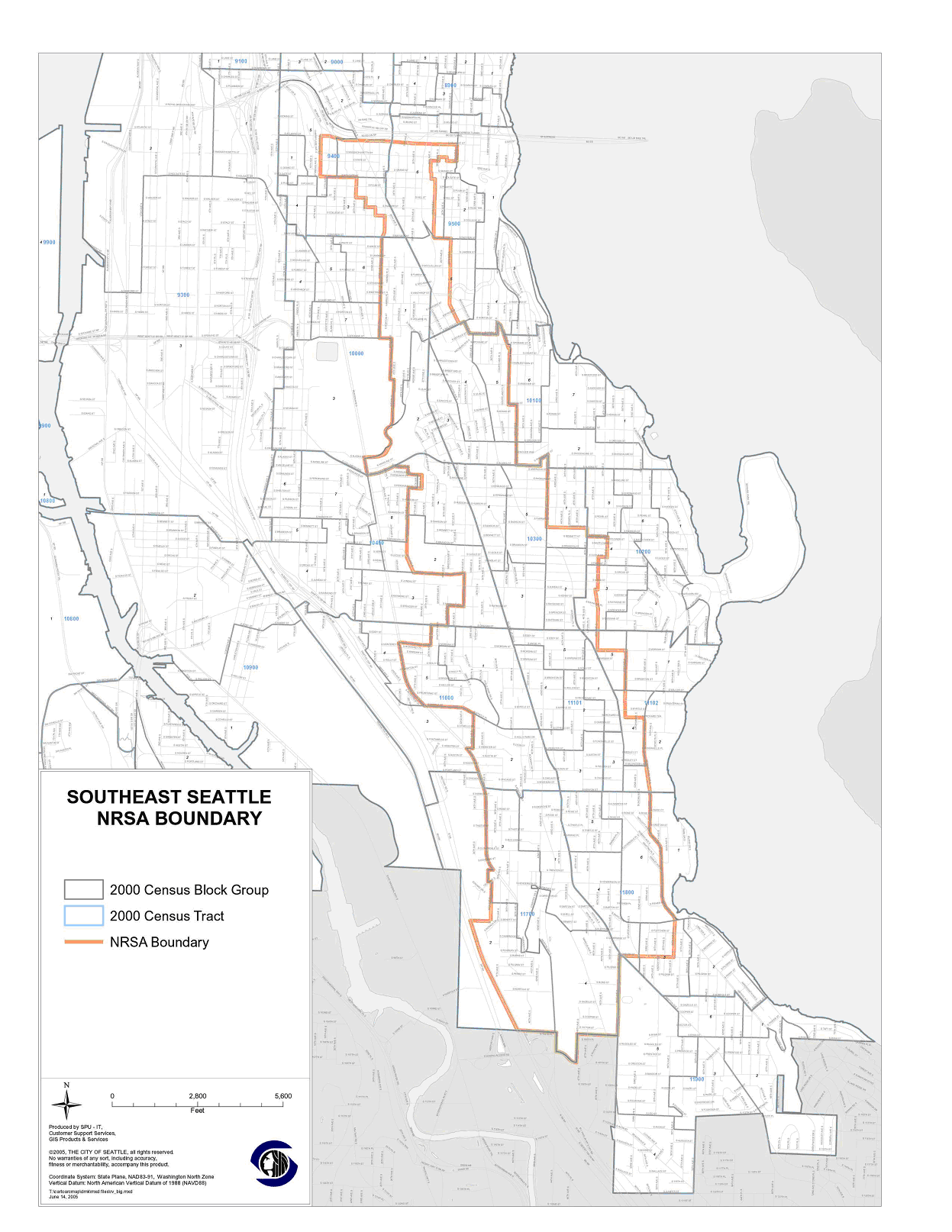
ORDINANCE _________________ AN ORDINANCE relating to the City's Consolidated Plan for Housing and Community Development for 2005-2008; authorizing acceptance of grant funds from the United States Department of Housing and Urban Development for programs included in the City's Consolidated Plan for Housing and Community Development; decreasing appropriations in the 2005 Budget for activities under the Emergency Shelter Grant Program, HOME Program, Community Development Block Grant Program, and Housing Opportunities for Persons With AIDS program; amending City's Consolidated Plan to amend the 2005 Table of Proposed Projects component and the Housing Policies appendix, and revising Appendix P to such Plan to include a new Neighborhood Revitalization Strategy for Southeast Seattle and to delete such strategies for four other neighborhoods; authorizing the submission of revised Appendix P to the United States Department of Housing and Urban Development; authorizing other conforming amendments to the Consolidated Plan; allocating unused funds from prior years; and ratifying and confirming prior acts. WHEREAS, Ordinance 121625, passed October 18, 2004, adopted The City of Seattle's 20052008 Consolidated Plan for Housing and Community Development (Consolidated Plan) and the 2005 Table of Proposed Projects as a component thereof, and authorized the submission of the Consolidated Plan and thereby applied for funds available from the United States Department of Housing and Urban Development (HUD) for community development, human services, economic development, and housing under four separate entitlement grants: the Community Development Block Grant (CDBG), the HOME program, Housing Opportunities for Persons With AIDS (HOPWA) and the Emergency Shelter Grant (ESG); and WHEREAS, the City of Seattle's 2005-2008 Consolidated Plan adopted by Ordinance 121625 called for the adoption of Neighborhood Revitalization Strategy Areas for the year 2005; and WHEREAS, Ordinance 121660, passed November 22, 2004, adopted the City Budget for fiscal year 2005 and included appropriations in several City departments based on estimates of the grant awards for the four HUD fund sources listed above; and WHEREAS, the grant awards that have been received from HUD for the HOME, ESG, HOPWA, and CDBG programs are smaller than anticipated, and authorization levels for these grants made in the 2005 Budget must be adjusted to match approved 2005 funding for the grant activities; and WHEREAS, the 2005 Table of Proposed Projects must be revised to reflect revised 2005 funding levels, to incorporate unused funds from prior years, and to revise allocations to programs and projects; NOW, THEREFORE, BE IT ORDAINED BY THE CITY OF SEATTLE AS FOLLOWS: Section 1. As requested by the Mayor, the Mayor or his designee is hereby authorized to enter into agreements for financial assistance from the United States Department of Housing and Urban Development (HUD) for the following grant programs up to the maximum amounts listed below: Community Development Block Grant (CDBG) $14,038,888 HOME / American Dream Downpayment Initiative (ADDI) $4,746,089 Housing Opportunities for Persons With AIDS (HOPWA) $1,611,000 Emergency Shelter Grant (ESG) $541,420 The Mayor or his designee is authorized to execute and deliver for and on behalf of The City of Seattle such agreements as may be necessary to accept the financial assistance. CDBG funds, when received, shall be deposited into the Housing and Community Development Revenue Sharing Fund (17810). HOME funds, when received, shall be deposited into the HOME Subfund of the Low-Income Housing Fund (16490). HOPWA and ESG funds, when received, shall be deposited into the Human Services Operating Fund (16200). The Mayor or his designee is further authorized to execute and deliver such other documents relating to the agreements as may be required in connection therewith. The agreements and such other documents shall be in form and content consistent with the City Charter and other applicable law. Section 2. The appropriations for the following in the 2005 Adopted Budget are decreased from the funds/subfunds shown as follows: Fund Department Budget Control Amount of Increase Level (Decrease) 17810 Housing and Human Services H17810 HSD CDBG ($51,061) Community Main Fund Development Revenue Sharing Fund 16490 HOME Office of Housing XZ9001 ($139,473) Homeownership and Sustainability 16490 HOME Office of Housing XZ490 ($16,006) HOME Administration 16490 HOME Human Services H30ET ($144,053) Tenant Based Rental Assistance 16200 Human Human Services H30ET Emergency & ($79,366) Services Operating Transitional Fund Services Section 3. The revised 2005 Table of Proposed Projects, Attachment 1 to this ordinance, is hereby adopted as a component of the 2005 2008 Consolidated Plan for Housing and Community Development, superseding the similar table as adopted by Ordinance 121625, as previously amended. The Director of the Human Services Department is authorized to make any conforming changes that may be necessary to other portions of the current Consolidated Plan to reflect the changes adopted in this section. Section 4. The allocations set forth in Attachment 1 do not constitute appropriations or modify the amounts of any existing appropriations, nor are they to be considered as final funding decisions. The authority of the respective City departments and offices to implement the activities set forth in the Adopted Plan is subject to sufficient appropriations in the 2005 Adopted Budget or in any separate ordinance. Implementation of any specific project or program is also subject to a final determination by the appropriate office or department after completion of any necessary review under environmental and related laws. The adoption of Attachment 1 is not intended to confer any legal rights or entitlements on any persons, groups or entities. Section 5. The City hereby adopts the Southeast Seattle Neighborhood Revitalization Strategy, attached hereto as Attachment 2, as an amendment to the 2005-2008 Consolidated Plan for Housing and Community Development, replacing in its entirety the existing Appendix P. The Mayor and the Director of Human Services ("the Director") and their designees are hereby authorized to submit the Southeast Seattle Neighborhood Revitalization Strategy as an amendment to the 2005-2008 Consolidated Plan, together with any supplementary material, to the United States Department of Housing and Urban Development ("HUD"), to represent the City in seeking HUD approval of the amendment to the Plan and to sign and deliver on behalf of the City such assurances and certifications as may be necessary to obtain HUD approval of the amendment. Section 6. Execution of the agreements authorized in Section 1 hereof, and other acts pursuant to the authority and prior to the effective date of this ordinance, are hereby ratified and confirmed. Section 7. The City hereby adopts Appendix H, attached hereto as Attachment 3, as an amendment of the 2005 2008 Consolidated Plan for Housing and Community Development, superseding Appendix H as adopted by Ordinance 121625. Section 8. This ordinance shall take effect and be in force thirty (30) days from and after its approval by the Mayor, but if not approved and returned by the Mayor within ten (10) days after presentation, it shall take effect as provided by Municipal Code Section 1.04.020. Passed by the City Council the ____ day of ________________, 2005, and signed by me in open session in authentication of its passage this _____ day of ________________, 2005. ______________________________________ President _________ of the City Council Approved by me this _____ day of _______________, 2005. ______________________________________ Gregory J. Nickels, Mayor Filed by me this _____ day of _______________, 2005. ______________________________________ City Clerk (Seal) Attachment 1: City of Seattle 2005 Table of Proposed Projects (Revised) Attachment 2: Southeast Seattle Neighborhood Revitalization Strategy Attachment 3: Revised Appendix H, Housing Policies Michael Look 2005 subst amend ord v9 June 22, 2005 version #9 1 0 2005 PROPOSED PROJECTS: BY LOB/PROG 01 00001 Agency Name City of Seattle: CDBG, ESG, HOPWA, & HOME 001 Activity 2004 Allocation 2005 CDBG 2005 ESG 2005 2005 HOME Prop. 2005 Code Log # HOPWA Allocation 1 9999 zz 1: Office of Housing 99 11 9999 zz 11: Home Ownership and Sustainability 99 1109 9999 zz 111: Rehabilitation Lending and 99 Investment 111 7030C City of Housing Technical Assistance HomeWise and 14A 202 CD $361,279 $361,279 $361,279 010 Wong Seattle OH Homebuyer Assistance Staffing (CDBG) LMH (Citywide) LocGov Prog Single-family residential. Support staff cost of managing homeowner rehabilitation projects, facilitating rental rehabilitation, providing downpayment assistance, contract costs for lead-based paint and Endangered Species Act, and various housing development loan programs throughout the City. Provide staff support for weatherization and energy efficiency improvements in low-income residences. Note: actual costs of home weatherization are supported by various non-CDBG federal, state, and local revenues. Performance indicator: 1,200 housing units weatherized; rehabilitation indicator is shown below under Rehabilitation Lending (CDBG) and homebuyer assistance indicator is shown below under Homebuyer Programs (HOME). Start date: 1/1/2005 Completion date: 12/31/2005. Rumpf City of Lead Paint Contracts (CDBG) (Citywide) $14,527 $14,527 Seattle OH OH administers two contracts for lead paint testing and contractor training and certification. The training is required for all contractors that do HomeWise Program weatherization and rehabilitation work. Performance indicator: 8 contractors receive training and 12 single-family homes are tested for lead-based paint. Start date: 1/1/2005-Completion date: 12/31/2005 111 87060C-PI City of Rehabilitation Lending (CDBG PI) 24 14A 202 CD $1,416,219 $ $875,000 $875,000 020 Rumpf Seattle OH (Citywide) LMH The HomeWise rehab program provides loans LocGov Prog and grants for repairs for owner-occupied single-family homes. Applicants are served on a first-come, first-served basis subject to eligibility criteria including income, credit, and repair/rehab needs. 10% of Program Income received may be used for program delivery. Performance indicator: 38 housing units. Start date: 1/1/2005 Completion date: 12/31/2005. 1115 9999 zz 111: Rehabilitation Lending and 99 $1,777,498 $0 $0 $0 $1,250,806 Investment Subtotal $1,250,806 1119 9999 zz 112: Home Buyer Assistance 99 112 7084M City of Homebuyer Programs PI (Citywide) 27 05R HM $870,294 $50,000 $50,000 $100,000 010 Benson Seattle OH HOME and CDBG program income will be used 201(e) for eligible homebuyer activities. 10% of LMH program income received may be used for LocGov Prog program delivery. Performance indicator: 2 households 112 Benson City of Homebuyer Programs (HOME ADDI) (Citywide) 27 05R HM $599,535 $185,050 $185,050 020 Seattle OH Downpayment Assistant Initiative (ADDI) 201(e) LMH HOME ADDI funds from 2005 will be used LocGov Prog for eligible homebuyer activities. These funds will be pooled with the HOME allocation. Performance indicator: Shown below under Homebuyer Programs (HOME) 112 Benson City of Homebuyer Programs (HOME) (Citywide) 24 05R $225,000 [CD PI $818,855 $818,855 030 Seattle OH HOME homeownership funds will be used for 201(e) LMH $96,000 eligible homebuyer activities for first LocGov Prog HM PI $129,000] time homeowners with household incomes at or below 80% of area median income. Funds will be pooled with ADDI funds. Performance indicator: 25 households (HOME homebuyer assistance funds, including ADDI) Start date: 1/1/2005 Completion date: 12/31/2005. 1125 9999 zz 112: Home Buyer Assistance Subtotal 99 $1,694,829 $50,000 $0 $0 $1,103,905 $1,053,905 1129 9999 zz 113: Minor Home Repair 99 113 7150C Senior Minor Home Repair (CDBG) (Citywide) 14A 202 CD $449,917 $474,917 $474,917 010 Kirkland Services of Single-family residential. Provide LMH Seattle & low-cost inspection and minor home SubPriv Prog King County repairs such as plumbing, electrical work, and carpentry in homes of low-income homeowners, primarily (but not limited to) those 60 years of age and over. Senior Services will serve all low-income clients in the City. Performance indicator: 725 housing units Start date: 1/1/2005 Completion date: 12/31/2005. 1135 9999 zz 113: Minor Home Repair Subtotal 99 $449,917 $474,917 $0 $0 $0 $474,917 114: Homebuyer Education and Counseling 111 7172C City of Low-Income Housing Development Services 01 201(a) CD $216,989 $216,989 $216,989 030 Benson Seattle OH (CDBG) (N/A) LMH LocGov Funding for HomeSight for homebuyer education and counseling. Performance indicator: 20 housing units Start date: 1/1/2005 Completion date: 12/31/2005. 114: Homebuyer Education and Counseling $216,989 $216,989 $216,989 Subtotal 119 9999 zz 11: Home Ownership and Sustainability 99 $4,139,233 $0 $0 $3,046,617 Subtotal $1,992,712 $1,053,905 12 9999 zz 12: Multifamily Production and 99 Preservation 1209 9999 zz 121: Multifamily Lending and Investment 99 121 7035C City of Housing Multifamily Staffing (CDBG) 21A 206 CD $621,909 $621,909 $621,909 010 Wong Seattle OH (Citywide) LMH Support staff cost of funding and LocGov managing multifamily rental projects, facilitating rental rehabilitation and site acquisition when developing affordable housing, compliance with relocation, construction & labor requirements, lead-based paint, Endangered Species Act, NEPA, and various housing development loan programs throughout the City. Performance indicator: NA Start date: 1/1/2005 Completion date: 12/31/2005. 121 7086M City of Rental Unit Preservation & Development 24 14B 202 HM PI $500,000 PI $200,000 020 LaTuchie Seattle OH (HOME PI) (Citywide) [LMH] LocGov $200,000 Provide gap financing of up to $200,000 for site acquisition when developing affordable housing, new construction, acquisition and rehabilitation of low-income housing in return for fixed-term rental rate and occupancy income restrictions consistent with HOME Program regulations. Performance indicator: 5 housing units Start date: 1/1/2005 Completion date: 12/31/2005. 121 7086M City of Rental Unit Preservation & Development 27 14B 202 HM $3,001,292 $3,080,133 $3,080,133 030 LaTuchie Seattle OH (HOME) (Citywide) [LMH] Provide gap financing for site LocGov acquisition when developing affordable housing, new construction, acquisition and rehabilitation of low-income housing in return for fixed-term rental rate and occupancy income restrictions consistent with HOME Program regulations. Performance indicator: 69 housing units Start date: 1/1/2005 Completion date: 12/31/2005. 121 7170C City of Multifamily Loan Fund (CDBG) (Citywide) 14B 202 CD $701,369 $701,369 $701,369 040 LaTuchie Seattle OH Multifamily residential. Provide gap LMH financing for site acquisition and/or new LocGov construction as allowed under CDBG regulations when developing affordable housing, acquisition and rehabilitation of low-income housing in return for fixed-term rental rate and occupancy income restrictions. Projects will be selected through a competitive selection process. 10% of Program Income received may be used for program delivery. Performance indicator: 16 housing units Start date: 1/1/2005 Completion date: 12/31/2005. 121 87170C-PI City of Multifamily Loan Fund (CDBG PI) 24 14B 202 CD PI $880,000 PI $222,050 050 Seattle OH (Citywide) LMH $222,050 LaTuchie Multifamily residential. Provide gap LocGov financing for site acquisition and/or new construction when developing affordable housing, acquisition and rehabilitation of low-income housing in return for fixed-term rental rate and occupancy income restrictions. Projects will be selected through a competitive selection process. 10% of Program Income may be used for program delivery. (See also CDBG entitlement funding). $102,050 shall be used to support the redevelopment of City surplus sites in the Central Area for affordable housing. Performance indicator: 5 housing units Start date: 1/1/2005 Completion date: 12/31/2005. 1215 9999 zz 121: Multifamily Lending and Investment 99 $5,704,570 $0 $0 $3,280,133 $4,825,461 Subtotal $1,545,328 129 9999 zz 12: Multifamily Production and 99 $5,704,570 $0 $0 $3,280,133 $4,825,461 Preservation Subtotal $1,545,328 13 9999 zz 13: Strategic Planning, Resource and 99 Program Development 1329 9999 zz 133: Housing Planning and Resource 99 Development 133 7035C City of Housing Planning Staffing (CDBG) 20 205 LMC CD $352,449 $352,449 $352,449 010 Wong Seattle OH (Citywide) LocGov Unit of the Office of Housing will develop and evaluate City housing strategies, goals, and policies for low-income housing; update the Housing Element of the Consolidated Plan; work with neighborhoods and developers to include affordable housing in redevelopment strategies; identify ways to combine housing with other economic development resources to reinvest in targeted neighborhoods. Performance indicator: NA Start date: 1/1/2005 Completion date: 12/31/2005. 1339 9999 zz 133: Housing Planning and Resource 99 $352,449 $352,449 $0 $0 $0 $352,449 Development Subtotal 139 9999 zz 13: Strategic Planning, Resource and 99 $352,449 $352,449 $0 $0 $0 $352,449 Program Development Subtotal 14 9999 zz 14: Administration & Management 99 1419 9999 zz 142: Management Support Services 99 142 8006M City of HOME Administration (HOME) (700 5th 27 21A 206 HM $499,511 $456,104 $456,104 010 Flanagan Seattle OH Avenue, 57th Floor) [LMH] Fund City costs of implementing the HOME LocGov including ADDI program. Performance indicator: N/A Start date: 1/1/2005 Completion date: 12/31/2005. 1425 9999 zz 142: Management Support Services Subtotal 99 $499,511 $0 $0 $0 $456,104 $456,104 149 9999 zz 14: Administration & Management Subtotal 99 $499,511 $0 $0 $0 $456,104 $456,104 19 9999 zz 1: Office of Housing Subtotal 99 $10,695,763 $0 $0 $8,680,631 $3,890,489 $4,790,142 2005 PROPOSED PROJECTS: BY LOB/PROG 01 0001 Agency Name City of Seattle: CDBG, ESG, HOPWA, & HOME 001 2004 Allocation 2005 CDBG 2005 2005 2005 HOME Prop. 2005 Code Log # Activity ESG HOPWA Allocation 2 9999 zz 2: Human Services Department 99 2105 9999 zz 21: Leadership & Management Services [H5] 99 2119 9999 zz 212: Communications [H5100] 99 212 8030C City of Human Services Planning (618 Second 20 205 LMC $351,364 [GF $368,080 $368,080 010 Seattle HSD Avenue: Citywide) LocGov $10,433 CD Staff will develop and evaluate City $340,931] human service strategies, goals, policies, and programs for lowand moderate-income households, including those of people who are homeless or who have special needs. CSD Unit: $$187,641; FYS Unit: $81,368; CDBG Office: $99,071. Performance indicator: 1 organization. Start date: 1/1/2005 Completion date: 12/31/2005. 2125 9999 zz 212: Communications Subtotal 99 $351,364 $368,080 $0 $0 $0 $368,080 2149 9999 zz 215: Grants & Budget Administration [H55] 99 215 8010C City of Block Grant Administration (Office: 618 21A 206 CD $1,199,332 $1,252,837 $1,252,837 010 Price Seattle HSD 2nd Avenue) LMC CBO Provide administration and technical LocGov assistance to City departments and community-based organizations so they can implement CDBG and other HUD grant funds and programs in an efficient, accountable, and responsive manner. [Also contributes to Lines of Business: Programs 216, 211, 212, & 241.] [CDBG Unit: $448,184; HSD; CBO: $52,612; Indirect (21B): $570,990. CSD Unit: $181,051 in CDBG.] Performance indicator: 1 organization. Start date: 1/1/2005 Completion date: 12/31/2005. 2155 9999 zz 215: Grants & Budget Administration 99 $1,199,332 $1,252,837 $0 $0 $0 $1,252,837 Subtotal 2167 9999 zz 21: Leadership & Corporate Services 99 $1,550,696 $1,620,917 $0 $0 $0 $1,620,917 Subtotal 2205 9999 zz 22: Aging & Disability Services [H6] 99 2209 9999 zz 221: Home Based Care [H62] 99 221 1231C CISC Public Housing Case Management (Citywide: 05 201(e) CD $16,691 $16,873 $16,873 010 Meinig SHA facilities) LMC Seattle Housing Authority (SHA) residents SubPriv are able to live as independently and safely as possible in a safe and healthy environment, avoiding unnecessary hospitalization or relocation to other residences. To achieve this, residents are provided with a broad range of services, support and access to community services. Performance indicator: 134 people (general). Start date: 1/1/2005 Completion date: 12/31/2005. 221 1233C ACRS Public Housing Case Management (Citywide: 05 201(e) CD $25,668 $25,948 $25,948 020 Meinig SHA facilities) LMC Seattle Housing Authority (SHA) residents SubPriv are able to live as independently and safely as possible in a safe and healthy environment, avoiding unnecessary hospitalization or relocation to other residences. To achieve this, residents are provided with a broad range of services, support and access to community services. Performance indicator: 65 people (general). Start date: 1/1/2005 Completion date: 12/31/2005. 221 1235C City of Public Housing Case Management (Citywide: 05 201(e) CD $264,621 $267,167 $267,167 030 Meinig Seattle HSD SHA facilities) LMC Seattle Housing Authority (SHA) residents LocGov are able to live as independently and safely as possible in a safe and healthy environment, avoiding unnecessary hospitalization or relocation to other residences. To achieve this, residents are provided with a broad range of services, support and access to community services. Performance indicator: 1,492 people (general). Start date: 1/1/2005 Completion date: 12/31/2005. 2215 9999 zz 221: Home Based Care Subtotal 99 $306,980 $309,988 $0 $0 $0 $309,988 2219 9999 zz 222: Healthy Aging Senior Wellness [H64] 99 222 1250C Senior Home Sharing for Seniors (Citywide) 05A 201(e) CD $65,650 $66,366 $66,366 010 Pope Services of Homesharing for Seniors is an LMC Seattle/King intergenerational, alternative housing SubPriv County program that helps older adults stay in their homes by helping them find someone to share their home for rent or in exchange for services. The program helps older adults remain independent and in their own homes while providing affordable, safe housing choices for people of all ages. Older people who are looking for help with household chores or a modest rent are matched with carefully screened, compatible persons looking for a place to live. Performance indicator: 32 people. Start date: 1/1/2005 Completion date: 12/31/2005. 2225 9999 zz 222: Healthy Aging Senior Wellness 99 $65,650 $66,635 $0 $0 $0 $66,635 Subtotal 2247 9999 zz 22: Aging & Disability Services Subtotal 99 $372,630 $376,354 $0 $0 $0 $376,354 2305 9999 zz 23: Children, Youth, & Family Development 99 [H2] 2309 9999 zz 231: Child Development [H21] 99 231 2360C City of Comprehensive Child Care Services (N/A) 05L 201(e) 664,531 $673,970 $673,970 010 Tumbleson Seattle HSD Provide subsidy for child care services LMC [CD 574,531 GF to children of low-income persons to LocGov 90,000] assist their employment and training opportunities and support the children's optimal development in high quality child care settings. Funding includes one child care intake worker. Performance indicator: 180 Households, 222 children, (general). Start date: 1/1/2005 Completion date: 12/31/2005. 2315 9999 zz 231: Child Development Subtotal 99 $664,531 $673,970 $0 $0 $0 $673,970 2319 9999 zz 232: Youth Development [H22] 99 232 2020C Catholic University District Youth Center (4516 03T 201(e) CD 66,217 $66,939 $66,939 010 Tumbleson Community 15th Ave. NE, 98105) LMC Services Provide street outreach, case management, SubPriv counseling, and supportive services to homeless or low-income youth. Performance indicator: 140 youth. Start date: 1/1/2005 Completion date: 12/31/2005. 232 2030C United UIATF Youth Programs (1945 Yale Place E, 03T 201(e) CD $80,982 $81,865 $81,865 020 Tumbleson Indians of 98102) LMC All Tribes Provide counseling and supportive SubPriv Found services to low-income homeless street youth, including basic life skills, crisis counseling, substance abuse evaluation and counseling, health services, and cultural education. Performance indicator: 23 youth. Start date: 1/1/2005 Completion date: 12/31/2005. 232 2050C YMCA of Young Adults in Transition (909 4th 03T 201(e) CD $155,223 $156,915 $156,915 030 Tumbleson Greater Avenue, 98104) LMC Seattle Provide transitional housing and case SubPriv management services to homeless male and female young adults 18 to 22 years of age. Performance indicator: 25 youth. Start date: 1/1/2005 Completion date: 12/31/2005. 232 2060C Youthcare Straley House (5602 15th Avenue NE, 03T 201(e) CD $52,137 $52,705 $52,705 040 Tumbleson 98105) LMC Provide transitional housing and SubPriv supportive services, including clinical assessment, case management, substance abuse counseling, living skills instruction and vocational training services to homeless youth aged 18 to 21. Performance indicator: 20 youth. Start date: 1/1/2005 Completion date: 12/31/2005. 232 2070CE Youthcare The Shelter (2500 NE 54th St., 98105) 03T 201(e) $85,325 $62,966 $23,038 $86,004 050 Tumbleson Provide emergency shelter and supportive LMC [CD 62,287 services including family and group SubPriv ES $23,038] counseling, meals, medical care, recreational activities and related services to homeless youth, ages 11 to 17. Performance indicator: 60 youth. Start date: 1/1/2005 Completion date: 12/31/2005. 232 2080C Youthcare Orion Multi-service Street Youth Center 03T 201(e) CD $118,954 $120,251 $120,251 060 Tumbleson (1020 Virginia St, 98101) LMC Provide outreach, case management, and SubPriv supportive counseling services to homeless street youth. Performance indicator: 250 youth.. Start date: 1/1/2005 Completion date: 12/31/2005. 232 7416E Shalom Zone University Temple Young Adult Shelter 26 03T ES $7,680 $7,680 $7,680 070 Tumbleson Nonprofit (1415 NE 43rd, 98104) 201(e) Association Provide safe emergency, overnight shelter [LMC] to street involved youth and young adults LocGov ages 18-25. Performance indicator: 50 youth. Start date: 1/1/2003 Completion date: 12/31/2003. 2325 9999 zz 232: Youth Development Subtotal 99 $566,518 $541,641 $30,718 $0 $0 $572,359 2347 9999 zz 23: Children, Youth, & Family Development 99 $1,231,049 $1,215,611 $30,718 $0 $0 $1,246,329 Subtotal 2405 9999 zz 24: Community Services 99 2409 9999 zz 241: Community Facilities 99 241 3010C Environ-ment Community Design Center Architectural 20 205 CD $120,000 $120,000 $120,000 010 Painter al Works Services (Citywide) LMC Provide construction, design, and SubPriv planning assistance to nonprofit community agencies and community economic development projects that serve lowand moderate-income people. Approximately 20 organizations will receive 1,700 hours of technical assistance during the year. (See also Program Delivery: 03.) Performance indicator: 20 projects. Start date: 1/1/2005 Completion date: 12/31/2005. 241 3060C City of Facilities and Services Project 03 201(c) CD $211,384 $209,162 $209,162 020 Painter Seattle HSD Management (Citywide) LMC Fund staff support for human service LocGov physical development initiatives; projects proposed by community-based organizations and funded through a competitive process (RFP); projects may include planning, predevelopment/ design, acquisition, new construction or rehabilitation. Staff also support the Community Design Center Architectural Services project. Performance indicator: 20 facility projects managed. Start date: 1/1/2005 Completion date: 12/31/2005. 241 City of Asian Counseling & Referral Service (MLK 03 201(c) $381,000 $381,000 030 Seattle HSD & S. Walden St.) LMA Funding for the predevelopment and LocGov construction costs of a new social services center in SE Seattle. Performance indicator: 1 facility improved. Start date: 1/1/2005 Completion date: 12/31/2006. 241 City of SE Health Clinic (4400 37th Avenue South, 03 201(c) $140,000 $140,000 040 Seattle HSD 98118) LMA Funding to help renovate the SE Health LocGov Clinic, which serves southeast Seattle. Performance indicator: 1 facility improved. Start date: 1/1/2005 Completion date: 12/31/2005. 241 3119C City of Community Facilities RFP (Citywide) 03 201(c) CD $413,988 $413,988 $413,988 050 Painter Seattle HSD Make funding allocations through a LMA competitive Request for Proposals process LocGov to various community-based organizations for planning, acquisition, construction, or renovation activities. Provide funding for a number of capital improvement projects proposed by community-based agencies serving lowto moderate-income clients and neighborhoods. Awards will be announced in the Spring. Performance indicator: 4 facilities projects. Start date: 1/1/2005 Completion date: 12/31/2005 2415 9999 zz 241: Community Facilities Subtotal 99 $745,372 $1,264,150 $0 $0 $0 $1,264,150 2419 9999 zz 242: Emergency & Transitional Services 99 242 7400C Archdiocesan Lazarus Day Center Operations (416 2nd 03T 201(e) CD $67,957 $68,698 $68,698 010 Flowers Housing Ave, 98104) LMC Authority Provide hygiene and laundry facilities, SubPriv light snacks or meals, and information to homeless men and women aged 50 and older. Performance indicator: 1,600 persons who are homeless. Start date: 1/1/2005 Completion date: 12/31/2005. 242 7410C Archdiocesan Noel House Operations (2301 Second 03T 201(e) CD $426,112 $430,757 $430,757 020 Flowers Housing Avenue, 98121) LMC Authority Provide emergency shelter, meals, SubPriv hygiene, and supportive services to homeless women. (25,000 bed nights.) Performance indicator: 1050 persons who are homeless. Start date: 1/1/2005 Completion date: 12/31/2005. 242 7415GE Low Income Urban Reststop Essential Services (1922 26 03T ES $108,035 $108,035 $108,035 030 Flowers Housing 9th Ave, 98121 ) 201(e) Institute Provide toilets, showers, washers, [LMC] dryers, temporary storage, and waiting SubPriv areas to homeless adults. 2004 GF= $50,113 Performance indicator: 3,000 persons who are homeless. Start date: 1/1/2005 Completion date: 12/31/2005. 242 7420C Archdiocesan Sacred Heart Shelter (232 Warren Avenue 03T 201(e) CD $138,657 $140,168 $140,168 040 Botz Housing N, 98109) LMC Authority Provide shelter, food, and supportive SubPriv services to homeless 1or 2-parent families with children and single women for up to 3 months. Services include needs assessment, referrals, counseling, goal setting, and other assistance (8,000 bed nights.) Performance indicator: 95 households (general). Start date: 1/1/2005 Completion date: 12/31/2005. 242 7430C Arch-diocesa St. Martin De Porres Shelter (1561 03T 201(e) CD $312,579 $268,847 $268,847 050 Flowers n Housing Alaskan Way S, 98134) LMC Authority Provide emergency shelter and supportive SubPriv services including food, clothing, showers, hygiene assistance, storage facilities and related assistance to male homeless individuals over 50 years old. Funding will be supplemented with $47,139 of other City funds for a total of $315,986. Performance indicator: 700 persons who are homeless. Start date: 1/1/2005 Completion date: 12/31/2005. 242 7460GCE Downtown Emergency Shelter Program (517 3rd Ave, 03T 201(e) $1,101,149 $515,721 $312,250 $808,345 060 Flowers Emergency 98104) LMC [CD $788,899 Service Provide emergency shelter and supportive SubPub ES $312,250] Center services for homeless adult persons. Funding will be supplemented with $443,012 of other City funds. Total contract budget will be $1,270,983. Performance indicator: 80,292 bed nights. Start date: 1/1/2005 Completion date: 12/31/2005. 242 7500C El Centro Housing Case Management (2524 16th Avenue 03T 201(e) CD $111,063 $112,274 $112,274 070 Botz de la Raza S, 98144) LMC Provide bilingual case management CBDO services to assist homeless Chicano/Latino families and individuals and other low-income residents of southeast and southwest Seattle to obtain and maintain permanent, affordable housing. Limited emergency housing vouchers or first months rent assistance may be provided as part of case plan. Performance indicator: 240 persons who are homeless. Start date: 1/1/2005 Completion date: 12/31/2005. 242 7510C Fremont Broadview Emergency and Transitional 03T 201(e) CD $423,478 $428,094 $428,094 080 Botz Public Shelter and Transitional Housing (420 LMC Association Terry Avenue, 98104) CBDO Provide temporary emergency shelter and transitional housing to homeless single women and single women with children. Services include shelter, crisis intervention, counseling, and supportive counseling. [Now incorporates Log 7710C] Performance indicator: 399 persons who are homeless. Start date: 1/1/2005 Completion date: 12/31/2005. 242 7520GCE Fremont Bethlehem House Family Emergency Shelter 03T 201(e) 134,549 $117,992 $17,829 $135,821 090 Botz Public (Citywide) LMC [CD $116,720 Association Provide emergency shelter, counseling and CBDO ES $17,829] extended stay shelter to homeless families. Performance indicator: 200 persons (53 households) who are homeless. Start date: 1/1/2005 Completion date: 12/31/2005. 242 7540CE New New Beginnings Shelter For Battered Women 05G 201(e) 182,588 $7,834 $7,834 100 Chapman Beginnings (Restricted address) LMC [CD 174,754 Provide shelter, crisis intervention, SubPriv ES 7,834] counseling, support and referral services to women and children who are victims of domestic violence. The eliminated CDBG will be replaced in 2005 by other City funding; there will be no net decrease to the contract. Performance indicator: 425 persons at risk of homelessness. Start date: 1/1/2005 Completion date: 12/31/2005. 242 7570E Salvation Catherine Booth House (Restricted 26 05G ES 7,834 $7,834 $7,834 110 Chapman Army Address) 201(e) Provide confidential temporary shelter to [LMC] women and children victims of domestic SubPriv violence. Services include shelter, crisis intervention, and supportive counseling. Performance indicator: 380 persons at risk of homelessness. Start date: 1/1/2005 Completion date: 12/31/2005. 242 7630C YWCA of Angeline's Day Center and Night Shelter 03T 201(e) CD $552,742 $358,767 $358,767 120 Flowers Seattle (2024 3rd Avnenue 98121) LMC King County Provide a daytime shelter for chronically SubPriv homeless low-income women. Services include hygiene, laundry, and supportive services. [2005 GF=$341,526] Performance indicator: 1,500 persons who are homeless. Start date: 1/1/2005 Completion date: 12/31/2005. 242 7640C YWCA of Downtown Shelter For Women and Children 03T 201(e) CD $151,561 $153,213 $153,213 130 Botz Seattle (1118 5th Avenue, 98101) LMC King County Provide emergency shelter and counseling SubPriv services for homeless women and children in crisis. Performance indicator: 300 persons (215 households) who are homeless. Start date: 1/1/2005 Completion date: 12/31/2005. 242 7650C YWCA of Emergency Housing For Families (2820 E. 03T 201(e) CD $75,183 $76,002 $76,002 140 Botz Seattle Cherry Street, 98122) LMC King County Provide emergency shelter for 2and SubPriv 1-parent homeless families; also provide supportive services. Performance indicator: 300 persons (75 households) who are homeless. Start date: 1/1/2005 Completion date: 12/31/2005. 242 7690C Archdiocesan Aloha Inn (1911 Aurora Avenue N, 98109) 03T 201(c) CD $220,736 $223,142 $223,142 150 Flowers Housing Partially support operation of a LMC SubPriv Authority self-managed transitional housing facility serving previously homeless men and women. Performance indicator: 175 persons who are homeless. Start date: 1/1/2005 Completion date: 12/31/2005. 242 7700C Church Homelessness Project (Citywide: 12 03T 201(e) CD $25,944 $26,227 $26,227 160 Botz Council of service sites located throughout Seattle, LMC Greater access site is 4759 15th Avenue NE, SubPriv Seattle 98105) Provide transitional housing, case management, and support services for homeless families with children for up to 18 months. Performance indicator: 180 persons who are homeless. Start date: 1/1/2005 Completion date: 12/31/2005. 242 8005E City of Emergency Shelter Grant Program 26 21A 206 ES $25,500 $25,500 180 Poole Seattle HSD Administration (Office: 618 2nd Avenue) [LMC] $27,071 Emergency Shelter Grant Program LocGov Administration Performance indicator: 1 organization. Start date: 1/1/2005 Completion date: 12/31/2005. 242 Painter City of Municipal Shelter Relocation (citywide) 26 03T ES $41,728 $35,786 190 Seattle HSD To be used for to support the Municipal 201(e) $29,849 Shelter after they vacate the Public LMC LocGov Safety Building. 2425 9999 zz 242: Emergency & Transitional Services 99 $4,134,779 $2,919,902 $0 $0 $3,430,604 Subtotal $510,702 2429 9999 zz 243: Tenant Stabilization 99 243 7870P Family Resident Choices (citywide) 28 03T CD $269,212 $272,146 $272,146 010 Betts Services Eviction Prevention: provide intervention 201(e) LMC and supportive services to maintain the SubPriv housing of low income tenants who are at high risk of eviction or other cause of imminent housing loss. Performance Indicator: 160 households. Start Date: 1/1/2005 Completion Date: 12/31/2005 243 7870P Plymouth Housing Stability Program (citywide) 03T 201(e) CD $110,000 $111,199 $111,199 020 Betts Housing Eviction Prevention: Agency provides LMC SubPriv Group in-house intervention and supportive services to its tenants who are at high risk of eviction. Performance Indicator: 140 households. Start Date: 1/1/2005 Completion Date: 12/31/2005 243 7870P YWCA Project Self-Sufficiency (citywide) 03T 201(e) CD $100,000 $101,090 $101,090 030 Betts Housing Stability: provides eviction LMC SubPriv intervention, supportive services, and placement in Transitional housing units pending permanent housing placement primarily for single women of color with dependents who are homeless or subject to imminent eviction. Performance Indicator: 90 households. Start Date: 1/1/2005 Completion Date: 12/31/2005 243 7870P Compass Housing Stability Program (citywide) 03T 201(e) CD $36,463 $36,860 $36,860 040 Betts Center Eviction Prevention: provide intervention LMC SubPriv and supportive services to maintain the housing of extremely low income formerly homeless tenants who are subject to eviction action or other cause of imminent housing loss. Performance Indicator: 142 individuals. Start Date: 1/1/2005 Completion Date: 12/31/2005 243 7870P Catholic Legal Action Center (citywide) 03T 201(e) CD $100,000 $101,090 $101,090 050 Betts Community Eviction Prevention: provide legal LMC SubPriv Services representation and litigation services to low income tenants who are the subjects of wrongful landlord eviction actions. Performance Indicator: 135 households. Start Date: 1/1/2005 Completion Date: 12/31/2005 243 tbd HOPWA RFP 28 03T $1,611,000 060 An RFP process will be used to allocate 201(e) $1,611,000 the 2005 HOPWA funds. The RFP will occur [LMC] in 2005. LocGov 243 Botz Salvation Rent Stabilization Program (Citywide) 03T 201(e) $449,403 [CD $100,486 $205,947 $306,433 070 Army Provide rental assistance with case LMC SubPriv $99,403 HM management services to low-income $350,000] households who are transitioning out of homelessness or at-risk of eviction. Performance indicator: 100 households (general). Start date: 1/1/05 Completion date: 12/31/2005. 2435 9999 zz 243: Tenant Stabilization Subtotal 99 $1,065,078 $722,871 $0 $205,947 $2,539,818 $1,611,000 2547 9999 zz 24: Community Services Subtotal 99 $5,945,229 $4,906,923 $205,947 $7,234,572 $510,702 $1,611,000 29 9999 zz 2: Human Services Department Subtotal 99 $9,099,604 $8,119,805 $205,947 $10,478,172 $541,420 $1,611,000 2005 PROPOSED PROJECTS: BY LOB/PROG 01 0001 Agency Name City of Seattle: CDBG, ESG, HOPWA, & HOME 001 Activity 2004 Allocation 2005 CDBG 2005 2005 2005 HOME Prop. 2005 Code Log # ESG HOPWA Allocation 4 9999 zz 4: Office of Economic Development 99 41 9999 zz 41: Workforce Development 99 4109 9999 zz 411: Support for Low-Income Workers 99 411 4041C City of Workforce Development Program (Citywide) 20 205 $372,101 [GF $55,207 $55,207 010 Bethea Seattle OED In the process of attracting, supporting LocGov $231,925 CD the retention and growth of a variety of $140,176] businesses/emerging industries in the region, OED seeks to highlight Workforce Development opportunities and challenges. OED will simultaneously provide technical, outreach, and planning support for both industry and workforce development entities linking low-income individuals to jobs and benefits as well as long term retention. Performance Indicator: 500 placements Start date: 1/1/2005 Completion date: 12/31/2005 4115 9999 zz 411: Seattle Jobs Initiative Operations 99 $656,591 $55,207 $0 $0 $0 $55,207 Subtotal 419 9999 zz 41: Workforce Development Subtotal 99 $656,591 $55,207 $0 $0 $0 $55,207 42 9999 zz 42: Neighborhood and Community 99 Development 4209 9999 zz 421: Community Development 99 421 City of Central Area Capital Fund (Central Area) 18B 203(b) $816,000 $816,000 005 Seattle OED The Central Area Capital Fund provides LMA funding for physical development projects contributing to the economic revitalization of the Central Area . Funds are structured as short-term subordinated loans which can be recoverable or converted to a grant depending on the use of funds and source and level of secured permanent financing. In 2005, OED anticipates receipt of a loan proposal from the Central Area Development Association for the Colman Building Redevelopment Project. Performance Indicator: 1 project. Start date: 1/1/2005 Completion date: 12/31/2005 421 4113CG Individual Community Development Technical & Project 18B 203(b) CD $311,390 $416,250 $416,250 010 Bethea Community Assistance Projects (Citywide). OED LMA Development will work with Impact Capital to fund at CBDO Corporations least six community development (CDCs) corporations to work on specific housing, commercial, and community development projects. Certain community development corporations will be funded to asses the feasibility to proposed economic development projects (See also planning 20) Performance indicators: 6 organizations Start date: 1/1/2005 Completion date: 12/31/2005. 421 4113CG Impact Community Development Technical & 20 205 $481,039 [GF $328,590 $328,590 020 Bethea Capital, Project Assistance Technical Assistance $47,589 CD et. al. (Citywide) $433,450] The City will fund community development corporations via Impact Capital to provide specific technical assistance in support of economic and community development projects sponsored by community development corporations. Additionally, this program will fund an update of one or more of the Neighborhood Revitalization Strategies (See also Program Delivery : 18B) Performance Indicators: 6 organizations Start date: 1/1/2005 Completion date: 12/31/2005. 421 4131C City of Community Development Corporation Equity 18A 203(b) CD $330,604 $330,604 $330,604 030 Bethea Seattle OED Fund LMJ The Community Development Corporation LocGov Prog Equity Fund provides forgivable loans to community development corporations for retail, commercial, and/or mixed-use development projects. OED staff will provide assistance in identifying loan opportunities and evaluating loan proposals. Performance Indicators: 1 project Start date: 1/1/2005 Completion date: 12/31/2005
421 4135C Rainier Rainier Valley Community Development 18A 203(b) CD $1,938,298
421 Bethea City of Loan Income (Citywide) 18A 203(b) CD $60,000 $10,000 $10,000 070 Seattle OED Loan fees from prior Section 108 loans LMJ will be used to provide public notice and public input to proposals from economic development activities funded by CDBG Float loans or Section 108 loans, and may be provided to National Development Council in connection with its real estate technical assistance regarding the Rainier Valley Community Development Fund. Loan fees from prior Float loan and Section 108 fees will also be provided to the National Development Council in connection with its assistance in originating development projects generating loan fees. Any remaining income from prior Section 108 loan fees will be deposited in the Community Development Equity fund to support equity necessary for retail, commercial and/or mixed use development projects of the community development corporations. Start date: 1/1/2005 Completion: 12/31/2005 4218 421: Community Development Subtotal 99 $5,303,316 $4,301,444 $0 $0 $0 $4,301,444 4219 422: Community Development Loans 99 422 4012C National National Development Council Float Loan 18A 203(b) CD 25,000 $25,000 $25,000 010 Bethea Development Origination (N/A) LMJ Council Handle marketing and outreach for the CDBG Float Loan and Section 108 Loan programs, and provide technical assistance to prospective borrowers Performance indicator: 1 loan Start date: 1/1/2005 Completion date: 12/31/2005 4228 422: Community Development Loans Subtotal 99 $25,000 $25,000 $0 $0 $0 $25,000 4229 9999 zz 423: Neighborhood Business District 99 Support 423 4030C Seattle Business Technical Assistance 18C 201(o) CD $100,000 $100,000 $100,000 010 Bethea Business Microenterprise (Citywide) LMC Assistance Seattle Business Assistance Center of Center Community Capital Development assists small businesses and evaluates business opportunities, provides business plan development, and secure financing. Performance indicator: 200 businesses assisted Start date: 1/1/2005 Completion date: 12/31/2005 423 4030C Neighborhood Business Technical Assistance Farmers 18B 203 CD $50,000 $50,000 $50,000 020 Bethea Farmers Markets (Citywide) LMA Market The Neighborhood Farmers Market Alliance Alliance promotes and supports the expansion of farmers markets in predominantly low-income areas. Performance indicator: 50 businesses assisted Start date: 1/1/2005 Completion date: 12/31/2005 423 4046C SEED, CISC, Neighborhood Business District Support 14E 202 CD $215,380 $215,380 $215,380 030 Bethea CADA, & UCC (various L/M Areas) LMA This program assists neighborhood business districts in low-income neighborhoods via facade improvements. Performance indicator: 15 businesses improved Start date: 1/1/2005 Completion date: 12/31/2005 4235 9999 zz 423: Neighborhood Business District 99 $365,380 $365,380 $0 $0 $0 $365,380 Support Subtotal 429 9999 zz 42: Neighborhood and Community 99 $5,693,696 $4,691,824 $0 $0 $0 $4,691,824 Development Subtotal 45 9999 zz 4: Office of Economic Development 99 $5,693,696 $4,747,031 $0 $0 $0 $4,747,031 Subtotal 47 zz Office of Economic Development Section 299 108 Loans 473 Hong Kong Building (507 Maynard Avenue) 30 $1,000,000 010 Approximately $1,000,000 will be loaned to an entity controlled by James and Christopher Koh from the City's $15,500,000 Section 108 loan pool. Funds will be used to pay for acquisition and certain predevelopment costs. The Hong Kong Building, upon completion, will include 49 units of housing and up to 6,070 square feet of retail space. (4% interest at 19 years). 2005 PROPOSED PROJECTS: BY LOB/PROG 01 0001 Agency Name City of Seattle: CDBG, ESG, HOPWA, & HOME 001 Activity 2004 Allocation 2005 CDBG 2005 2005 2005 HOME Prop. 2005 Code Log # ESG HOPWA Allocation 5 9999 zz 5: Department of Neighborhoods 99 51 9999 zz 51: Community Building Division 99 5119 9999 zz 512: Neighborhood Plan Implementation 99 512 4110C City of Neighborhood Plan Implementation 18B 203(b) CD $200,000 $84,631 $84,631 010 John Seattle DON Review neighborhood plan priorities to LMA Eskelin identify and fund capital infrastructure LocGov improvement projects, and continue to work in low-income neighborhoods to revive their business districts. Performance indicator: 10 facilities. Start date: 1/1/2005 Completion date: 12/31/2005. 512 City of Neighborhood P-Patch 03 201 LMA $97,000 $97,000 020 Seattle DON Provide capital improvements to P-Patches LocGov in eligible lowand moderate-income neighborhoods to facilitate community gardening and community development. Performance indicator: 3 P-Patches. Start date: 1/1/2005 Completion date: 12/31/2005. 521 City of CDBG Programs Administration (Citywide) 21A 206 LMC $40,000 $40,000 020 Seattle DON Provide administration for CDBG-funded LocGov programs in DoN; assessment and docucmentation of eligibility of projedts; and development of Consolidated Plan and other required reports. Performance indicator: 1 organization. Start date: 1/1/2005 Completion date: 12/31/2005. 5125 9999 zz 512: Neighborhood Plan Implementation 99 $200,000 $ $221,631 $0 $0 $0 $221,631 Subtotal 5129 9999 zz 513: Research & Prevention Office 99 513 4115C City of Communities That Care (South Park, the 20 205 LMA CD $145,000 $145,000 $145,000 010 Seattle DON Central District, and Rainier Beach) SubPriv Provide the Communities That Care (CTC) Planning System to 3 Seattle neighborhood coalitions to help develop plans for addressing youth issues and concerns. Fund tested and effective youth programs identified by community CTC teams in South Park, the Central District, and Rainier Beach to meet their needs, in order to decrease youth risk factors and problem behaviors and promote neighborhood coalitions for youth. Performance indicator:2 low-income neighborhoods communities. Start date: 1/1/2005 Completion date: 12/31/2005. 5135 9999 zz 513: Research & Prevention Office 99 $145,000 $145,000 $0 $0 $0 $145,000 Subtotal 5139 9999 zz 51: Community Building Division Subtotal 99 $345,000 $326,631 $0 $0 $0 $326,631 52 9999 zz 52: Executive Leadership and Historic 99 Preservation 5209 9999 zz 521: Executive Leadership and Historic 99 Preservation 521 3080C City of Historic Preservation Staffing (Citywide) 20 205 CD $45,589 $63,958 $63,958 010 Gordon Seattle DON LMA Conduct Section 106 Review, pursuant to LocGov 36 CFR 800 of the National Historic Preservation Act, for CDBG-supported programs and projects, required for compliance with CDBG environmental review requirements. Programmatic Reviews for 500 public structures, Determinations of Eligibility. Performance indicator: 500 public structures. Start date: 1/1/2005 Completion date: 12/31/2005. 5215 9999 zz 521: Executive Leadership and Historic 99 $45,589 $63,958 $0 $0 $0 $63,958 Preservation Subtotal 5219 9999 zz 52: Executive Leadership and Historic 99 $45,589 $63,958 $0 $0 $0 $63,958 Preservation Subtotal 59 9999 zz 5: Department of Neighborhoods Subtotal 99 $390,589 $430,589 $0 $0 $0 $430,589 2005 PROPOSED PROJECTS: BY LOB/PROG 01 0001 Agency Name City of Seattle: CDBG, ESG, HOPWA, & HOME 001 Activity 2004 Allocation 2005 CDBG 2005 ESG 2005 HOPWA 2005 HOME Prop. 2005 Code Log # Allocation 6 9999 zz 6: Department of Parks & Recreation 99 61 9999 zz 61: Parks Upgrades 99 6109 9999 zz 611: Parks Upgrades 99 611 3020C City of Parks Upgrades (Citywide) 03F 201(c) CD $507,961 $507,961 $507,961 010 Chin Seattle Perform general capital renovation LMA Parks & Rec employing community-based labor to make LocGov improvements to identified park sites. Tiered4yr Planned are projects such as: barrier-free access (ADA), erosion control, landscape renovation, irrigation upgrades, and play area improvements. Various low-income census tracts. Performance indicator: 14 public facilities. Start date: 1/1/2005 Completion date: 12/31/2005. 6115 9999 zz 611: Parks Upgrades Subtotal 99 $507,961 $507,961 $0 $0 $0 $507,961 6119 9999 zz 61: Parks Upgrades Subtotal 99 $507,961 $507,961 $0 $0 $0 $507,961 69 9999 zz 6: Dept. of Parks & Recreation Subtotal 99 $507,961 $507,961 $0 $0 $0 $507,961 8 9999 zz Total: All Lines of Business 99 $26,387,613 $24,844,384 $17,695,875 $541,420 $1,611,000 $4,996,089 91 8975 zzz 70 t ATTACHMENT TWO SOUTHEAST SEATTLE NRSA 1. INTRODUCTION 2. COMMUNITY CONSULTATION 3. COMMUNITY CONTEXT 4. EXISTING CONDITIONS 5. REVITALIZATION GOALS AND OBJECTIVES 6. STRATEGIES, ACTIONS AND PERFORMANCE MEASURES 7 HUD REGULATORY FRAMEWORK/IMPLEMENTATION APPROACH 8. EVALUATION AND MONITORING 1. INTRODUCTION Regulations published by the United States Department of Housing and Urban Development in January 1995 authorize Community Development Block Grant (CDBG) recipients to develop comprehensive approaches to promote economic development within residential neighborhoods that are home to high concentrations of lowand moderate income persons. Known as Neighborhood Revitalization Strategy (NRS) areas, these designations allow neighborhoods more flexibility with the use of federal HUD funds. This document proposes the designation of a NRS for Southeast Seattle, to replace the previous NRS that expired at the end of 2004. As proposed, the NRS will cover the time period from 2005 through 2012, with the understanding that it will be necessary to update and resubmit the plan to HUD for re-approval for the period of 2009 2012. In addition, the City will annually review progress and adjust the plan as part of the City's annual Substantial Amendment to the Consolidated Plan, as necessary. The NRS plan describes how the City of Seattle will use its CDBG resources in conjunction with other major local investments in Southeast Seattle to spur redevelopment of Southeast Seattle and maximize benefit to lowand moderate income persons. The other complementary initiatives covered in this NRS plan include the construction of a light rail system serving the community, redevelopment of Seattle's two largest public housing projects, and implementation of a Transit-Oriented Community Development Fund for Southeast Seattle. The strategies and actions proposed in this NRS Plan are grouped in to three priority areas, based on extensive planning and consultation with community representatives from Southeast Seattle. These three high-priority areas are: * Business Development and Job Creation * Housing and Commercial Development * Parks and Public Infrastructure Within each priority area, the NRS plan identifies specific strategies and results, and assigns responsibility for the execution of the strategies to wide variety of public and non-profit agencies. Specific results are provided for an intermediate target date of 2008, and a final target date of 2012. All results will be revisited in 2008 to monitor progress-to-date and to determine whether adjustments are appropriate. In addition, the City and its non-profit partners will assess progress annually in a report to HUD. History/background of NRSA The purpose of the Neighborhood Revitalization Strategy (NRS) program is to assist in the revitalization of economically distressed areas. The Southeast Seattle NRS was developed in response to the U.S. Department of Housing and Urban Development's (HUD) authorization of the Neighborhood Revitalization Strategy (NRS) program. Each NRS area conducts a community-based process to develop a Strategy and actions designed to bolster economic revitalization. This Strategy serves as a planning tool and policy framework for spending federal Community Development Block Grant (CDBG) dollars in the implementation of community goals. Once HUD approves the Strategy, the City of Seattle receives enhanced flexibility in using CDBG funds in the NRS area. The City's Office of Economic Development (OED) is the lead agency for managing the NRS program in Seattle. The selection of neighborhoods for which Neighborhood Revitalization Strategies are developed has been determined by a combination of factors. To ensure that the program serves communities with a high concentration of economic distress, neighborhoods are assessed for eligibility based upon HUD criteria and on the community's organizational capacity to carry out the Strategy. The designation is valid for five years, when the NRS must be evaluated and if appropriate, updated, and re-approved by the City Council and HUD. In the first cycle of NRSs (1999 to 2004), HUD approved NRS areas for five Seattle neighborhoods, one of which was Southeast Seattle. Southeast Seattle has shown evidence of revitalization; however, significant portions of Southeast Seattle remain economically distressed and have significant needs for additional economic development. At the same time, significant public and private investments are underway that present opportunities for catalyzing further revitalization. These include the construction of LINK light rail, the $50 million Rainier Valley Community Development Fund, two major public housing redevelopments, and the City of Seattle's Southeast Seattle Action Agenda released in March 2005. As a result, the City of Seattle, with the concurrence of communitybased development organizations (CBDOs) in Southeast Seattle, is proposing to focus its resources and renew the NRS for Southeast Seattle. This will enable the City to leverage public and private investments from numerous sources targeted to Southeast Seattle and help transform a historically low-income underserved community. This document is the 2005 2008, second round, updated Neighborhood Revitalization Strategy for Southeast Seattle. The NRS contains the key revitalization goals and a comprehensive set of strategies and actions that the City is proposing to achieve those goals. The actions and associated targets are described for 2008 and 2012 to provide a longer-term framework for achieving revitalization. Within this broad spectrum is a sub-set of strategies for the use of HUD CDBG funds in Southeast Seattle, the vast majority of which will be appropriated for the activities of the Rainier Valley Community Development Fund (RVCDF). Contents of this Document Section 3 describes the community outreach that resulted in the Neighborhood Revitalization Strategy for Southeast Seattle. Section 4, Community Context, lays out the proposed boundaries for the Southeast Seattle NRSA. Section 5, Assessment, describes the current economic conditions in Southeast Seattle, and challenges and opportunities for revitalization. Section 6 details the community vision and priorities for Southeast Seattle in three topical areas: Business Development and Job Creation, Housing and Commercial Development, and Parks and Public Infrastructure. Section 7 springboards from the key strategies to specific actions which City agencies and community-based organizations (CBDOs) will undertake to implement the strategies. Each action is paired with performance-based results so residents, implementers and funders may track progress. Section 8 describes the proposed method that the City of Seattle and the community will use to monitor and evaluate progress toward revitalization in Southeast Seattle. 2. COMMUNITY CONSULTATION The Southeast Seattle NRS is built on extensive community consultation and numerous past and recent planning initiatives. Several venues served as opportunities for involvement, including recent neighborhood planning efforts in Southeast Seattle, as well as direct outreach conducted specifically for the development of this NRS. Recent planning initiatives Southeast Seattle Action Agenda. In the autumn of 2004, this community-led, City-staffed planning process was initiated to develop goals and strategies for Southeast Seattle in five topical areas: Business and Job Creation, Physical Development, Education and Workforce Development, Public Safety/Image, and Arts, Culture and Public Space. A broad cross-section of community leaders that represented residents, businesses, social services, educational institutions, and non-profits, was involved in this effort. Subcommittees were organized for each of the five topic areas and over the initial five-month planning effort, approximately 13 subgroup and 3 full group meetings, involving approximately 50 people, were held. Over the course of the two-month community outreach process, over 600 community residents/members were involved and over eleven neighborhood meetings were conducted. The resulting product, the Southeast Seattle Action Agenda, is a living document that will continually be refined and updated in support of community revitalization in Southeast Seattle. Recommendations from this planning process have strongly influenced the development of this NRS. Rainier Valley Community Development Fund (RVCDF). The Rainier Valley Community Development Fund is a $50 million fund established to support community development in the Rainier Valley, which comprises the primary geographic area of the Southeast Seattle NRS. The City of Seattle, along with Sound Transit and King County, established this Fund to support light rail mitigation and overall community development in Southeast Seattle. The City of Seattle is the most significant source for this Fund, committing $42.8 of the $50 million. In addition to the funding appropriations, the City has also committed to supporting the creation and development of a community-based development organization, the Rainier Valley Community Development Fund (RVCDF), to oversee and administer the use of monies from the Fund for the revitalization of Southeast Seattle. Since its inception in 2002, the RVCDF has focused its work on providing supplemental mitigation assistance to businesses being impacted by construction of Seattle's light rail line. As supplemental mitigation activities ramp down in the next two years with the completion of light rail construction, RVCDF will accelerate the Fund's Community Development Program. The Community Development Program will be capitalized primarily by federal CDBG monies appropriated by the City of Seattle. In the past year, the RVCDF has facilitated an extensive community process to shape its community development program. The results of those efforts have directly influenced the NRS strategies in this document. The RVCDF's work has been organized as the result of significant community engagement since its inception. A community-based Founding Board was created to build the organizational structure and legal foundations for the RVCDF. A community-identified Board currently leads the organization. The most recent process to develop the Community Development Program has been comprised of a stakeholder Steering Committee, community surveys, Technical Advisory Committees, targeted community outreach, and targeted interviews. The creation of the Community Development Program alone has involved several hundred community members in over a hundred meetings. Housing Investment Areas. In 2003, the Seattle City Council asked the Office of Housing to reexamine the City's Special Objectives Area (SOA) guidelines, which had been adopted over twenty years ago to prevent over-concentration of subsidized housing in economically distressed areas. The process involved analyzing data to identify changes and trends in historically distressed areas and presenting the information to residents and community groups as part of in-depth discussions. These discussions would help the community to identify strategies to achieve housing and community development goals for their neighborhoods. One of the results of the process was designation of eight Housing Investment Areas (HIAs) throughout Seattle, one of which includes a large part of the Rainier Valley. HIA strategies are broader than those for the former SOAs in that they seek to achieve community development and revitalization objectives unique to each area. One of the key HIA strategies is targeting of funds for two Housing Levy programs (the Neighborhood Housing Opportunity Program and the Homebuyer Assistance Program) primarily in those areas. Other Community Planning Efforts. Several important planning processes have been conducted in Southeast Seattle in the past fifteen years, including the creation of neighborhood plans (1996 to 1999), light rail station area plans (1998 to 2001), and the Southeast Action Plan (1990 to 1991). Key Community Organizations The Rainier Valley Community Development Fund (RVCDF) is the primary community organization that will utilize CDBG funds to implement the strategies and actions described in this NRS. The RVCDF was established in 2002 as a community-based response to the construction of light rail transit in Southeast Seattle. Since then, RVCDF has worked to support community development in the areas of small business development and physical revitalization. In addition to the RVCDF, SEED and HomeSight are also key communitybased development organizations, specializing in catalytic real estate development and home-ownership respectively. SEED and HomeSight were involved in developing the 1999 NRSA for Southeast Seattle, and have been involved in all the planning efforts described above. This has provided a strong link and assurance that the strategies in the 2005 NRS are consistent with and supportive of other community plans and initiatives. The community organizations were consulted individually early in the process of developing the NRSA, to help identify and/or validate revitalization priorities, actions and benchmarks. They also reviewed drafts of the NRS and helped shape it leading up to the final NRS. 3. COMMUNITY CONTEXT NRSA Boundaries North: S Atlantic Street South: City of Seattle city limits West: South on S Sturgis Ave, east on S Holgate S, south on 20th Ave S, east on S Hill St, south on 25th Ave S, east on S Walker St, south on 22nd 22nd Ave S, east on S College St, south on 23rd Ave S, east on S Spokane St, south on 24th Ave S, west on Cheasty Blvd S, south on Beacon St S, east on S Columbia Way, east on S Americus St, south on 26th Ave S, east on S Angelines St, south on S Crest Place St, west on S Ferninand St, south on 26th Ave S, east on S Orcas St, south on 32nd Ave S, west on S Raymond St, south on 30 Ave S, west on S Graham St, south on 29th Ave S, west on S Morgan St, south on S Beacon St, east on Myrtle St, south on 33rd Ave S, west on Webster St, South on S Beacon St, South on 36th Ave St, east on Barton St, south on I-5 until Seattle city limits East: South on 30 Ave S, west on S Massachusetts St, north on 29th Ave S, east pm S Massachusetts Ave, south on Brandon Place S, west on S Massachusetts St, south on 28th St S, east on S Holgate Rd, south on 28th Ave S, east on S Bayview St, south onto 30th Ave S, south on Westmore Ave S, east on Walden St, south on Gale Place, east on Hind S Hind St, north on 36th Ave S, south on York Rd S, south onto 37th Ave S, east on Dakota St S, south on 38th Ave S, east on S Alaska St, south on 42nd Ave S, east on S Dawson St, south on 46h Ave S, east on S Bennet St, south on 48th Ave S, west on Juneau St S, south on 47th Ave S, east on S Morgan St, south on 51st Ave S, east on S Orchard St, south on Seward Park Ave, south on 56th Ave S, west on S Roxbury St, south on 51st Ave S until Seattle city limits. The revitalization area includes all or part of the following Census Tracts and Block Groups: Tract Block Group 9400 2,3,5 9500 5,6 10000 1,2 10100 3,4,5 10200 3,4 10300 1,2,3,4,5 10400 1,2 11000 1,2,5 11101 1,2,3,4,5 11102 3,4,5 11700 1,2,3,4 11800 3,4,5,6 How area meets demographic criteria The revitalization strategies contained in this document apply to the designated area depicted in the map below and meet the following criteria: * The area is comprised of census tracts and block groups where, when taken as an aggregate, more than 54.7% of households are low or moderate-income. The threshold of 54.7% is the "upper quartile percentage" or top 25% of low or moderate-income block groups in Seattle. This is the basic qualifying criteria in order for a neighborhood to qualify as a NRSA. Within the boundaries of the Southeast NRSA, 61.5% of residents are low or moderate income. * The Southeast NRSA is primarily residential. * All block groups within the designated NRSA are contiguous. Geographic Focus The revitalization area described above is also roughly contiguous with the designated Investment Area for the Rainier Valley Community Development Fund. One key difference is that the western boundary of the NRS area includes parts of Beacon Hill that contain significant low and moderate income Census tracts. The RVCDF Investment Area does not include Beacon Hill because the original mandate of the Community Development Fund is to target the Rainier Valley floor, which is the area in which the light rail surface alignment will be located. The community has identified several existing and emerging business districts within the NRS area that are priorities for investment. These business areas include: North Rainier/McClellan, Columbia City/Edmunds, Martin Luther King Jr. Way at Graham/Orcas, Martin Luther King Jr. Way at Othello, and Rainier Beach/Henderson. These areas are consistent with targeted areas as described in the Southeast Action Agenda and the Rainier Valley Community Development Fund's Operating Plan for community development. History and Geography Southeast Seattle was first settled in the last part of the 19th century. The area's exceptional timber stands led to construction of timber mills, farming, and residential development. Columbia City, in the heart of the valley, was incorporated as a city in 1892 and later annexed into the City of Seattle. In 1978, the Columbia City Landmark District was established by the City of Seattle, and in 1980 the district was listed in the National Register of Historic Places. The area has historically been a largely minority, under-invested and low-income area. The Seattle Housing Authority has two major public housing complexes in Southeast Seattle: Rainier Vista and Holly Park. In the last five years, both complexes have undergone major renovation into mixed-use, mixed-income communities integrated with surrounding neighborhoods. In the 1970's and early 1980's Southeast Seattle and the Rainier Valley suffered the loss of major retail and commercial businesses, including basic retail such as grocery stores. The area's economy slowed and increases in the numbers of residents living in poverty further eroded the commercial base. The population of the NRS area, while primarily Southeast Asian and African-American, includes all of Seattle's ethnic groups. Recognized as the area of the city with the greatest cultural diversity, Southeast Seattle currently attracts more recent immigrants than any other part of the city. Since the 1980s, many Southeast Asian businesses in particular have opened establishments along Martin Luther King Jr. Way, one of two main corridors that form the backbone of Southeast Seattle. More recently, refugees from East African countries have also settled in the area, further adding to the diverse mix of groups in the community. 4. EXISTING CONDITIONS Socioeconomic Conditions and Characteristics * Southeast Seattle has historically been a low-income, underinvested community. The population of nearly 45,000 includes 61.5% low and moderate-income households, compared with 43.9% for the citywide. 17.0% of households live in poverty, compared with 11.8% citywide.1 * The unemployment rate in Southeast Seattle is 8.3%, while for all of Seattle it was 5.1% in 1999.2 In terms of academic achievement, 15.5% of Southeast students passed the Washington Assessment of Student Learning (WASL) compared with 34.4% citywide.3 * Southeast Seattle is also very racially diverse compared with the rest of Seattle. Foreign born residents comprise 36.2% of Southeast Seattle compared with 16.9 across the city. Nonwhite households comprise 80.1% of the total population, compared with 29.9% for the city as a whole.4 * Historically, Southeast Seattle has experienced significant underinvestment in business and real estate development. Often, development projects are not built because the market is not mature enough; development costs exceed project value and render projects financially infeasible. Additional public assistance is needed to boost the financial feasibility of development projects, especially those that would spur further revitalization.5 * There is also a gap in local services that forces many residents to go outside the community to meet their shopping needs. A survey conducted by the Rainier Valley Community Development Fund in Southeast Seattle reported that more than 60% of respondents expressed a need for more local businesses. Availability of more varied services would reduce retail leakage into neighboring areas.6 * Recent years have seen greater public and private investment: the construction of light rail as major public transportation infrastructure; refugee and immigrant businesses; gradual strengthening of business districts such as Columbia City, North Rainier, Rainier Beach; and public housing redevelopments at Rainier Vista and NewHolly. * These recent public and private investments will help spur additional revitalization in Southeast Seattle; however, existing conditions still indicate a need for further revitalization. At the same time, the Southeast community has established its goal that revitalization take place in a manner that is beneficial to, rather than exclusive or displacing of, existing residents and businesses. Barriers to Revitalization A number of challenges exist in achieving the community revitalization vision for Southeast Seattle: Lack of capital to support business development. Small businesses are an integral part of the Rainier Valley economy. They provide for the needs of neighborhoods, and they provide jobs and income for residents. Many new businesses benefit from the Valley's role as an incubator for new economic entities. Yet many do not have access to credit through traditional sources, and subsequently face difficulty finding the capital to expand their businesses or sustain them through difficult business cycles. Under-invested and under-utilized real estate/properties. Despite pockets of recent real estate activity, much of which is either the result of public investment or strong grassroots efforts, new investment is still slow in coming to Southeast Seattle. Often, this is because development costs continue to exceed what investors expect to earn in rents or purchase prices. As a result, the community still has many under-utilized and poorly maintained properties. Retail leakage. Local businesses capture only a portion of local spending. A significant level of residential spending on goods and services is met outside of Southeast Seattle. Business development has not reached its potential capacity. 5. REVITALIZATION GOALS AND OBJECTIVES Community Vision As described in section 3, a community-led, City-staffed planning initiative called the Southeast Seattle Action Agenda took place in the fall of 2004. This process affirmed many of the community revitalization goals that emerged from previous processes, and further refined strategies and actions for the dynamic conditions of Southeast Seattle today. Out of the Southeast Seattle Action Agenda process, the community developed the following vision: Southeast Seattle is a vibrant community where: racial, cultural and economic diversity is embraced and preserved; immigrants are welcomed; all residents have access to economic and educational opportunities, housing, and cultural and recreational amenities; and the economic benefits generated by public and private investments are shared with current residents, businesses and community institutions. The Southeast NRS adopts this vision and a set of strategies intended to foster equitable development in Southeast Seattle by which existing residents and local entrepreneurs as well as future residents and business owners realize the benefits of revitalization, increased prosperity, property values and community well-being. In carrying out the strategies, CBDOs and city agencies will take actions to not displace residents and businesses that desire to remain in the NRSA, including but not limited to offering financial resources to existing businesses and providing increased affordable rental and ownership housing options to residents. Revitalization Priorities The community consultation efforts described previously have also articulated the community's needs and development goals. The Southeast Action Agenda along with numerous previous planning initiatives have identified key areas for community revitalization. The NRS focuses on three high-priority areas: * Business Development and Job Creation * Housing and Commercial Development * Parks and Public Infrastructure Business Development and Job Creation. The community has identified as a priority the need to support business development in Southeast Seattle. This support will largely be in the form of providing additional investment through loans and grants to businesses, as well as technical assistance. Much of this work will be facilitated by the Rainier Valley Community Development Fund through the resources of its Community Development loan fund, which is being capitalized primarily with CDBG dollars. The City will also support this goal through other commitments such as assisting with marketing efforts and piloting a wireless internet access area. The objectives of this goal are to: 1. Encourage local ownership of properties and businesses. 2. Provide opportunities for local businesses to benefit from the increased economic activity that will result from the substantial public and private investment planned for the area. 3. Diversify and increase the availability of retail goods, services and jobs within the Rainier Valley. 4. Preserve the multi-ethnic mix of local entrepreneurs. 5. Promote local residential spending that reinvests in the community while strengthening the area's role as a shopping destination. 6. Increase employment opportunities through the strengthening of Rainier Valley businesses. Housing and Commercial Development. The community has also identified as a priority the need to encourage continued investment in housing and commercial development in Southeast Seattle. As with business development, much of this support will be in the form of providing loans and grants as incentives to property owners and developers, facilitated by the Rainier Valley Community Development Fund through the resources of its Community Development loan fund, which is being capitalized primarily with CDBG dollars. The City will also support this priority area through investment in housing and mixed-use catalyst developments. The objectives of this goal are to: 7. Promote opportunities for housing, commercial, mixed-use and transit-oriented developments that benefits the people who live and work in the Rainier Valley. 8. Preserve the unique characteristics of existing neighborhoods and their racial, cultural and economic diversity. 9. Improve Rainier Valley's physical environment by enhancing the commercial and multi-family residential building stock. 10. Augment the supply of affordable housing to limit the potential for displacement caused by rising living costs associated with increased public and private investment. Parks and Public Infrastructure. The City will support physical revitalization through other commitments to invest in new open space, build an effective multimodal transportation system, and support expansion of community and cultural facilities. 11. Improve the quality of the built environment in the Rainier Valley by supporting improvements in open space, transportation and infrastructure. 12. Increase cultural and recreational opportunities and programs that reflect the Rainier Valley's diverse population into all community development strategies. 6. STRATEGIES, ACTIONS AND PERFORMANCE MEASURES This section includes current and future strategies to support revitalization in Southeast Seattle. The strategies provide the shape and direction for neighborhood revitalization and are the link between broad goals and objectives and specific implementation actions. The strategies are borne primarily from elements of the Southeast Seattle Action Agenda. In this section, each strategy is grouped by goal, related to objectives and followed by action steps which are being or will be undertaken by CBDOs and/or City agencies. Performance results are also included for each action. Results are provided for an intermediate target date of 2008, and a final target date of 2012. All results will be revisited in 2008 to monitor progress-to-date and to determine whether adjustments are appropriate. Note that projected results are cumulative; 2012 figures include 2008 projections. In addition, the NRS will comply with annual reporting requirements to HUD. Where the City has already begun to complete an action or made a definitive commitment to complete an action, this is also indicated. The strategies and actions are grouped by the three priority areas; within each, specific strategies fall into one of two categories: 1) Those that describe how HUD Block Grant Funds will be used to support the Community Development Program of the Rainier Valley Community Development Fund and 2) Other public investments that will support revitalization in Southeast Seattle. A. BUSINESS DEVELOPMENT AND JOB CREATION Strategy 1: Increase awareness and usage of available business technical assistance and financing, with a particular emphasis on serving the multi-ethnic communities of the Rainier Valley in a culturally appropriate and effective manner. Strategy 1 achieves objectives #1, 2, 4 and 6. Action 1a: Identify and fund new approaches to improve access to technical and financial services for limited English speaking business owners. City Commitment: OED will emphasize the improvement of services to refugee and immigrant owned businesses in its program that funds technical assistance for lowto moderate-income business owners. Result by 2008: City of Seattle OED to complete by end of 2006. Action 1b: The RVCDF will continue to leverage its unique expertise in establishing relationships with small businesses, especially ethnic businesses, to provide culturally-competent technical assistance. Result by 2008: RVCDF will provide technical assistance to at least 200 small businesses. Result by 2012: RVCDF will provide technical assistance to 280 small businesses. Action 1c: Improve environmental practices of small business owners. City Commitment: The City Office of Sustainability will work with the utilities to increase technical and financial assistance to business owners and operators with limited English, for energy and water efficiency, recycling and waste prevention, hazardous materials reductions and storm water pollution prevention. Outreach in 2005 will focus on restaurants and bakeries in Southeast Seattle. Result by 2008: The City will approach at least 60 small business owners and operators with limited English in effort to improve access to City services to improve energy and water efficiency, recycling and waste prevention, hazardous materials reductions and storm water pollution prevention by mid-2006. The City will have evaluated the success of the program and determine how best to continue to serve this group of businesses. Strategy 2: Create a more aggressive facade improvement program that targets existing business nodes within the Rainier Valley, with particular emphasis on the Rainier Avenue corridor. Strategy 3 achieves objectives #5, 6 and 9. Action 2a: RVCDF will work with Southeast Effective Development (SEED) to augment SEED's existing facade improvement program using RVCDF's Facade Improvement Grant. Result by 2008: RVCDF and SEED will identify at least two business nodes on which to concentrate resources and will complete at least 4 total facade improvement projects across the two nodes. Result by 2012: RVCDF and SEED will complete at least 10 facade improvement projects across the two nodes. Action 2b: The City will: (1) increase the overall amount of facade funds available to complete facade projects in Southeast Seattle; (2) raise the maximum amount of funding available for each individual project to $25,000; and (3) eliminate the match requirement for the first $10,000 per project. Result by 2008: The City will fund at least 30 facade improvements in Southeast Seattle. Result by 2012: The City will fund a total of 60 facade improvements in Southeast Seattle. Strategy 3: Provide financial and technical assistance to small businesses that currently do not have access to and/or are not reached by existing community lenders, with an emphasis on supporting the retention and growth of locally-owned businesses in the Rainier Valley. Strategy 4 achieves objectives #1, 2, 3, 4, 5 and 6. Action 3: RVCDF will offer its Business Incentive Loan and Business Interest Subsidy Grants to support the investment of additional capital for business development in Southeast Seattle. Result by 2008: RVCDF will complete: (a) at least 7 Business Incentive Loans resulting in at least 25 new jobs in the Rainier Valley; and (b) at least 10 Business Interest Subsidy Grants, in partnership with another community lender, by the year 2008 resulting in 10 new jobs in the Rainier Valley. Result by 2012: RVCDF will complete: (a) a total of at least 30 Business Incentives Loans resulting in at least 125 new jobs in the Rainier Valley; and (b) at least 30 Business Interest Subsidy Grants, in partnership with another community lender, by the year 2008 resulting in 30 new jobs in the Rainier Valley. Strategy 4: Develop wireless and high speed internet access in the Rainier Valley to spur business growth and development. Strategy 5 achieves objectives #2, 3, and 6. Result by 2008: Wireless network is installed in the Columbia City business node along Rainier Avenue: (S. Alaska to S. Dawson) and is available through 2008. Result by 2012: Network functions through 2010, and by 2012 decision is made whether or not to continue and/or expand network into other neighborhoods. Strategy 5: Initiate and execute a concerted marketing and public outreach effort highlighting the opportunities and successes in the Rainier Valley. Strategy 6 achieves objectives #2, 3, 4, and 5. Action 5: The Rainier Valley Chamber of Commerce will coordinate the development of a marketing strategy. Participants will include representatives of neighborhood business district organizations, key business leaders, Sound Transit, Seattle Housing Authority, and the City of Seattle. OED will provide $20,000 to pay for the development of the strategy leading and the Chamber will coordinate the fundraising to pay for the implementation of the campaign. City Commitment: City has provided $20,000 for a marketing campaign to promote the Rainier Valley and its businesses. Result by 2008: Rainier Valley Chamber of Commerce has developed marketing plan and is coordinating its implementation among participants. Result by 2012: Marketing plan is completed. Strategy 6: Support creation of new jobs for local residents by supporting pre-apprenticeship training and job placement for employment opportunities emerging from light rail construction. Strategy 7 achieves objectives #2 and 3. Action 6: The City of Seattle will provide CDBG funds to the Rainier Valley Community Development Fund to implement a four-year preapprenticeship program. City Commitment: City of Seattle is dedicating $2 million over four years to support this program. Result by 2008: 160 local residents provided with pre-apprenticeship training and 220 job placements completed. B. HOUSING AND COMMERCIAL DEVELOPMENT Strategy 1: Encourage development in neighborhood business districts and light rail station areas in Southeast Seattle through incentives, such as increased height/density and reduced parking, provision of public amenities and other planning tools. Strategy 1 achieves objectives #7 and 8. Action 1a: Evaluate market conditions, zoning and other land use regulations at light rail stations. (OED, OPM, DPD, OH) Result by 2008: By 2006, complete a feasibility analysis of potential development incentives at key sites, including incentives to encourage affordable housing and public amenities. Action 1b: Revise land use codes in neighborhood business districts (DPD). Result by 2008: By 2005, land use revisions made that simplify regulatory requirements, permit residential-only buildings outside designated pedestrian areas, allow more flexibility for parking and open space, and make other changes to promote revitalization. Action 1c: Explore the use of the state's Community Renewal Law to assist a community-supported and focused investment strategy for the Rainier Valley. (OED) Result by 2008: By the end of 2006, conduct an area wide assessment. If community support exists, (i) develop a community renewal plan in accordance with state law and reflecting community input and (ii) seek City Council approval of community renewal plan with areas identified for community renewal activities on a demonstration basis. Action 1d: Support the completion of Seattle Housing Authority's NewHolly project, particularly the redevelopment of the mixed commercial-residential area adjacent to the Othello station area, into a pedestrian-friendly and transit-oriented community. (OPM, OED, OH) Result by 2008: Planning and any regulatory changes needed to complete the Othello station area at NewHolly are completed. Action 1e: Support the completion of SEED's Rainier Court mixed-use project by assisting with site assembly and project financing. (OED, OH) Result by 2008: Site assembly for all phases of the Rainier Court development is completed. Strategy 2: Support development and preservation of homeownership opportunities, including ownership options for low-income and firsttime homebuyers, through land use approaches and financial assistance. Strategy 2 achieves objectives #7, 8, 9 and 10. Action 2a: Encourage the development of town homes and condominiums in and near neighborhood business areas to promote market rate and affordable homeownership options close to retail services and transit. (OH, OED, DPD and RVCDF) Action 2b: Support the development of attached and detached for-sale housing at NewHolly and Rainier Vista, including affordable homes constructed by private builders and Habitat for Humanity. (SHA and OH) Results by 2008 for Actions 2a and 2b: 406 homeownership units developed or under development due to City, SHA or nonprofit activities Results by 2012 for Actions 2a and 2b: 458 homeownership units developed or under development due to City, SHA or nonprofit activities Action 2c: Propose legislation allowing cottage housing developments in Southeast Seattle. (DPD) Results by 2008: By 2006, legislation will have been introduced to Council. Action 2d: Propose code amendments to allow detached accessory dwelling units in single-family zones in Southeast Seattle, providing opportunities for rental income for homeowners and for housing that accommodates extended families. (DPD) Results by 2008: By 2005, legislation will have been introduced to Council. Action 2e: Work with housing developers, lenders and housing counseling organizations in Southeast Seattle to market the availability of City-funded down payment assistance for low-income, first-time homebuyers purchasing new and existing homes. (OH) Action 2f: Through a new partnership with Fannie Mae and local lenders, provide housing rehabilitation loans in conjunction with down payment assistance loans to help first-time homebuyers to purchase lower cost homes in revitalizing neighborhoods. The program will also provide refinance of first mortgages in conjunction with rehab loans. (OH) Action 2g: Provide housing repair loans and weatherization grants for low-income homeowners whose homes are in need of health and safety repairs. (OH) Results by 2008 for Actions 2e, 2f & 2g: 35 first-time homebuyers receive City purchase assistance 45 low-income homeowners receive home repair loans 480 low-income residents receive weatherization grants Results by 2012 for Actions 2e, 2f & 2g: 55 first-time homebuyers receive City purchase assistance 90 low-income homeowners receive home repair loans 960 low-income residents receive weatherization grants Action 2h: Working with community partners, prevent displacement of low-income homeowners by educating about the dangers of predatory lending, which is often targeted at minority homeowners and lowerincome and minority neighborhoods. (OH) Results by 2008: information about predatory practices, in a variety of languages, is provided to residents attending homebuyer education classes and requesting information about low-cost home repair programs. Strategy 3: Support rental housing development and preservation for a range of household sizes and a mix of incomes, including opportunities for low-income households and larger families, through land use approaches and financial assistance. Strategy 3 achieves objectives #7 and 10. Action 3a: Continue to support rental housing development and preservation through City and nonprofit lending programs, with an emphasis on developments located within the neighborhood business areas designated as urban villages. (OH and CDF) Action 3b: Support the development of market rate and affordable rental housing at NewHolly and Rainier Vista. (SHA and OH) Action 3c: Encourage development of rental housing in mixed-use buildings that contain commercial space and/or community facilities, as a catalyst for neighborhood revitalization, using the Seattle Housing Levy's Neighborhood Housing Opportunity Program and other fund sources. (OH and CDF) Result by 2008 for Actions 3a, 3b and 3c: 825 rental housing units constructed or preserved using public funds and/or incentive programs; 742 of these will have long-term affordability for households below 60% of median income. Result by 2012 for Actions 3a, 3b and 3c: 1,340 rental housing units constructed or preserved using public funds and/or incentive programs; 890 of these will have long-term affordability for households below 60% of median income. Strategy 4: Support the development and improvement of commercial properties, providing opportunities for business growth and new jobs. Strategy 4 achieves objectives #5, 8, 9 and 11. Action 4a: Identify and fund at least one small to medium scale development project that allows local businesses to become owners of their place of business. Result by 2008: RVCDF will provide financing to HomeSight as the developer of at least one or more commercial properties that will result in at least 5 local businesses becoming owners of their place of business. RVCDF will coordinate or partner with other CBDOs as appropriate. Result by 2012: Development project (s) completed. Action 4b: Provide loans for development of commercial properties (OED and CDF) See Business Development and Job Creation, Strategies 2, 4 and 5. Action 4c: By 2005, submit an application for federal New Market Tax Credits with a substantial amount targeted to development projects in the Rainier Valley. (OED) Results by 2008 for Actions 4a, 4b and 4c: The creation of 85 new jobs. Result by 2012 for Actions 4a, 4b and 4c: The creation of 265 new jobs Strategy 5: Continue to build community capacity to carry out community services and revitalization efforts by supporting key community-based partners, especially CBDOs. Strategy 5 supports all the objectives. Action 5a: Provide CDBG funds to the RVCDF for revitalization activities as described in the CDF Operating Plan and Operating Plan Amendment, including site assembly loans and real estate financing loans for residential and commercial developments. (OED) Result by 2008: City will fund the program delivery cost of the RVCDF per RVCDF Operating Plan Amendment. Result by 2012: City will fund the program delivery cost of the RVCDF per RVCDF Operating Plan Amendment. Action 5b: Assist social service agencies to improve, enhance, or increase social services capacity by providing affordable or forgivable loans to improve their facilities. Provide architectural and construction management assistance to ensure the development and completion of sound and efficient capital projects. (HSD) Result by 2012: Completion of 3 social service community facilities Action 5c: Continue to support CBDOs and other local non-profit organizations in their efforts to revitalize Southeast Seattle. (OED) Result by 2008: CBDOs business plans are aligned with the NRS and other community plans and initiatives that support community development in the Rainier Valley. CBDOs have a culturally sensitive systematic community outreach approach to solicit input and educate the community about its goals, mission, initiatives, services and products. Result by 2012: CBDOs business plans are aligned with the NRS and other community plans and initiatives that support community development in the Rainier Valley. CBDOs have a culturally sensitive systematic community outreach approach to solicit input and educate the community about its goals, mission, initiatives, services and products. C. PARKS AND PUBLIC INFRASTRUCTURE Strategy 1: Address the conflicting demands on Rainier Avenue as a major arterial and neighborhood business district "Main Street." Strategy 1 achieves objectives #8 and 11. Action 1a: Identify and address pedestrian safety issues through the installation of sidewalks, crosswalks and other traffic safety measures. (SDOT) Result by 2008: Complete 44.4 lane miles of paving on arterial streets. --Complete 56.5 of paving on non-arterial streets. --Complete 17 sidewalk or curb enhancement projects. --Complete 13 or more neighborhood traffic calming projects such as traffic circles or speed humps. Result by 2012: 5 miles of new concrete roadway and sidewalks, new street lights (with substantially higher light level than existing), a new state-of-the-art signal system, including CCTV, emergency vehicle signal preemption, and 10 new signalized pedestrian crossings (from 21 today, to 31 when it's finished), and nearly 1,000 new street trees. Sidewalks, lighting, and landscaping are being improved for 1 mile along South Edmunds (to Columbia City) and for 1.5 miles along South Henderson (to Rainier Beach) to improve pedestrian connections to Light Rail stations. Action 1b: Identify transportation needs and develop comprehensive transportation improvement financing and programming for Southeast Seattle. (SDOT) Result by 2008: Completion of multimodal transportation plan which will serve as a blueprint for transportation improvements in Southeast Seattle for next twenty years. Implementation of improvements according to investment strategy. Result by 2012: Implementation of improvements according to investment strategy. Strategy 2: Increase the amount of community facilities and public open space in Southeast Seattle. Strategy 2 achieves objective #12. Action 2: Improve existing community, park and open space facilities in Southeast Seattle. (Parks) Result by 2008: City will commit 1) over $4 million to make improvements to two community centers in Southeast Seattle by 2006; 2) over $14 million to make improvements to enhance twelve public parks or open spaces in the Rainier Valley, including Columbia Park, John C. Little Park, Martin Luther King Jr. Way Memorial Park, Hillman City PPatch, Jefferson Park, Lake Washington Boulevard, the Amy Yee Tennis Center, Brighton Playfield and the Mapes Creek Walkway; 3) additional funding to acquire property in the Kubota Garden Natural Area and the East Duwamish Greenbelt. Result by 2012: Additional improvements will occur through the Department's Capital Improvement Program and through grant funded projects. Strategy 3: Provide and/or assist in the development of open space that provide recreational opportunities. Strategy 3 achieves objectives #11 and #12. Action 3: Provide additional "off-road" recreational opportunities to walk or bike between Beacon Hill and the southern boundary of Rainier Valley. (Parks, SDOT) Result by 2008: City has initiated construction of the initial 3.6 mile segment of the Chief Sealth Trail in Southeast Seattle. Result by 2012: Completion of the next 1.5 mile segment of Chief Sealth Trail in Southeast Seattle. Strategy 4: Support completion and launch operations of light rail construction in Southeast Seattle. Strategy 4 supports objective #11. Action 4a: City will continue to provide staff resources to coordinate with Sound Transit during light rail construction. This includes construction liaison support, and strategic planning services Result by 2008: 5 miles of Light rail construction in Southeast Seattle will be completed and in testing mode. Result by 2012: 5 miles of Light rail in Southeast Seattle completed and operational, with 9,600 boardings at the 4 Rainier Valley stations per day. Action 4b: City of Seattle is relocating and upgrading major utilities (water, sewer, drainage, electricity) along Martin Luther King Jr. Way South as part of its contribution to light rail construction Result by 2008: Work complete. All new sewer (trunk and service lines), water, and drainage for the entire length of the corridor, including new service connections to more 300 properties. Water work includes over 13,000 feet of new water pipe. All new overhead electrical and telecommunciations utilities south of Henderson Street (about 1 mile), and overhead utilities relocated to new underground utilities north of Henderson (about 4 miles), including new service connections to more than 300 properties. Result by 2012: All work complete. 7. HUD REGULATORY FRAMEWORK/IMPLEMENTATION APPROACH In Southeast Seattle, the Rainier Valley Community Development Fund (RVCDF) will be one of the key community-based organizations with primary responsibility for implementing the strategies and actions described in this NRS. The RVCDF was incorporated in 2002 as 501(c)(3) non-profit organization to correct the causes of "community deterioration through forms of debt or equity to distressed small businesses and to nonprofit institutions and other organizations working directly with those otherwise disadvantaged by such problems." In this capacity, the RVCDF is leading the implementation of the $50 million Transit-Oriented Community Development Fund for Southeast Seattle (the Fund). The City, King County and Sound Transit agreed to create this Fund in 1999 to help mitigate impacts of light rail construction and to support revitalization in Southeast Seattle. An Operating Plan adopted by the City of Seattle and Sound Transit in 2002 describes the initial purposes of the Fund to assist businesses impacted by light rail construction. This work is referred to as supplemental mitigation account activities and has been administered by the RVCDF since its inception. However, the long-term vision for the Fund is to use a large portion of it to contribute to the longterm revitalization of the Rainier Valley. Over the last two years, the Rainier Valley community, led by the Board of the RVCDF, has worked with City, County and Sound Transit staff to develop a Community Development Program as an amendment to the original Operating Plan. This amendment will define and govern the activities, products, and approaches to program delivery and accountability for the Fund. The Rainier Valley Community has established goals for the Community Development Program that will be incorporated into the amendment to the Operating Plan. They are as follows: * Support projects that benefit lowand moderate-income residents, businesses, and institutions in the Rainier Valley. * Use community development funds as a catalyst for fostering commercial and residential development in the Rainier Valley. * Improve Rainier Valley's physical environment by enhancing the commercial and multi-family residential building stock. * Encourage local ownership of properties and businesses. * Increase employment opportunities through the strengthening of Rainier Valley businesses. * Augment the supply of affordable housing to limit the potential for displacement caused by rising living costs associated with increased public and private investment. In addition to accomplishing these goals, the community has established a complementary goal of using a portion of the Fund to support the establishment of a community development financial institution that can invest in the Rainier Valley for many years to come. As such, the RVCDF will administer and implement the Community Development Program of the Fund and originate loans as a Community Based Development Organization (CBDO), as defined by the Department of Housing and Urban Development (HUD), using federal Community Development Block Grant funds provided by the City of Seattle. The revenues from the original loans using CDBG would be held permanently in Trust for the benefit of the Rainier Valley Community and administered by the RVCDF in its capacity as Trustee. The amendment to the Operating Plan will establish the parameters of the Trust relationship and a subsequent Trust Agreement will determine the specific responsibilities of the RVCDF. The Community Development Program will be capitalized by public funds to be appropriated by the City of Seattle between 2005 and 2012 to pay for activities defined in the Operating Plan Amendment. Of the total $50 million mandated for use in Southeast Seattle, up to $21.5 million may be spent on supplemental mitigation activities, and $2 million is earmarked for a four-year pre-apprenticeship job training program, per the original 2002 Operating Plan. The remainder will be available for the Community Development Program as defined in the Operating Plan Amendment. Any residual funds not used for supplemental mitigation activities, any funds repaid from supplemental mitigation advances (unless recommitted for supplemental mitigation) and any interest earned on community development loan payments will be dedicated to eligible activities defined in the Operating Plan Amendment. The Community Development Program will focus on needs identified through several community-based planning efforts, including the Southeast Action Agenda developed in the autumn of 2004. These efforts have consistently identified two critical community priorities: 1) supporting business growth and development, and 2) promoting physical improvements in the Rainier Valley. The Community Development Program is a direct and strategic response to these objectives. The Community Development Program will consist of two lines of business: Business Development and Real Estate Development. For the initial use of funds for community development purposes, 25% of funds governed by the Operating Plan Amendment will be targeted to Business Development and 75% will be targeted to Real Estate Development. Business Development encourages small business formation, strengthens existing businesses in the Rainier Valley, and promotes job creation. Business loan and grant products include a Business Interest Subsidy Grant, a Business Incentive Loan, and a Facade Improvement Grant. Real Estate Development encourages new catalyst development and physical improvements in the Rainier Valley. This includes a range of physical revitalization activities involving both new construction and rehabilitation of existing building stock, for the purpose of stimulating economic activity, increasing the inventory of commercial spaces for Rainier Valley businesses, and promoting affordable housing for Rainier Valley residents. Real estate loan and grant products include a Site Assembly Loan for Non-profits, a Site Assembly Loan for For-profits, a Site Assembly Interest Subsidy Loan, and a Real Estate Financing Loan. As the implementing organization of the Community Development Program, the RVCDF will maximize benefit to the community in the most costeffective manner, strategically using its strengths and expertise, while leveraging the strengths and expertise of other community partners when appropriate. As such, the RVCDF will directly provide some products, while others will be offered in conjunction with established partner organizations. In order to achieve the community's revitalization goals, the City of Seattle is proposing to use a portion of the CDBG funds dedicated to the Fund as identified below: 1. Business Interest Subsidy Grant: The Business Interest Subsidy Grant will address an existing gap in business lending by enhancing the access of Rainier Valley businesses to loan products currently offered by community-based lending organizations. This product targets borrowers who are less experienced, have poorer credit, and/or inadequate personal assets that could be used as "collateral." The purpose of this grant is to provide an opportunity for those businesses to improve their operations. The grants can be used for working capital or for machinery and equipment. RVCDF will market the product to eligible businesses and will partner with an existing organization that currently provides a business loan product. The partner organization will originate the loan using its own monies, and the RVCDF will provide a commitment to pay half of the borrower's annual interest costs on the loan. The effect of the grant would be to lower the interest cost to the borrowing business and provide additional lending capacity in the Rainier Valley. Each individual transaction will be approved by the RVCDF Board and subject to a final CDBG eligibility determination by the City of Seattle. The City of Seattle is proposing that HUD release the entire interest subsidy grant upon a determination of eligibility rather than release small monthly grants over a ten year period. This will simplify administration of the Fund and substantially reduce the workload for RVCDF and City staff. Any interest earned off the interest subsidy grant will be treated as program income and subject to all HUD rules governing the treatment of program income. 2. Site Assembly Interest Subsidy Loans: This product will help address the impediment of high carrying costs for land using currently available loan products. The product supports site acquisition and land assembly for CDBG eligible projects undertaken by non-profit developers. The Fund will help these developers by assuming some of the cost of assembling land in the Rainier Valley for CDBG eligible projects. RVCDF will partner with an organization that already funds site acquisition for non-profit developers. The partner organization will provide a loan for site acquisition for a CDBG eligible project, and the Fund will provide an interest-free loan for up to 50% of the interest costs of the primary loan. The City of Seattle interprets 24 Code of Federal Regulations Part 570.203 to allow the use of interest supplements to support a CDBG eligible economic development undertaken by a private non-profit corporation, as proposed under this product of the Fund. HUD confirmation of that interpretation is hereby requested as part of their review of this Southeast Neighborhood Revitalization Strategy. 8. EVALUATION AND MONITORING The revitalization strategies and actions described above are aimed at making Southeast neighborhoods more livable and economically vibrant for new and existing residents alike. Such outcomes are in concert with Seattle's Comprehensive Plan goals and are the intended result of the Southeast Seattle NRS. How will we know that revitalization is happening? At what point will barriers limiting private market investment be overcome? And how can a balance be achieved between upgrading residents' incomes, local housing values and business investment while still retaining economic and ethnic diversity? While these are difficult questions, we believe a rigorous solution lies in a two-pronged approach to monitoring and evaluating NRSA activities and results. First, this document includes Output measures for each activity and identifies the public or nonprofit agency responsible for the result. These measures, as described in Section 7, are 4-year targets toward which progress will be assessed annually. Second, the City of Seattle will use indicators to assess the overall Outcome of revitalization as defined by a more livable and economically vibrant Southeast Seattle. The indicators below are directly related to the socioeconomic conditions described in Section 5. They have been selected because they are available on a regular basis over time, are relatively cost-efficient to obtain, and can act as a proxy to answer the broader question of "How do we know if Southeast Seattle is revitalizing?" Revitalization outcomes will be reported in 2008 and 2012. The 2012 evaluation will include a community profile showing demographic and market changes in the SE NRSA, based on the results of the 2010 Census. The Census is the best source of information to allow a detailed look at changes in household incomes, race and ethnicity, homeownership rates, and other community characteristics within the NRSA boundaries. This information will help the City and the community assess whether, and to what extent, the revitalization has occurred at the expense of the racial and economic makeup of the Rainier Valley. It is the intent of this strategy to achieve economic revitalization with minimum impact on the racial, ethnic and economic diversity that distinguishes the Rainier Valley. In addition, outcomes of the SE NRSA will be evaluated in 2008 and 2012 based on the indicators provided below: HOUSING INDICATORS Existing Condition: Historically, Southeast Seattle has been underinvested in real estate development. Public support is needed to increase the economic feasibility of new workforce housing, which would boost revitalization.7 Providing housing units that are affordable to lower-income families is another important NRSA goal. Indicators of Revitalization: * Progress toward the Comprehensive Plan 2024 residential growth targets for the four Rainier Valley urban villages, which call for 2,890 net new households. * In accordance with the Comprehensive Plan, at least 20% of new housing units would be affordable to households earning up to 50% of median income and at least 17% of new housing units would be affordable to households earning 51-80% of median income.8 * Maintain or increase the supply of rental housing affordable to households with incomes up to 60% of median income, which is currently about 3,750 units.9 EMPLOYMENT/BUSINESS INDICATORS Existing Condition: Gaps in local services force many residents to go outside the community to meet their shopping needs. A more diverse range of available services would increase spending in Southeast Seattle and support business growth.10 An increase in jobs within the NRSA would be another sign of economic revitalization. Indicators of Revitalization: * An increase in the number of City business licenses in Southeast using the 2004 figures as a baseline. * An increase in the number of loans to small business owners in the Rainier Valley originated by the Rainier Valley Community Development Fund, Community Capital Development and Cascadia Revolving Loan Fund using the 2004 totals as a baseline. * Progress toward the Comprehensive Plan 2024 employment growth target for the North Rainier Hub Urban Village, which calls for 750 net new jobs. COMMUNITY DEVELOPMENT INDICATORS Existing Condition: Recent years have seen greater investment in Southeast Seattle, particularly due to light rail construction and major redevelopment at Rainier Vista and NewHolly by Seattle Housing Authority. Indicator of Revitalization: Private-market residential and commercial development underway in the McClellan and Othello LINK light rail station areas. 1 2000 Census. 2 2000 Census. 3 Washington State Superintendent of Public Instruction. 4 2000 Census. 5 City of Seattle 2005-2008 Consolidated Plan. 6 City of Seattle 2005-2008 Consolidated Plan. 7 City of Seattle 2005-2008 Consolidated Plan. 8 Seattle's Comprehensive Plan, Policy H30, January 2005. 9 Establish number of housing units affordable to low-income households through OH MFDB data by block group and Dupre+Scott survey. 10 City of Seattle 2005-2008 Consolidated Plan. 27 ATTACHMENT THREE APPENDIX H H O U S I N G P O L I C I E S The policies outlined in this Appendix H to the Consolidated Plan pertain to all capital funds administered by the Seattle Office of Housing (OH) unless otherwise noted. Please refer to the currently applicable 2002 Housing Levy Administrative and Financial Plan for additional policies governing the use of 2002 Housing Levy funds. Affordable Rental Housing Policies Rental Housing Priorities The rental housing priorities described below indicate the types of rental housing the City is most interested in funding, but are not listed in priority order. Proposed projects not meeting one or more these priorities may still be considered for City funding. PRIORITY: HOUSING FOR FAMILIES WITH CHILDREN Particular interest: * The area of greatest need based on 2000 Census special tabulation data provided by HUD is housing for extremely low-income families (030% of MI); * Supportive transitional and permanent housing for families who are homeless, including projects participating in the Gates Foundation Sound Families Initiative. Needs rationale: * Over 5,000 extremely low-income families in Seattle have housing problems as defined by HUD, meaning they pay more than they can afford for rent and utilities (i.e., > 30% of their income), live in overcrowded conditions, or lack complete kitchen and plumbing facilities. Almost 60% of extremely low-income families pay more than one-half of their household income for rent and utilities. * The October 2003 One Night Count found that 369 families with children were living in shelters or transitional housing. * Preliminary findings from a recent evaluation of the Sound Families Initiative found positive outcomes for homeless families, with twothirds moving on to stable housing, and slightly more than half with increased monthly income. PRIORITY: HOUSING FOR SMALL HOUSEHOLDS Particular interest: * The area of greatest need among Seattle's small households is for housing for extremely low-income (0-30% of MI) single individuals; * Permanent supportive housing projects serving people who are chronically homeless and/or disabled. Needs rationale: * In Seattle, over 10,000 extremely low-income singles (under the age of 62) and another 2,500 extremely low-income seniors who live alone or with others pay more than one-half of their income for rent and utilities. * The Seattle-King County Health Care for the Homeless Network (HCHN) estimated that, in 2002, at least 4,900 single men and women in the downtown Seattle area met the definition of chronically homeless, meaning they had been homeless for a year or longer or had four or more episodes of homelessness in the past three years. * Ninety-eight percent of persons who are homeless or who live in transitional housing report either having no source of income or having extremely low incomes through social security, unemployment insurance, or State general assistance. * Most homeless persons suffer from one or more disabilities, such as mental illness, chemical or alcohol dependency, and/or chronic and acute medical conditions. * National studies have documented the success of supportive housing models on multiple levels: * utilization of health services (decreases in emergency room visits, hospitalization, and emergency detoxification, and increases in preventive health care services); * employment status (increase in earned income and employment rates when employment services are provided in supportive housing, and decrease in dependence on entitlements); * treatment of mental illness (decreased symptoms of schizophrenia and depression); and * ending substance abuse (much higher success rates for people living in supportive housing). PRIORITY: PRESERVATION OF SUBSIDIZED RENTAL HOUSING PROJECTS WITH EXPIRING AFFORDABILITY RESTRICTIONS Particular interest: * Projects that preserve affordable units that are at risk due to expiring project-based Section 8 subsidy. * Preservation of tax credit projects with expiring affordability restrictions, if rents are currently below-market and buildings serve a significant number of very low-income (0-50% of MI) households. Needs rationale: * The Washington Low Income Housing Alliance estimates that 984 affordable units in 19 buildings in Seattle are at risk of being lost by 2006 due to expiring project-based Section 8 subsidies. * In addition, a list provided by the Washington State Housing Finance Commission in January 2004 showed 19 other low-income housing tax credit buildings (1,023 units) in Seattle with affordability restrictions that will be expiring by 2006. Some of this affordable housing stock may be at risk of converting to market-rate. PRIORITY: HOUSING THAT HELPS ADDRESS SPECIFIED COMMUNITY DEVELOPMENT OBJECTIVES Particular interest: Affordable workforce housing (generally housing affordable to households with incomes 31-80% of MI) that furthers revitalization or other community development goals in Housing Investment Areas. Strategies and priorities for Housing Investment Areas are identified in the Levy Administrative & Financial Plan, Consolidated Plan, and neighborhood plans. * New construction of affordable housing in urban centers, especially those lagging in meeting their residential growth targets as identified in the Comprehensive Plan or those where affordable housing is needed to help mitigate displacement of low-income people due to gentrification. * Transit-oriented development projects that are generally located within 1/2 mile of a light rail station or major transit center. Needs rationale: * Mixed-use and multifamily development projects are needed in certain Seattle neighborhoods, particularly ones where the private market is not developing due to economic distress or other factors. Such projects fulfill both housing and commercial needs, and higher-density populations and pedestrianor transit-friendly orientation meet goals of smart growth, the Growth Management Act, and neighborhood plans. * The market in some Seattle neighborhoods is not mature enough to support desired mixed-use and residential development without public subsidies. Non-profit developers often are relied on to lead community development and revitalization in distressed areas. * Housing is integrally connected to targeted community development strategies, as well as to wealth creation efforts for economically disadvantaged families and individuals. Affordable housing not only benefits residents, but also contributes to security and stability of neighborhoods. As neighborhoods revitalize, continued provision of affordable housing helps enable existing residents to continue to live there. * Locating affordable housing near employment centers and public transit reduces household transportation costs and increases transportation choices. Affordability Policies The policies described in this section apply to capital funds awarded by OH for production or rehabilitation to provide or preserve affordable rental housing, including HOME and CDBG funds, except that these policies do not apply to Housing Levy funds, Sound Families funds, programs where the City leverages other funds through credit enhancement strategies, other City fund sources for which specific affordability guidelines are adopted by City legislation, mitigation funds that are used to provide affordable rental housing in accordance with the findings of a nexus study, or funds used for bridge loans (but amounts repaid on bridge loans and bridge loans converted to long-term financing are subject to these policies unless the fund source for the bridge loan was otherwise exempt). Affordability policies for Levy funds are provided in the Levy Administrative & Financial Plan. The following rental affordability policies apply to permanent capital funding appropriated for use in a biennial budget cycle (e.g. 20052006): * At least 50% of rental program funds shall be used for units with affordable rents for extremely low-income households; * Remaining rental program funds shall be used for units with affordable rents for very low-income households, except: * Funds may be used to produce or preserve units with affordable rents for low-income households, that are not affordable to very low-income households, in the Central Area, Rainier Valley/Beacon Hill, Delridge/Westwood, South Park, Pioneer Square, and International District Housing Investment Areas as described in Appendix G of this Consolidated Plan; * Funds may be used to produce or preserve units with affordable rents for low-income households, that are not affordable to very low-income households, within half a mile of a light rail station or major transit center located outside of Downtown; * Funds may be used to acquire or rehabilitate an existing, occupied project and subsidize some units affordable to low-income households, but occupied by over-income households with incomes up to 80% of median income. Such funds will be considered to have been used for housing affordable to extremely low-income households or very lowincome households, respectively, to the extent the units are required to be occupied solely by, and affordable to, such households within 2 years of the date of the loan agreement. In such case, the initial regulatory term will be established for a 52-year period. By the end of the initial 2-year period after the date of the loan agreement, over-income households need to be relocated or the Borrower will be in default and required to return a prorata portion of the OH funding. Rent Standards and Eligible Households Except as provided in the Affordability Policies above, program funds are to be used only for units that are occupied or will be initially occupied by eligible households at affordable rents for the respective income categories. For the purposes of the Consolidated Plan, "affordable rent" for lowincome households means annual rent not exceeding 30% of 80% of median income; affordable rent for very low-income households means an annual rent not exceeding 30% of 50% of median income; and affordable rent for extremely low-income households means an annual rent not exceeding 30% of 30% of median income. For the purposes of determining whether a unit bears affordable rent, the term "rent" includes the rent paid by the tenant plus an allowance for utilities paid by the tenant. Tenant households with income above the applicable eligibility levels are called "over-income households." City funding is not available for units that are occupied at the time of funding by residents with household income greater than 80% of median income. The City may require as a funding condition that units occupied by such households, although not City-funded, become rent-regulated under a City regulatory agreement when occupancy changes. Siting Policy Unless the Director waives the siting policy as stated below, OH will not fund, or certify as consistent with this Consolidated Plan, a project if the proposed number of subsidized rental housing units for extremely low-income households would exceed the capacity for additional subsidized rental housing units for extremely low-income households in the Census block group where the proposed project is located. Capacity for additional subsidized rental housing units for extremely low-income households is defined as: * The total number of housing units in the Census block group according to the latest information as updated annually by the Department of Planning and Development (DPD), multiplied by 20%; * Less the number of existing subsidized rental housing units for extremely low-income households in the Census block group according to the latest report available from OH (OH's inventory of subsidized rental housing in Seattle includes projects with capital subsidies from public agencies; i.e. City-funded projects as well as non-City funded projects as reported annually by county, state and federal agencies). The siting policy does not apply to projects located within Downtown because of its special nature as a high priority area for affordable housing investment. A map of Downtown is included in Appendix G of this Consolidated Plan. The OH Director may grant a waiver of the siting policy if one or more of the following criteria is met: * The proposed project is a "neighborhood-supported project". To be considered a neighborhood-supported project, OH will need to determine that the proposed project is supported by a reasonable number of immediate neighbors and/or affected neighborhood organizations. Such determination will be based on review of results of the community notification process as described in the Good Neighborhood Guidelines section of this Appendix H, including notification of immediate neighbors, consultation with established community groups, public meetings, and/or other means of community notification as OH deems appropriate. In accordance with national, state and local fair housing laws, OH disregards, in evaluating neighborhood support for the project, any opposition that appears to be based on characteristics of future residents of a project if discrimination based on such characteristics is prohibited. * Additional market-rate housing development is planned in the Census block group, and OH determines that the proposed project would not result in more than 20% of total housing units in the block group being subsidized rental housing for extremely low-income households, based on an adjusted estimate of total housing units that includes units for which building permits have been issued (based on the Department of Planning & Development's latest annual report of building permit data) or other such documentation as deemed appropriate by OH. * OH determines that natural or manmade barriers (e.g. a bluff, waterway, or freeway) physically separate the proposed project from existing concentrations of subsidized rental housing for extremely low-income households. Bridge Loan Policy OH bridge loans are intended to provide short-term funding to permit housing projects to proceed in advance of the availability of permanent project funding. Bridge loan funding is available to enable property acquisition, construction or rehabilitation to proceed when the borrower can provide assurance that permanent funding will be available from other sources on acceptable terms within a reasonable time period to repay the bridge loan. Given reasonable assurance of repayment, bridge loans may also be made for acquiring at-risk Section 8 preservation projects or to assist in the acquisition of sites or buildings in designated Housing Investment Areas or in certain neighborhood areas in order to implement neighborhood plan-identified strategies advocated by community organizations. Applications for bridge loans may be made outside of OH's NOFA process. Bridge loans for affordable housing are made utilizing any OHadministered fund sources determined to be appropriate by the OH Director. The maximum term of a bridge loan shall be two years. OH shall require payment of a reasonable rate of interest, which shall be no less than 3% simple interest. In addition, a loan fee may be charged for providing the bridge loan. A bridge loan may be made as a component of a larger loan that includes long-term financing. OH may allow all or a portion of a bridge loan to be converted to a permanent loan subject to maximum subsidy limits for all OH and other City agency administered or allocated capital funds that may be combined to provide permanent gap financing for the housing portion of a project, pursuant to the Levy Administrative & Financial Plan, and availability of permanent fund sources. Conversion to a long-term loan may be conditioned upon affordability restrictions for additional units. Homebuyer Assistance Program Policies The policies that follow apply to City Homebuyer Assistance Program funds, including Levy, American Dream Downpayment Initiative (ADDI), and other HOME funds. Additional policies pertaining to Housing Levy Homebuyer Assistance Program funds are provided in the Levy Administrative & Financial Plan. Eligible Use of Funds * HOME funds, including ADDI funds, may be used for home purchase assistance and development of affordable units to be sold to eligible low-income households. * All types of for-sale units are eligible, including single-family residences, condominiums, limited equity cooperatives, co-housing, land trusts, and homes on leased land. * The maximum home purchase price is the same as the FHA mortgage limit, as adjusted annually or 95 percent of the median purchase price for single family housing in Seattle as documented according to HUD requirements/. * Borrowers must purchase a home in Seattle and use it as their principal residence. Purchases of investment properties are not allowed under this program. Homes with an accessory dwelling unit are eligible, provided that the borrower is an owner-occupant of the home. A lease-to-own contract may be considered a purchase. Homebuyer Eligibility * Borrowers must have household incomes at or below 80% of median income. * Each borrower or the borrower's family must be a "first-time homebuyer", which is defined as any individual and his or her spouse who have not owned a home during the three-year period prior to purchase of a home using Homebuyer Assistance Program funds. Any individual who is a displaced homemaker may not be excluded because that individual, while a homemaker, previously owned a home with his or her former spouse. Any individual who is a single parent may not be excluded because that individual previously owned a home with his or her spouse. Definitions of "displaced homemaker" and "singleparent" are per 24 CFR 92.2. OH may narrow the definition of "firsttime homebuyers" in order to ensure equitable treatment between married and non-married persons, subject to federal requirements in the case of loans using ADDI funds. OH also may, for the same purpose, expand the "single parent" eligibility category with respect to loans not using ADDI funds. * Borrowers must successfully complete a pre-purchase homebuyer education program approved by OH. * Borrowers must be able to financially qualify for a first mortgage approved by OH. * In programs administered directly by the City, qualifying income will be defined using the IRS definition of adjusted gross income for reporting on IRS Form 1040, subject to any adjustments or exclusions required by federal law or regulations. House Key Plus Seattle, a program administered for the City by the Washington State Housing Finance Commission, will use the Section 8 Program definition for gross annual income. Lending Guidelines * Homebuyer assistance loans will be limited to the amount needed for each borrower, providing gap financing for low-income borrowers unable to qualify for sufficient private financing to purchase a home. * Borrowers may receive homebuyer assistance loans up to a maximum of $45,000 per assisted household, including both Levy funds and other City-administered funds, unless the maximum is increased in accordance with provisions below. Homebuyer assistance loans include loans to homebuyers and loans to developers or prior owners assumed by, or otherwise passed through to, homebuyers. Homebuyer assistance loans may be used for downpayments, closing costs, and/or first mortgage loan interest rate write down, as approved by OH. City-funded assistance for any home improvements, if committed or provided in connection with a home purchase, is considered to be assistance for the purchase and, together with the homebuyer assistance loan, cannot exceed the applicable loan limit except in the following cases: (1) assistance provided to a nonprofit developer for home purchase and improvement costs associated with an OH-approved land trust project, and (2) assistance to an eligible buyer purchasing a home located within a Housing Investment Area, for which the combined homebuyer and home improvement assistance may total up to $65,000, provided that the homebuyer assistance loan does not exceed $45,000. * In order that single-source downpayment assistance may be provided for the convenience of borrowers, in lieu of loans from Levy or other City funds and non-City sources to the same borrower, OH may allow a higher amount of City-funded home purchase assistance, not to exceed $70,000, for a borrower that receives a loan made as part of a project or lending program for which a developer or nonprofit lending agency has obtained commitments of non-City homebuyer subsidy funds, but only if all of the following conditions are satisfied: (1) Non-City subsidy funds provided to such project or program must be used for deferred downpayment assistance loans or other assistance that increases the ability of low-income households to purchase a home. (2) The average amount of City-administered home purchase assistance for all low-income homebuyers participating in the project or lending program, including buyers who do not receive any City-administered funds, may not exceed $45,000. * The OH Director may revise the maximum loan amount of $45,000 by up to $10,000 for the homebuyer assistance if increases in interest rates or sales prices, or lack of other homebuyer subsidies, create difficulty in qualifying households with incomes up to 60% of median income as eligible homebuyers in Seattle. The OH Director must provide five working days notice to the Mayor and City Council if the loan amount is to be increased. The final decision of the OH Director will be made with responses from the Mayor and City Council taken into account. Council approval is required if the OH Director wants to increase the maximum loan amount by more than $10,000. * Homebuyer assistance loans using HOME funds, including ADDI funds, and using the recapture option will be structured with repayment obligations, using a promissory note and deed of trust approved by OH. * Loans will generally be 30-year amortizing loans, with payments deferred for the first 5 to 8 years. Loans may include provisions for payment of a share of appreciation. Any share of appreciation payable may be reduced and/or eliminated over time. Loan repayment terms shall specify the interest rate, which generally shall not exceed 3% simple interest; loan term; period of payment deferral; and any contingent interest or share of appreciation. * Borrowers must provide a minimum of $2,500 or 2% of the purchase price, whichever is greater, of their own funds toward the home purchase as a condition to any homebuyer assistance loan. Borrowers may receive gifts of funds towards their portion of the downpayment; however, gifts must not exceed 25% of the borrower's total downpayment requirement. Borrowers with incomes 60% of median income or less may provide a lower contributin as follows: (1) for borrowers who are participating in an Individual Development Account-type matching fund program, verified and approved by the Office of Housing, the minimum downpayment to be paide from the borrower's own funds, not including matching funds provided to the borrower, is $2,500; (2) for borrowers participating in an OH-approved nonprofit-sponsored sweat equity housing program that requires significant participation by the borrower, the borrower's contribution of volunteer time may be accepted in lieu of the minimum cash contribution; and (3) for borrowers who have a long-term disability and whose household income includes SSI or similar public income support, gifts may constitute up to 75% of the borrower's total downpayment requirement. * The terms of each loan made to a homebuyer shall provide that the entire principal balance is due upon sale or refinancing of the home, at the lender's option, to the extent permitted by applicable law. However, OH may permit assumption of the loan by another eligible borrower in lieu of repayment. * Borrowers may use any first mortgage product approved by OH, including FHA, Fannie Mae and Freddie Mac products, and portfolio loans. FHA 203(k) purchase-rehabilitation loans are also eligible, provided the rehabilitation amount exceeds $5,000. Recapture and Resale Guidelines The following provisions apply to HOME, including ADDI, homebuyer assistance funds. In conformity with HUD rules, OH will impose either resale or recapture requirements, at its option. The recapture or resale options may be managed by the City, a subrecipient, or other contracting party at OH's option. The recapture or resale options cannot be used together in the same loan. * For HOME funds that are allocated for eligible development costs and programs operated by nonprofit housing agencies, the resale option may be used. In such cases, the agreement with the developer or nonprofit housing agency will provide for long-term affordability of the housing. Requirements include: * The initial sale and any resale of subsidized units during the applicable affordability period must be made to low-income households. * The resale price during the applicable affordability period is limited to maintain an affordable purchase price for subsequent lowincome homebuyers. The resale formula must also provide for a fair return to the seller. The resale price and return formula must be approved in advance by OH. * New purchaser income and resale price are restricted during the affordability period via a recorded deed restriction or land covenant, or there is a purchase option or right of first refusal in favor of the City or a City-approved entity at a restricted price, or both methods are used. * For HOME funds allocated to lending programs, the recapture option may be used. The City or a City-approved entity will have the right to require full repayment of the HOME subsidy, including ADDI funds, when resale occurs, regardless of the applicable affordability period, to the full extent permitted by law. Subordination Policy Many program borrowers refinance their homes or borrow against the value of their homes, and request that their homebuyer assistance loan's lien position be subordinated to another loan. In some cases agreeing to these subordination requests could greatly increase the risk that taxpayer funds may not be paid back. The current policy of OH is that subordination requests will be evaluated by the Homeownership Program Manager and will be considered only when all of the following conditions are met: * The total proposed loan to value ratio does not exceed 90% of the appraised or assessed value, whichever is less. The new loan does not have a balloon payment before the homebuyer assistance loan maturity date and is not an interest only loan. * The homeowner needs to refinance only the existing first mortgage indebtedness against the property to take advantage of better rates, terms, and payments, and is not incurring additional indebtedness against the property, except for one or more of the following: * Refinancing fees; * Payments needed in order to save the house from a foreclosure; * Costs of an urgent health and safety repair; * Medical, funeral, or other emergency expenses of the homeowner or immediate family that are determined to be allowable by the Homeownership Program Manager. Targeted Outreach OH has worked with the Seattle Housing Authority (SHA), local lenders, and the Washington State Housing Finance Commission (WSHFC) to make City downpayment assistance funds available for residents and tenants of public housing and manufactured housing. SHA, through its Family Self-Sufficiency and Section 8 Homeownership programs, is marketing to residents and tenants of public housing and identifying eligible families for homeownership programs. The City will work with the WSHFC and participating lenders to identify tenants of manufactured housing in the City and mail program brochures to them. The City has made Levy, ADDI, and other HOME funds available for downpayment assistance. WSHFC is making below-market interest rate first mortgages available to eligible borrowers. Private mortgage lenders are originating and closing the mortgage loans. Homebuyer Education and Counseling All homebuyers using City downpayment assistance funds are required to attend homebuyer education. The City funds the HomeSight homebuyer education and counseling program with CDBG funds. In addition, the Seattle Housing Authority (SHA) has contracted with the Urban League and the International District Housing Alliance to provide homebuyer education and counseling to residents and tenants of public housing who are planning to buy homes. SHA staff screen and determine the suitability of residents and tenants of public housing for participation in homebuyer programs. SHA and King County Housing Authority (KCHA) received ROSS Homeownership Counseling funding in a joint application in FY 2002. SHA and KCHA procured the services of an ethnically-diverse homeownership counseling and referral consortium. The consortium of the Urban League, El Centro de la Raza and International District Housing Alliance has begun culturally-specific outreach to qualified public housing tenants in Family Self-Sufficiency or similar programs to identify possible Section 8 homeownership recipients. The consortium also recruits and enrolls eligible households in homebuyer education workshops, works with participants on credit issues, prequalifies and connects them with lending programs and assists with housing search and other supportive services. HomeWise Program Policies OH's HomeWise Program provides for low-interest rehabilitation loans and weatherization grants primarily for the purpose of improving the health, safety, and energy efficiency of housing for low-income households. Income limits for rehabilitation loans vary by fund source, but in no case exceed 80% of MI. The maximum individual rehab loan is $45,000, with a waiver by the OH Director allowing up to $10,000 additional (for an overall total of $55,000) due to demonstrated health and safety needs. Interest rates generally are set at 3% simple interest. Depending on the circumstances of the individual household, the loan may be amortized or deferred. The program gives priority to loans for improving health and safety, and for curing code violations. Weatherization grants are made for energy efficiency-related repairs in ownerand renteroccupied single-family homes and eligible multifamily rental properties. The income limits for such grants vary by both fund source and tenure of the household (i.e. owner, renter). Tenant-Based Rental Assistance Policies The City administers two rental assistance programs. The Rental Stabilization Program is funded with HOME funds. The second program, called the Emergency Rental Assistance Program, is funded through the 2002 Seattle Housing Levy and is described in more detail in the Levy Administrative & Financial Plan. Under the Rental Stabilization Program, $205,947 of 2005 HOME funds are available for tenant-based rental assistance for families and individuals who are transitioning out of homelessness or who are at risk of becoming homeless. Up to eighteen months of transition and eviction prevention assistance is provided to eligible households. Additional non-HOME funding supplements the core rental assistance with case management services to address the special needs of those who have been or are at-risk of homelessness and to promote long-term stability for the households served. The program emphasizes client stabilization in housing six months after leaving the program. The Salvation Army is administering the program through a contract with the City. Population served: Only Seattle households and individuals with incomes at or below 50% of median income are eligible to apply for rental-assistance funds. Need: The need for rental assistance in Seattle is great. The three primary factors that demonstrate the need for tenant-based rental assistance funds are: * The increasing number of individuals who are homeless; * The "cost burden" or extent to which gross housing costs exceed 30% of gross household income; and * The number of households on the Seattle Housing Authority's waiting list for subsidized housing. Feasibility: Tenant-based rental assistance is feasible in Seattle where the housing stock is in good condition. Vacancy rates vary from neighborhood to neighborhood and indicate that rental housing is available. Consistency with the Consolidated Plan: Tenant-based rental assistance is used to assist households with incomes up to 50% of median income and who are homeless or at risk of becoming homeless. This is consistent with the Seattle Consolidated Plan priority to provide safe, habitable permanently affordable, rental housing primarily to very low-income Seattle renter households most in need. Both of Seattle's rental assistance programs were developed by the City in coordination with the Seattle Housing Authority and a diverse group of stakeholders who are experienced with rental subsidy and eviction prevention programs. The programs are an important element in the City's overall homelessness prevention and long-term stability strategy. The models emphasize flexibility to foster coordination with other homelessness prevention programs, as well as with other fund sources dedicated to rental assistance and eviction avoidance. Administration of the Rental Stabilization Program includes oversight of HUD-defined fair market rent/rent reasonableness, Housing Quality Standards (HQS) and lead-based paint inspections, processing of payments to landlords/tenants, and developing terms for rental assistance contracts. Tenant selection procedures: At least 50% of the households assisted each year qualify, or would qualify in the near future without tenantbased rental assistance, for one of the three federal preferences: * Households occupying substandard housing, including households that are homeless or living in a shelter for homeless; * Households paying more than 50% of annual income for rent; or * Households that are involuntarily displaced. The remaining households selected to receive HOME funds meet the following criteria: * Households currently living in permanent housing but at risk of becoming homeless. Subsidy amounts: The City uses SHA published Voucher Payment Standard as the rent payment standard for units. The minimum tenant contribution toward the rent is $50 per month. The tenant shall pay any amount in excess of the Voucher Payment Standard. 1 |
|
Attachments |
|---|
![[TOP]](/netaicon/toppg.gif)