![[HOME]](/netaicon/homeicon.gif)
![[SEARCH]](/netaicon/srchpage.gif)

![[CURR_LIST]](/netaicon/curlist.gif)


![[BOTTOM]](/netaicon/bottom.gif)
![[HELP]](/netaicon/help.gif)
Seattle City Council Bills and Ordinances
Information modified on March 18, 2005; retrieved on May 2, 2026 5:04 AM
Ordinance 120611
Introduced as Council Bill 113941
Title | |
|---|---|
| AN ORDINANCE relating to land use and zoning, amending Section 15.16.030, Title 15, Street and Sidewalk Use, Sections 23.32.016, 23.41.004, 23.41.012, 23.43.040, 23.45.018, 23.47.028, 23.48.032, 23.49.018, 23.49.332, 23.50.002, 23.53.020, 23.55.036, 23.66.130, 23.66.170, 23.76.006, 23.84.016, 23.84.024, 23.84.036, and Chapter 23.49, Title 23, Land Use Code, and Section 25.05.675, Title 25, Environmental Policies, to correct typographical errors and inaccurate citations, add code provisions inadvertently omitted from previously approved legislation, and clarify regulations; and repealing Section 7.16.020, an obsolete Title 7, Consumer Protection provision. | |
Description and Background | |
|---|---|
| Current Status: | Passed |
| Index Terms: | LOW-INCOME-HOUSING, DISABLED-PERSONS, AGED, APARTMENT-BUILDINGS, STREETS, FEES, PERMITS, PUBLIC-REGULATIONS, ADMINISTRATIVE-PROCEDURES, DESIGN-REVIEW, URBAN-DESIGN, LAND-USE-PLANNING, LAND-USE-CODE, COMPREHENSIVE-PLAN, BUILDING-CODES, PARKING, DOWNTOWN, INDUSTRIAL-DISTRICTS, SIGNS-AND-BILLBOARDS |
| Notes: | Omnibus Land Use Code Amendments |
| References: | Amending: Ord 117569, 110381, 119972, 120447, 117430, 120117, 117432, 119715, 120443, 118409, 118409, 116295, 120117, 120388, 119484, 119974, 120117, 119839, 120000, |
Legislative History | |
|---|---|
| Sponsor: | NICASTRO |
| Date Introduced: | October 29, 2001 |
| Committee Referral: | Landlord/Tenant and Land Use |
| City Council Action Date: | November 5, 2001 |
| City Council Action: | Passed |
| City Council Vote: | 8-0 |
| Date Delivered to Mayor: | November 6, 2001 |
|
Date Signed by Mayor: (About the signature date) | November 13, 2001 |
| Date Filed with Clerk: | November 14, 2001 |
| Signed Copy: | PDF scan of Ordinance No. 120611 |
Text | |
|---|---|
|
ORDINANCE ____________ AN ORDINANCE relating to land use and zoning, amending Section 15.16.030, Title 15, Street and Sidewalk Use, Sections 23.32.016, 23.41.004, 23.41.012, 23.43.040, 23.45.018, 23.47.028, 23.48.032, 23.49.018, 23.49.332, 23.50.002, 23.53.020, 23.55.036, 23.66.130, 23.66.170, 23.76.006, 23.84.016, 23.84.024, 23.84.036, and Chapter 23.49, Title 23, Land Use Code, and Section 25.05.675, Title 25, Environmental Policies, to correct typographical errors and inaccurate citations, add code provisions inadvertently omitted from previously approved legislation, and clarify regulations; and repealing Section 7.16.020, an obsolete Title 7, Consumer Protection provision. BE IT ORDAINED BY THE CITY OF SEATTLE AS FOLLOWS: Section 1. Section 7.16.020 of the Seattle Municipal Code is repealed. Section 2. Section 15.16.030 of the Seattle Municipal Code, which Section was last amended by Ordinance 117569, is amended as follows: 15.16.030 Notification of surrounding tenants and owners.
The Director of the Department of Design, Construction and Land Use shall provide notice of receipt of an application for a sidewalk cafe permit Section 3. Section 23.32.016 of the Seattle Municipal Code, which Section was adopted by Ordinance 110381, is amended as follows: 23.32.016 Official Land Use Map.
Section 4. Subsections A and B of Section 23.41.004 of the Seattle Municipal Code, which Section was last amended by Ordinance 119972, is amended as follows: 23.41.004 Applicability. A. Design Review Required. 1. Design review is required for any new multifamily or commercial structure that exceeds SEPA thresholds if the structure: a. Is located in one (1) of the following zones: i. Lowrise (L3, L4), ii. Midrise (MR), iii. Highrise (HR), iv. Neighborhood Commercial (NC1, 2, 3), or v. Seattle Cascade Mixed (SCM); or b. Is located in a Commercial (C1 or C2) zone, and i. The proposed structure is located within an urban village area identified in the Seattle Comprehensive Plan, or ii. The site of the proposed structure abuts or is directly across a street or alley from any lot zoned single-family, or iii. The proposed structure is located in the area bounded by NE 95th Street on the south, NE 145th Street on the north, 15th Ave NE on the west, and Lake Washington on the east. 2. Design review is required for all new Major Institution structures that exceed SEPA thresholds in the zones listed in subsection A1 of this section, unless the structure is located within a Major Institution Overlay (MIO) district. 3. Downtown design review is required for all new multifamily and commercial structures greater than or equal to the following thresholds: DOC 1 and DOC 2 Zones Use Threshold Nonresidential 50,000 square feet of gross floor area Residential 20 dwelling units DRC, DMC, DMR, DH1, DH2 Use Threshold Nonresidential 20,000 square feet of gross floor area Residential 20 dwelling units 4. Design review is required for all new structures exceeding one hundred and twenty (120) feet in width on any single street frontage in the Stadium Transition Area Overlay District as shown in Exhibit 23.41.006 A.
5. Administrative Design Review to Protect Trees. As provided in Sections 25.11.070 and 25.11.080, administrative design review (Section 23.41.016) is required for new multifamily and commercial structures in Lowrise, Midrise, and commercial
zones when an exceptional tree, as defined in Section 25.11.020, is located on the site, if design review would not otherwise be required by this subsection A.
B. Design Review -Optional. 1. Design review is optional to any applicant for new multifamily, commercial or Major Institution structures not otherwise subject to this chapter, in the Stadium Transition Area Overlay District and in all multifamily, commercial or downtown zones. 2. An administrative design review process is an option to an applicant for new multifamily, or commercial structures, if the structure would not exceed SEPA thresholds or as provided in subsection B3 below, in the Stadium Transition Area Overlay District and in multifamily, commercial or downtown zones, according to the process described in Section 23.41.016.
3. Administrative Design Review to Protect Trees. As provided in Sections 25.11.070 and 25.11.080, an administrative design review process (Section 23.41.016) is an option to an applicant for new multifamily and commercial structures in
Lowrise, Midrise, and commercial zones to protect a tree over two (2) feet in diameter measured four and one-half (4 1/2) feet above the ground, even when the project exceeds SEPA thresholds but design review would not otherwise be required by
Subsection A, above.
Section 5. Subsection B of Section 23.41.012 of the Seattle Municipal Code, which Section was last amended by Ordinance 120447,is amended as follows: 23.41.012 Development standards departures. B. Departures may be granted from the following requirements: 1. Structure width and depth limits; 2. Setback requirements; 3. Modulation requirements; 4. SCM zone facade requirements, including transparency and blank facade provisions; 5. Design, location on the lot and access to parking requirements; 6. Open space or common recreation area requirements; 7. Lot coverage limits; 8. Screening and landscaping requirements; 9. Standards for the location and design of nonresidential uses in mixed use buildings; 10. Within Urban Centers, in L3 zones only, the pitched roof of a structure, as provided in Section 23.45.009 C, may incorporate additional height of up to twenty (20) percent of the maximum height permitted, as provided in Section 23.45.009 A, subject to the following limitations: a. A pitched roof may not incorporate the additional height if the structure is on a lot abutting or across a street or alley from a singlefamily residential zone, b. The proposed structure must be compatible with the general development potential anticipated within the zone, c. The additional height must not substantially interfere with views from upslope properties, and d. No more than one (1) project on one (1) site within each Urban Center may incorporate additional height in the pitched roofs of its structures pursuant to this subsection unless development regulations enacted pursuant to a neighborhood planning process allow other projects to incorporate such additional height; 11. Building height within the Roosevelt Commercial Core, up to an additional three (3) feet, for properties zoned NC3-65', (Exhibit 23.41.012 A, Roosevelt Commercial Core); 12. Building height within the Ballard Municipal Center master plan area, for properties zoned NC3-65', (Exhibit 23.41.012 B, Ballard Municipal Center Master Plan Area). The additional height may not exceed nine (9) feet and may be granted only for townhouses that front a mid-block pedestrian connection or a park identified in the Ballard Municipal Center Master Plan; 13. Reduction in required parking for ground level retail uses that abut established mid-block pedestrian connections through private property as identified in the "Ballard Municipal Center Master Plan Design Guidelines, 2000." The parking requirement must be no less than the required parking for Pedestrian 1 designated areas shown in Section 23.47.044, Chart E; 14. Downtown or Stadium Transition Overlay District street facade requirements; 15. Downtown upper-level development standards; 16. Downtown coverage and floor size limits; 17. Downtown maximum wall dimensions; 18. Downtown street level use requirements; 19. Combined coverage of all rooftop features in downtown zones subject to the limitations in Section 23.49.008 C2; 20. Certain conditions to allowance of additional height in DOC 1 and DOC 2 zones pursuant to subsection 23.49.008A 2, as follows: a. Limits on gross floor area of stories under subsection 23.49.008 A2a(2); and
b. Percentages of lot area that must be occupied by open space or by structures no greater than thirty-five (35) feet in height, under subsection 23.49.008 A2b(1);
21. Building height in Lowrise zones, and parking standards of Section 23.54.015 in Midrise and Commercial zones, in order to protect existing trees as provided in Chapter 25.11; and
22. Downtown view corridor and Downtown Green Street requirements to allow open railings on upper level roof decks or rooftop open space to project into the required view corridor or Green Street setback, provided such railings are determined to have a
minimal impact on views and meet the requirements of the Building Code
Section 6. Subsection A of Section 23.43.040 of the Seattle Municipal Code, which Section was adopted by Ordinance 117430, is amended as follows: 23.43.040 Accessory uses and structures. A. Accessory structures shall be permitted in the RSL zone under the following conditions:
1. New garages shall be subject to the following yard and setback requirements:
a.
b.
c. 2. When converted to principal use in tandem house developments, garages shall be subject to the development standards for tandem house principal structures. 3. Garages shall be limited to a height of twelve feet (12') as measured on the facade containing the entrance for the vehicle. 4. Accessory structures other than garages shall also be limited to twelve feet (12') in height. Section 7. Subsection B of Section 23.45.018 of the Seattle Municipal Code, which Section was last amended by Ordinance 120117, is amended as follows: 23.45.018 Parking and access Lowrise zones B. Access to Parking. 1. Alley Access Required. Access to parking shall be from the alley when the site abuts a platted alley improved to the standards of subsection C of Section 23.53.030 or when the Director determines that alley access is feasible and desirable to mitigate parking access impacts. Except as provided in subsections B2 or B3 of this section, street access shall not be permitted. 2. Street Access Required. Access to parking shall be from the street when: a. Due to the relationship of the alley to the street system, use of the alley for parking access would create a significant safety hazard; or b. The lot does not abut a platted alley; or c. In Lowrise 3 zones, apartments are proposed across an alley from a Singlefamily or Lowrise Duplex/Triplex zone; or d. In Lowrise 4 zones apartments are proposed across an alley from a Singlefamily, Lowrise Duplex/Triplex or Lowrise 1 zone. 3. Street or Alley Access Permitted. Access to parking may be from either the alley or the street, but not both, when the conditions listed in subsection B2 do not apply, and one (1) or more of the following conditions are met: a. Topography makes alley access infeasible; b. In all zones except Lowrise Duplex/Triplex, ground-related housing is proposed across an alley from a Single-family zone; c. Access to required barrier-free parking spaces which meet the Washington State Building Code, Chapter 11, may be from either the street or alley, or both. 4. In Lowrise Duplex/Triplex zones, no more than fifty (50) percent of the total area of the required front setback extended to side lot lines may be occupied by a driveway providing access to parking, except where the minimum required driveway standards will exceed fifty (50) percent of the front setback. Section 8. Subsection C of Section 23.47.028 of the Seattle Municipal Code, which Section was last amended by Ordinance 117432, is amended as follows: 23.47.028 Standards for drive-in businesses.
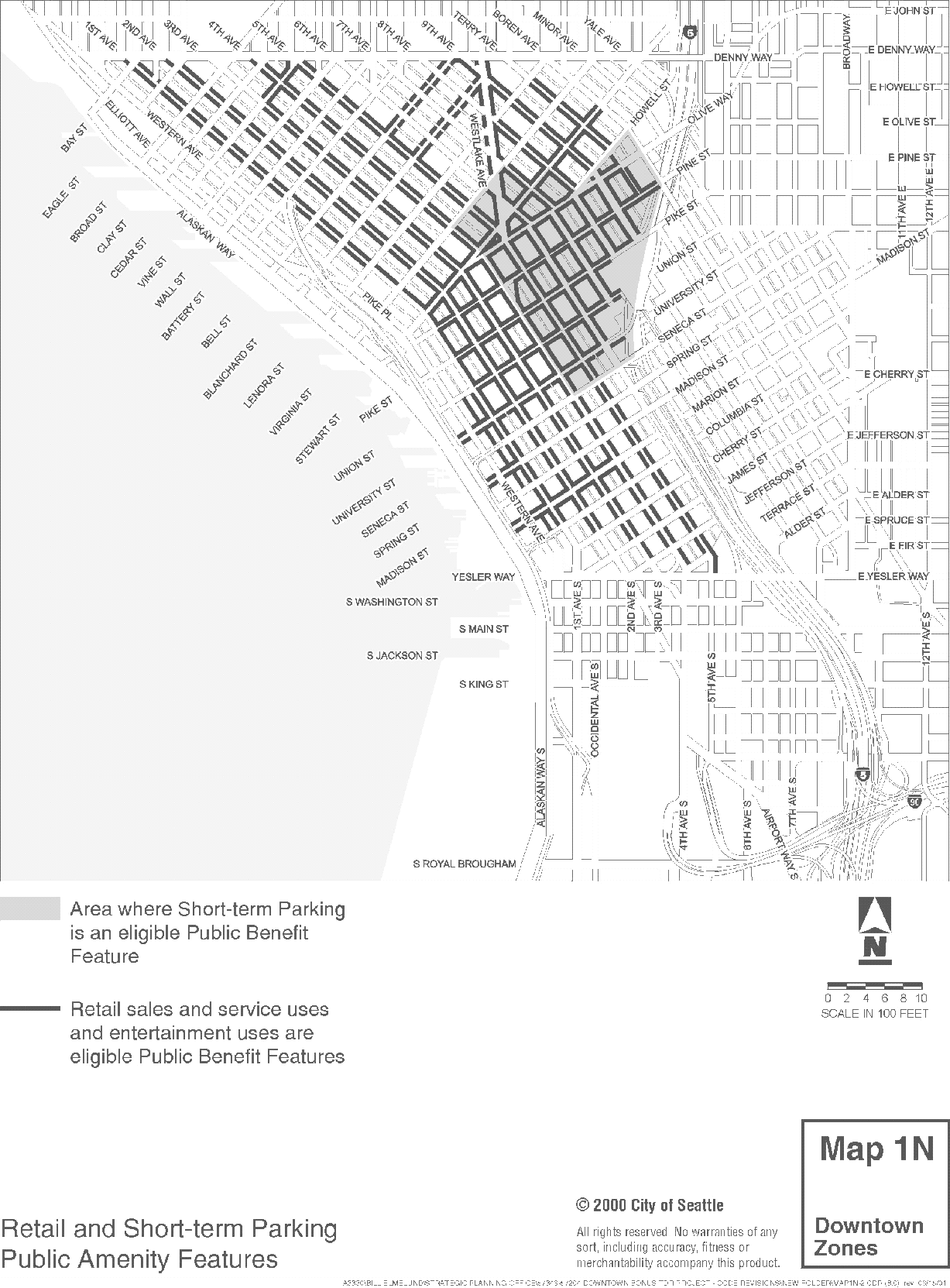
C. If the drive-in bank or car wash is located along either a principal arterial, a minor arterial, or along a street with only one (1) lane for moving traffic in each direction, the Director shall determine, after consulting with 1. Banks with one (1) or two (2) drive-in lanes, eight (8) spaces per lane; 2. Banks with three (3) or more drive-in lanes, six (6) spaces per lane; 3. Car washes, twenty (20) spaces per lane. Section 9. Subsection B of Section 23.48.032 of the Seattle Municipal Code, which Section was last amended by Ordinance 119715, is amended as follows: 23.48.032 Required parking and loading. B. Residential uses shall be required to provide one (1) off-street parking space per unit, except for low-income elderly/low-income disabled multifamily structures where the number of off-street parking spaces will be determined according to the requirements of Section 23.54.015, Required parking. Section 10. Map 1N, Retail and Short-term Parking Amenity Features, of Chapter 23.49, adopted by Ordinance 120443, is repealed and replaced with the following revised Map 1N: Section 11. Subsection A of Section 23.49.018 of the Seattle Municipal Code, which Section was last amended by Ordinance 118409, is amended as follows: 23.49.018 Standards for location of parking. A. Curbcut Location. 1. When a lot abuts more than one (1) right-of-way, the location of access shall be determined by the Director after consulting with the Director of Transportation. Except as provided in subsection A3, the location of access shall be determined by the classification of rights-of-way on Map IB1 and the ranking of the classification below, from most to least preferred: a. Alley -if of sufficient width to accommodate anticipated uses; b. Access street; c. Class II pedestrian street -Minor arterial; d. Class II pedestrian street -Principal arterial; e. Class I pedestrian street -Minor arterial; f. Class I pedestrian street -Principal arterial; g. Principal transit street.
2. Curbcut controls on 3. The Director, after consulting with the Director of Transportation, shall also determine whether the location of the access will expedite the movement of vehicles, facilitate a smooth flow of traffic, avoid the onstreet queuing of vehicles, enhance vehicular safety and pedestrian comfort, and will not create a hazard. Section 12. Subsections A, C and E of Section 23.49.332 of the Seattle Municipal Code, which Section was last amended by Ordinance 118409, is amended as follows: 23.49.332 Downtown Harborfront 2, street facade requirements. A. Minimum Facade Height. 1. Minimum facade height shall be as described in the chart below, and as shown in Exhibit 23.49.332 A, but the minimum facade heights shall not apply when all portions of the structure are lower than the elevation of the required minimum facade height listed below.
Class II Pedestrian Streets Minimum Facade* Height Minimum Facade* Height 25 feet 15 feet * Except as modified by view corridor requirements. 2. On designated view corridors described in Section 23.49.024, the minimum facade height shall be the required elevation of the setback when it is less than the minimum facade height required in subsection A1. C. Facade Transparency Requirements. 1. Facade transparency requirements shall apply to the area of the facade between two (2) feet and eight (8) feet above the sidewalk. Only clear or lightly tinted glass in windows, doors, and display windows shall be considered transparent. Transparent areas shall allow views into the structure or into display windows from the outside. 2. Facade transparency requirements shall not apply to portions of structures in residential use. 3. When the transparency requirements of this subsection are inconsistent with the glazing limits in the Energy Code,2 this subsection shall apply. 4. Transparency requirements shall be as follows:
a. Class II pedestrian streets and b. When the slope of the street frontage of the facade exceeds seven and onehalf (7 1/2) percent, the required amount of transparency shall be reduced to twenty-two (22) percent. E. Screening of Parking. 1. Parking located at or above street level in a garage shall be screened according to the following requirements: a. On Class II pedestrian streets, parking shall be permitted at street level when at least thirty (30) percent of the street frontage of the parking area, excluding that portion of the frontage occupied by garage doors, is separated from the street by other uses. The facade of the separating uses shall be subject to the transparency and blank wall standards for Class I pedestrian streets in subsections C and D of this section. The remaining parking shall be screened from view at street level and the street facade shall be enhanced by architectural detailing, artwork, landscaping, or similar visual interest features.
b. On c. The perimeter of each floor of parking garages above street level shall have an opaque screen at least three and one-half (3 1/2) feet high. 2. Surface parking areas shall be screened and landscaped pursuant to Section 23.49.020, Screening and landscaping of surface parking areas. Section 13. Section 23.50.002 of the Seattle Municipal Code, which Section was last amended by Ordinance 116295, is amended as follows: 23.50.002 Scope of provisions. A. There shall be four (4) industrial classifications: General Industrial 1 (IG1), General Industrial 2 (IG2), Industrial Buffer (IB), and Industrial Commercial (IC). This chapter describes the authorized uses and development standards for the Industrial zones.
B.
C.
Section 14. Subsection E of Section 23.53.020 of the Seattle Municipal Code, which Section was last amended by Ordinance 120117, is amended as follows: 23.53.020 Improvement requirements for existing streets in industrial zones. E. Exceptions. 1. Streets With Existing Curbs. a. Streets With Right-of-way Greater Than or Equal to the Minimum Rightof-way Width. When a street with existing curbs abuts a lot, and improvements would be required by subsections B or D of this section, and the existing right-of-way is greater than or equal to the minimum width established in subsection A of this section, but the roadway width is less than the minimum established in the Street Improvement Manual, the following requirements shall be met: (1) All structures on the lot shall be designed to accommodate the grade of the future street improvements. (2) A no-protest agreement to future street improvements shall be required, as authorized by RCW Chapter 35.43. The agreement shall be recorded with the title to the property with the King County Department of Records and Elections. (3) If there is no sidewalk, a sidewalk shall be constructed, except when the following projects are proposed: i. Remodeling and use changes within existing structures; ii. Additions to existing structures which are exempt from environmental review. b. Streets With Less Than the Minimum Right-of-way Width. When a street with existing curbs abuts a lot and the existing right-of-way is less than the minimum width established in subsection A6 of this section, the following requirements shall be met: (1) Setback Requirement. A setback equal to half the difference between the current right-of-way width and the minimum right-of-way width established in subsection A6 of this section shall be required; provided, however, that if a setback has been provided under this provision, other lots on the block shall provide the same setback. The area of the setback may be used to meet any development standard, except that required parking may not be located in the setback. Underground structures which would not prevent the future widening and improvements of the right-of-way may be permitted in the required setback by the Director after consulting with the Director of Transportation. (2) Grading Requirement. When a setback is required, all structures on the lot shall be designed to accommodate the grade of the future street, according to the Street Improvement Manual. (3) A no-protest agreement to future street improvements shall be required, as authorized by RCW Chapter 35.43. The agreement shall be recorded with the title to the property with the King County Department of Records and Elections. 2. Projects With Reduced Improvement Requirements. The following types of projects are exempt from all dedication and improvement requirements of subsections B, C and D of this section, but shall meet the setback, grading and no-protest requirements of subsection E1b if the street right-of-way abutting the lot has less than the minimum right-of-way width established in subsection A of this section or does not meet the grade of future street improvements. a. Structures with fewer than ten (10) artist's studio dwellings; b. The following uses when they are smaller than seven hundred fifty (750) square feet of gross floor area: fast-food restaurants; major and minor vehicle repair uses; and multipurpose convenience stores; c. Nonresidential structures which have less than four thousand (4,000) square feet of gross floor area and which do not contain uses listed in subsection E2b of this section which are larger than seven hundred fifty (750) square feet; d. Structures containing a mix of artist's studio dwellings and nonresidential uses, if there are fewer than ten (10) artist's studio dwellings, and the square footage of nonresidential use is less than specified in subsections E2b and E2c of this section; e. Remodeling and use changes within existing structures; f. Additions to existing structures which are exempt from environmental review; and g. Expansions of a surface parking area or open storage area of less than twenty (20) percent of parking area or storage area or number of parking spaces. 3. Exceptions From Required Street Improvement Requirements. The Director may waive or modify the requirements for paving, dedication, setbacks, grading, noprotest agreements, landscaping and sidewalk and pedestrian walkway installation when it is determined that one (1) or more of the following conditions are met: a. Location in an environmentally critical area, disruption of existing drainage patterns, or removal of natural features such as significant trees makes widening and/or improving the right-of-way impractical or undesirable. b. The existence of a bridge, viaduct or structure such as a substantial retaining wall makes widening the right-of-way impractical or undesirable.
c. Widening the right-of-way and/or improving the street would adversely affect the character of the street, as it is defined in an adopted neighborhood plan or adopted City plan for d. Widening and/or improving the right-of-way would make building on a lot infeasible by reducing it to dimensions where development standards cannot reasonably be met. e. Widening and/or improving the right-of-way would eliminate street access to an existing lot. f. One (1) or more substantial principal structures on the same side of the block as the proposed project are located in the area needed for future expansion of the right-of-way and the structure(s)' condition and size make future widening of the remainder of the right-of-way unlikely. g. Widening and/or improving the right-of-way is impractical because topography would preclude the use of the street for vehicular access to the lot, for example due to an inability to meet the required twenty (20) percent maximum driveway slope. h. Widening and/or improving the right-of-way is not necessary because it is adequate for current and potential pedestrian and vehicular traffic, for example, due to the limited number of lots served by the development or because the development on the street is at zoned capacity. Section 15. Subsection D of Section 23.55.036 of the Seattle Municipal Code, which Section was last amended by Ordinance 120388, is amended as follows: Section 23.55.036 Signs in IB, IC, IG1 and IG2 zones. D. On-premises Signs. 1. The following signs shall be permitted in addition to the signs permitted by subsections D2, D3 and D4: a. Electric, externally illuminated or nonilluminated signs bearing the name of the occupant of a dwelling unit, not exceeding sixty-four (64) square inches in area; b. Memorial signs or tablets, and the names of buildings and dates of building erection when cut into a masonry surface or constructed of bronze noncombustible materials; c. Signs for public facilities indicating danger and/or providing service or safety information; d. Property displayed national, state and institutional flags; e. One (1) under-marquee sign which does not exceed ten (10) square feet in area; f. One (1) electric, externally illuminated or nonilluminated sign bearing the name of a home occupation, not exceeding sixty-four (64) square inches in area. 2. Number and Type of Permitted Signs for Business Establishments. a. Except as further restricted in subsection D5, each business establishment may have one (1) ground, roof, projecting or combination sign (Type A sign) for each three hundred (300) lineal feet, or portion thereof, of frontage on public rights-of-way, except alleys. b. In addition to the signs permitted by subsection D2a, each business establishment may have one (1) wall, awning, canopy, marquee, or under-marquee sign (Type B sign) for each thirty (30) lineal feet, or portion thereof, of frontage on public rights-of-way, except alleys. c. In addition to the signs permitted by subsections D2a and D2b, each multiple business center and drive-in business may have one (1) pole sign for each three hundred (300) lineal feet, or portion thereof, of frontage on public rights-ofway, except alleys. Such pole signs may be for a drivein business or for an individual business establishment located in a multiple business center, or may identify a multiple business center. d. Individual businesses which are not drive-in businesses and which are not located in multiple business centers may have one (1) pole sign in lieu of another Type A sign permitted by subsection D2a for each three hundred (300) lineal feet, or portion thereof, of frontage on public rights-of-way, except alleys. e. Where principal use or activity on the lot is outdoor retail sales, banners and strings of pennants maintained in good condition shall be permitted in addition to the signs permitted by subsections D2a, D2b and D2c. 3. Maximum Area. Except as provided in subsection D5, there shall be no maximum area limits for on-premises signs for business establishments. 4. Identification Signs for Multifamily Structures. a. One (1) identification sign shall be permitted on each street or alley frontage of a multifamily structure. b. Identification signs may be wall, ground, awning, canopy, marquee, undermarquee, or projecting signs. c. The maximum area of each sign shall be seventy-two (72) square feet. 5. Sign Height. a. The maximum height for any portion of a projecting or combination sign shall be sixty-five (65) feet above existing grade, or the maximum height limit of the zone, whichever is less. b. The maximum height limit for any portion of a pole sign shall be thirty (30) feet; except for pole signs for multiple business centers and for business establishments located within one hundred (100) feet of a state route right-ofway which is not designated in Section 23.55.042 as a landscaped or scenic view section, which shall have a maximum height of forty (40) feet. c. The maximum height for any portion of a wall, marquee, under-marquee, or canopy sign shall be twenty (20) feet or the height of the cornice of the structure to which the sign is attached, whichever is greater. d. No portion of a roof sign shall:
(1) Extend beyond the height limit of the zone for office uses, except that spectator sports facilities with a seating capacity of forty thousand (40,000) or greater and more than one (1) roof level may have up to two (2) identification signs, with the
vertical dimension of lettering or characters limited to twelve (12) feet and a maximum total area for both signs limited to three thousand (3,000) square feet; provided, the sign height does not exceed the highest roof level. One (1) additional
identification sign may be applied to (2) Exceed a height above the roof in excess of the height of the structure on which the sign is located; or (3) Exceed a height of thirty (30) feet above the roof measured from a point on the roof line directly below the sign or from the nearest adjacent parapet. Section 16. Subsection A of Section 23.66.130 of the Seattle Municipal Code, which Section was last amended by Ordinance 119484, is amended as follows: 23.66.130 Street level uses.
A. Uses at street level in the area designated on Map Section 17. Subsection D of Section 23.66.170 of the Seattle Municipal Code, which Section was last amended by Ordinance 119484, is amended as follows: 23.66.170 Parking and access. D. Standards for Location of Access to Parking.
1. Access to parking and loading from alleys, and from streets which generally run east/west, is preferred to access from avenues. When a lot abuts more than one (1) right-of-way, the location of access shall be determined by the Department of
Neighborhoods Director in consultation with the Director of Transportation. This determination shall be made according to the traffic classification of the street, depicted on Map D.(Note 1) Access shall be from rights-of-way classified as follows, from
the most to least preferred, except when the Department of Neighborhoods Director, following review and recommendation by the Board, determines that access from the preferred right-ofway would create a hazardous condition: Alleys; Access streets; Class
II pedestrian streets -minor arterial; Class II pedestrian streets -principal arterial; Class I pedestrian streets -minor arterial; Class I pedestrian streets -principal arterial; Principal transit street; 2. Curbcut width and the number of curbcuts permitted per street frontage shall be governed by Section 23.54.030 of this Land Use Code. 3. The street-level location of entrances and exits of all parking garages, where permitted, shall be permitted only if approved by the Department of Neighborhoods Director after review and recommendation by the Preservation Board. View-obscuring screening may be required as needed to reduce adverse visual impacts on the immediate area. Section 18. Subsection B of Section 23.76.006, which Section was last amended by Ordinance 119974 and Council Bill 113818 (if Council Bill 113818 is approved by Council and signed by the Mayor), are amended as follows: 23.76.006 Master Use Permits required. B. The following decisions are Type I: 1. Determination that a proposal complies with development standards; 2. Establishment or change of use for uses permitted outright, temporary uses for four (4) weeks or less not otherwise permitted in the zone, and temporary relocation of police and fire stations for twelve (12) months or less; 3. The following street use approvals associated with a development proposal: a. Curb cut for access to parking, b. Concept approval of street improvements, such as additional on-street parking, street landscaping, curbs and gutters, street drainage, sidewalks, and paving,
c. Sidewalk cafes d. Structural building overhangs, e. Areaways; 4. Lot boundary adjustments; 5. Modification of the following features bonused under Title 24: a. Plazas, b. Shopping plazas, c. Arcades, d. Shopping arcades, e. Voluntary building setbacks; 6. Determinations of Significance (determination that an environmental impact statement is required) for Master Use Permits and for building, demolition, grading and other construction permits (supplemental procedures for environmental review are established in Chapter 25.05, Environmental Policies and Procedures), except for Determinations of Significance based solely on historic and cultural preservation; 7. Discretionary exceptions for certain business signs authorized by Section 23.55.042 D; 8. Waiver or modification of required right-of-way improvements; 9. Special accommodation pursuant to Section 23.44.015; 10. Reasonable accommodation; and 11. Minor amendment to Major Phased Development Permit. Section 19. Section 23.84.016 of the Seattle Municipal Code, which Section was last amended by Ordinance 120117, is amended as follows: 23.84.016 "H"
"Hazardous materials" means substances that are capable of posing
"Group A hazardous materials" means substances that generally pose physical hazards such as explosion or which are highly toxic. "Group A hazardous materials" shall include but not be limited to the following:
-Explosives and blasting agents (except Class C explosives as defined by the Fire Code);(Note 1)
-Reactive materials (includes alkali metals, metallic carbides, metallic hydrides, organometallic compounds, and other similar substances). Those materials that are rated with a reactivity (instability) rating of three (3) or four (4) when rated in
accordance with Uniform Fire Code Standard 79-3 are considered reactive materials. Combinations of materials listed in NFPA Standard 491M -Manual of Hazardous Chemical Reactions, are considered reactive materials.
-Unstable materials (materials with a reactivity rating of three (3) or four (4) in accordance with Uniform Fire Code Standard 79-3); materials that vigorously decompose; materials that vigorously polymerize; and peroxide-forming chemicals.
-Radioactive materials (common radiation source materials), except those used in medical and industrial test and measuring situations.
-Oxidizers -Class Three (3) or Four (4) from NFPA Standard No. 43A as follows:
-Class Three (3) -an oxidizing material that will cause a severe increase in the burning rate of combustible material with which it comes in contact;
-Class Four (4) -an oxidizing material that can undergo an explosive reaction when catalyzed or exposed to heat, shock or friction;
-Highly toxic materials including Class A poisons, as defined by the Fire Code(Note 1) -etiologic and biological agents that cause disease or abnormal conditions, carcinogens, mutagens and teratogens.
-Corrosive, highly toxic or poisonous, and unstable gases.
"Group B hazardous materials" means substances that generally are either flammable or corrosive. "Group B hazardous material" shall include, but not be limited to, the following:
-Class C explosives as defined by the Fire Code;(Note 1)
-Class B poisons as defined by the Fire Code(Note 1);
-Class I-A and I-B flammable liquids as defined by the Fire Code:(Note 1)
-Class I-A shall include those having flashpoints below seventythree (73) degrees Fahrenheit and having a boiling point below one hundred (100) degrees Fahrenheit;
-Class I-B shall include those having flashpoints below seventythree (73) degrees Fahrenheit and having a boiling point at or above one hundred (100) degrees Fahrenheit.
-Flammable Solids -organic and inorganic solids, and combustible metals.
-Oxidizing Materials -Class One (1) and Two (2) as listed in NFPA Standard No. 43A, as follows:
-Class One (1) -An oxidizing material whose primary hazard is that it may increase the burning rate of combustible material with which it comes in contact;
-Class Two (2) -An oxidizing material that will moderately increase the burning rate or which may cause spontaneous ignition of combustible material with which it comes in contact.
-Flammable and oxidizing gases.
-Corrosives -acids, bases, and other corrosives.
"Group C hazardous materials" means the following listed materials and other similar substances which may present severe risk to health, safety or property but which are generally more common and present less severe hazards than Group A and B
materials:
-Class I-C flammable liquids as defined in the Fire Code(Note 1) (flashpoints below one hundred (100) degrees Fahrenheit;
-Combustible liquids -Class II and III as defined in the Fire Code(Note 1) as follows:
-Class II liquids include those having flashpoints at or about one hundred (100) degrees Fahrenheit and below one hundred forty (140) degrees Fahrenheit;
-Class III-A liquids include those having flashpoints at or above one hundred forty (140) degrees Fahrenheit and below two hundred (200) degrees Fahrenheit.
-Inert or chemically unreactive, and liquified gases.
-Other regulated materials including irritants.
"High-impact use" means a business establishment that is considered to be dangerous and/or noxious due to the probability and/or magnitude of its effects on the environment; and/or has the potential for causing major community or health impacts,
including but not limited to nuisance, odors, noise, and/or vibrations; and/or is so chemically intensive as to preclude site selection without careful assessment of potential impacts and impact mitigation. The Director shall consult as
necessary with the Chief of the Seattle Fire Department, the Director of the Seattle-King County Health Department, and other local, state, regional, and federal agencies to determine when a business establishment shall be regulated as an high-impact
use.
"High-impact One (1)" use means the following or other substantially similar activities:
-Battery manufacture and reprocessing for reuse;
-Crude petroleum refinery and storage;
-Manufacture of wood preservatives;
-Distillation of wood, coal or bones, or manufacture of by-products; animal black or bone black manufacturing;
-Gas (illuminating or heating) manufacture or storage;
-Rendering of fat, tallow, lard; extraction of animal or fish fats and oils;
-Smelting of ore;
-Stockyards, hog farms, slaughterhouses except poultry, including packing and freezing;
-Tanneries;
-Wood pulp manufacture;
-Manufacture of Group A hazardous materials, except Class A or Class B explosives;
-Storage of Class A or Class B explosives;
-Manufacture of Group B hazardous materials when the hazardous materials are present in quantities greater than two thousand five hundred (2,500) pounds of solids, two hundred seventy-five (275) gallons of liquid, or one thousand (1,000) cubic feet of
gas at any time.
"High-impact Two (2)" use means the following or other substantially similar activities:
-Manufacture of Class A or B explosives;
-Manufacture, use or storage of fissile materials Section 20. The definitions for "Low-income disabled multifamily structure" and "Low-income elderly/low-income disabled multifamily structure" in Section 23.84.024 of the Seattle Municipal Code, which Section was last amended by Ordinance 120117, are amended as follows: Section 23.84.024 "L"
"Low-income disabled multifamily structure" means a multifamily structure in which at least ninety (90) percent of the dwelling units are occupied by one (1) or more persons who have a handicap as defined in
"Low-income elderly/low-income disabled multifamily structure" means a multifamily structure in which Section 21. The definition for "Single family attached structure" in Section 23.84.036 of the Seattle Municipal Code, which Section was last amended by Ordinance 119839, is repealed. Section 22. Exhibit 1, SEPA Scenic Routes Maps of North and South Seattle of Section 25.05.675 of the Seattle Municipal Code, which Section was last amended by Ordinance 120000, is amended as follows: Section 23. The provisions of this ordinance are declared to be separate and severable. The invalidity of any particular provision shall not affect the validity of any other provision. Section 24. This ordinance shall take effect and be in force thirty (30) days from and after its approval by the Mayor, but if not approved and returned by the Mayor within ten (10) days after presentation, it shall take effect as provided by Municipal Code Section 1.04.020. Passed by the City Council the _____ day of ____________, 2001, and signed by me in open session in authentication of its passage this _____ day of _________________, 2001. ___________________________________ President of the City Council Approved by me this _____ day of _________________, 2001. ___________________________________ Paul Schell, Mayor Filed by me this _____ day of ____________________, 2001. __________________________________ City Clerk (SEAL) Kd Omnibusord2001-c 11/1/01 V#5 |
|
Attachments |
|---|
![[TOP]](/netaicon/toppg.gif)