![[HOME]](/netaicon/homeicon.gif)
![[SEARCH]](/netaicon/srchpage.gif)

![[CURR_LIST]](/netaicon/curlist.gif)


![[BOTTOM]](/netaicon/bottom.gif)
![[HELP]](/netaicon/help.gif)
Seattle Comptroller/Clerk Files Index
Information modified on July 15, 2011; retrieved on April 27, 2026 5:08 AM
Clerk File 310851
Title | |
|---|---|
| Report of the City Auditor on the 2008 Audit of the City's Enforcement of Bias Crimes. | |
Description and Background | |
|---|---|
| Current Status: | Filed |
Legislative History | |
|---|---|
| Sponsor: | Burgess |
| Date Introduced: | June 14, 2010 |
| Committee Referral: | Public Safety and Education |
| City Council Action Date: | July 6, 2010 |
| City Council Vote: | 9-0 |
| Date Filed with Clerk: | June 9, 2010 |
| PDF Copy: | Clerk File 310851 |
Text | |||||||||||||||||||||||||||||||||||||||||||||||||||||||||||||||||||||||||||||||||||||||||||||||||||||||||||||||||||||||||||||||||||||||||||||||||||||||||||||||||||||||||||||||||||||||||||||||||||||||||||||||||||||||||||||||||||||||||||||||||||||||||||||||||||||||||||||||||||||||||||||||||||||
|---|---|---|---|---|---|---|---|---|---|---|---|---|---|---|---|---|---|---|---|---|---|---|---|---|---|---|---|---|---|---|---|---|---|---|---|---|---|---|---|---|---|---|---|---|---|---|---|---|---|---|---|---|---|---|---|---|---|---|---|---|---|---|---|---|---|---|---|---|---|---|---|---|---|---|---|---|---|---|---|---|---|---|---|---|---|---|---|---|---|---|---|---|---|---|---|---|---|---|---|---|---|---|---|---|---|---|---|---|---|---|---|---|---|---|---|---|---|---|---|---|---|---|---|---|---|---|---|---|---|---|---|---|---|---|---|---|---|---|---|---|---|---|---|---|---|---|---|---|---|---|---|---|---|---|---|---|---|---|---|---|---|---|---|---|---|---|---|---|---|---|---|---|---|---|---|---|---|---|---|---|---|---|---|---|---|---|---|---|---|---|---|---|---|---|---|---|---|---|---|---|---|---|---|---|---|---|---|---|---|---|---|---|---|---|---|---|---|---|---|---|---|---|---|---|---|---|---|---|---|---|---|---|---|---|---|---|---|---|---|---|---|---|---|---|---|---|---|---|---|---|---|---|---|---|---|---|---|---|---|---|---|---|---|---|---|---|---|---|---|---|---|---|---|---|---|---|---|---|---|---|---|---|---|---|---|---|---|---|---|---|---|---|---|
|
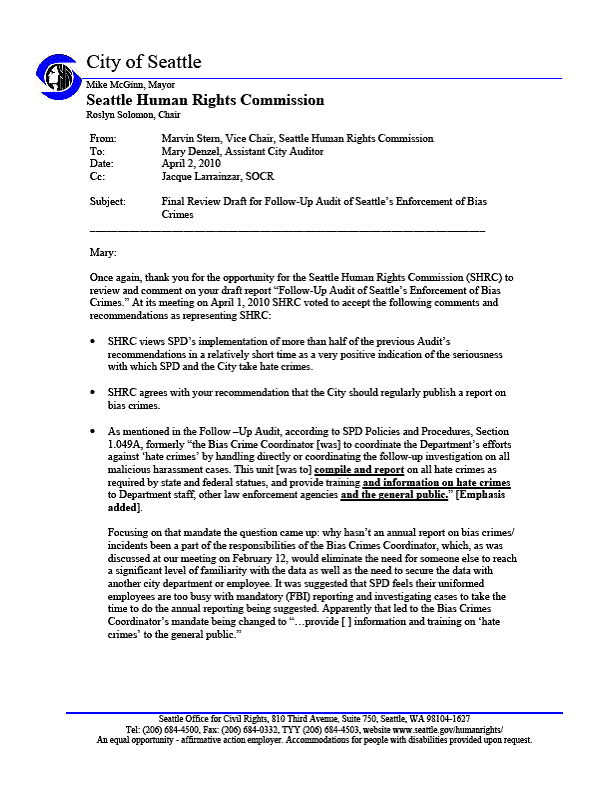
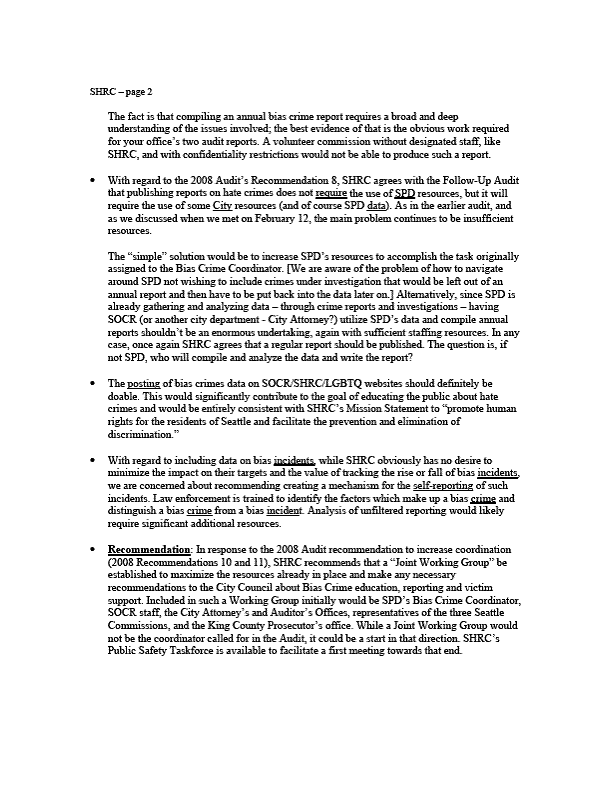
Office of City Auditor Follow-up Report on 2008 Audit: The City's Enforcement of Bias Crimes June 9, 2010 City of Seattle Office of City Auditor Our Mission: To help the City of Seattle achieve honest, efficient management and full accountability throughout City government. We serve the public interest by providing the Mayor, the City Council, and City department heads with accurate information, unbiased analysis, and objective recommendations on how best to use public resources in support of the well-being of the citizens of Seattle. Background: Seattle voters established our office by a 1991 amendment to the City Charter. The office is an independent department within the legislative branch of City government. The City Auditor reports to the City Council and has a four-year term to ensure his/her independence in selecting and reporting on audit projects. The Office of City Auditor conducts financial-related audits, performance audits, management audits, and compliance audits of City of Seattle programs, agencies, grantees, and contracts. The City Auditor's goal is to ensure that the City of Seattle is run as effectively and efficiently as possible. How We Ensure Quality: The office's work is performed in accordance with the Government Auditing Standards issued by the Comptroller General of the United States. These standards provide guidelines for staff training, audit planning, fieldwork, quality control systems, and reporting of results. In addition, the standards require that external auditors periodically review our office's policies, procedures, and activities to ensure that we adhere to these professional standards. An equal opportunity-affirmative action employer Street Address: 700 5th Avenue, Suite 2410, Seattle, WA Mailing address: PO Box 94729, Seattle, Washington 98124-4729 Phone Numbers -Office: (206) 233-3801 Fax: (206) 684-0900 email: davidg.jones@seattle.gov website: seattle.gov/audit City of Seattle Office of City Auditor June 2, 2010 The Honorable Michael McGinn Seattle City Councilmembers City of Seattle Seattle, Washington 98104 Dear Mayor McGinn and City Councilmembers: Attached is a follow-up report on our August 4, 2008 audit Seattle's Enforcement of Bias Crimes. The report's primary objective was to provide information about the implementation status of the August 2008 audit recommendations. We also provide an additional eighteen months of data (January 2008-June 2009) on bias attacks in Seattle. The 2008 audit contained 17 recommendations to improve and/or increase the City of Seattle's 1) response to bias attacks, 2) awareness and education about bias attacks, and 3) inter-department and inter-agency responsiveness to victims and communities affected by bias attacks. Of the 17 recommendations made in our August 2008 report, nine have been fully implemented (all by the Seattle Police Department), three have been partially implemented, and five have not been implemented (though one is being considered for implementation with the cooperation of the Seattle Office for Civil Rights and the Seattle Human Rights Commission). In particular, SPD modified its electronic data system to improve the data it collects on bias attacks. This will allow the City to better understand, respond to, and report on the incidence of bias attacks in Seattle. These actions are significant in demonstrating to the public that Seattle has no tolerance for bias attacks. The City has not yet implemented our recommendation to produce regular reporting on bias crimes and incidents. The Seattle Office for Civil Rights and the Seattle Human Rights Commission provided formal, written comments on a draft of this report. Those comments are found in Appendices 4 and 5. We appreciate the cooperation of the Seattle Police Department, the Seattle Office for Civil Rights, and the Seattle Human Rights Commission during the audit process. If you have any questions regarding this audit, please call Mary Denzel, Auditor in Charge, 684-8158, mary.denzel@seattle.gov, or me at 233-1095, davidg.jones@seattle.gov. Sincerely, David Jones City Auditor Attachment This page intentionally left blank Table of Contents Executive Summary01 Introduction05 Bias Attack Statistics and Reporting05 Bias Crime Prosecution09 Appendix 1. Details Regarding City Response to Audit Recommendations011 Appendix 2. Bias-Related Police Reports by Category, January 2000 June 2009017 Appendix 3. Scope and Methodology019 Appendix 4. Comment Letter from the Seattle Office for Civil Rights021 Appendix 5. Comment Letter from the Seattle Human Rights Commission023 This page intentionally left blank Executive Summary In August 2008 the Office of City Auditor issued an audit report titled Seattle's Enforcement of Bias Crimes. This audit contained 17 recommendations to improve and/or increase the City of Seattle's (City) 1) response to bias attacks1, 2) awareness and education about bias attacks, and 3) inter-department and inter-agency responsiveness to victims and communities affected by bias attacks. Of the 17 recommendations made in our August 2008 audit report, nine have been fully implemented (all by the Seattle Police Department [SPD]), three have been partially implemented, and five have not been implemented (though one is being considered for implementation with the cooperation of the Seattle Office for Civil Rights [OCR] and the Seattle Human Rights Commission [HRC]). Table 1 below shows each recommendation and its status. See Appendix 1 for details about City departments' responses to the recommendations.
The Seattle Police Department is responsible for the nine recommendations that have been fully implemented, three that have been partially implemented, and two that will not be implemented. The remaining recommendations that have not been implemented require the participation of the Mayor, the Seattle Office for Civil Rights, and potentially City commissions including the Seattle Human Rights Commission; the Seattle Lesbian, Gay, Bisexual, Transgender and Queer/Questioning Commission; and the Seattle Women's Commission. An Office for Civil Rights staff member is currently meeting with a Seattle Human Rights Commissioner to explore a role for that commission in creating bias attack reports. Seattle Police Department Improves Systems to Identify and Report Bias Crimes and Incidents In June 2009 SPD modified its electronic case management system (called SPIDER2) to prevent police officers from continuing beyond the first page of a police report until they fill in the bias field to indicate the presence or absence of bias in an event.3 SPD also added a category of "bias incident" to their reporting system, and made it easier to locate the offense category used for bias crimes (called malicious harassment in Washington State law). These changes will allow the City to better understand, respond to, and report on the incidence of bias attacks in Seattle. SPD's positive response to the recommendations establishes a good foundation for improving Seattle's response to bias attacks and should increase the accuracy of Seattle's bias attack data. These actions are significant in setting a tone for the city, and demonstrating to the public that Seattle has no tolerance for bias attacks. Seattle Police Department Should Take the Lead in Implementing Partially Implemented Recommendations In addition to the nine fully implemented recommendations, SPD has partially implemented three recommendations. SPD created one report on bias attacks (Recommendation 8) at the request of the City Council. In order to fully implement Recommendation 8 to report bias crimes and incidents, SPD should continue this type of reporting regularly (i.e., quarterly, biannually or annually). SPD and the Office for Civil Rights have continued to work with community groups to address bias crimes (Recommendations 11 and 13), but not at the increased levels we recommended. Full implementation of these recommendations would require that these efforts be expanded. This requires coordinating the City's bias attack response and education efforts among multiple departments and expanding outreach to and coordination with community organizations that could help reduce and/or address the effects of bias attacks. The City's budget constraints have prevented any new or expanded initiatives in response to these recommendations. However, a member of the City's Human Rights Commission has expressed interest in working with the City's Office for Civil Rights and SPD to expand community education and response, data analysis, and reporting, (Recommendations 8, 11 and 14). If the City believes this is a priority, it should take advantage of SPD's improved data and the willingness of the City's Human Rights Commission and the Seattle Office for Civil Rights to help with bias attack reporting and education by providing the resources required to produce regular bias attack reporting. Of the Five Recommendations That Have Not Been Implemented, One Is Under Consideration for Implementation. The City's Human Rights Commission has expressed an interest in working with the Seattle Office for Civil Rights to implement Recommendation 14, which calls for improving community outreach, education, and prevention efforts around bias attacks. While the Seattle Office for Civil Rights performs some coordinating functions on an ad hoc basis, the City has not appointed a coordinator for cross-department efforts to address bias attacks (Recommendation 10). The remaining three recommendations will not be implemented because they would require additional resources that are not available during the City's current budget difficulties: * Recommendation 2 regarding improved coordination with community groups to encourage victim reporting of bias crimes; * Recommendation 15 regarding providing victim assistance to victims of bias incidents; and * Recommendation 16 regarding increasing the amount of time SPD Liaison Officers can spend on community work related to bias attacks. This Page Intentionally Left Blank Introduction This report is a follow-up to the Office of City Auditor's August 2008 audit, Seattle's Enforcement of Bias Crimes. That audit evaluated the Seattle Police Department's (SPD) response to and reporting on bias attacks in 2006 and 2007.4 The 2008 audit contained seventeen recommendations for improving the City of Seattle's (City) response to bias attacks, focusing on improving awareness and education about bias attacks, and increasing inter-department and inter-agency responsiveness to victims and communities affected by bias attacks. The objective of this follow-up report is to report on the implementation status of the August 2008 audit recommendations. We also provide an additional eighteen months of data (January 2008-June 2009) on bias attacks in Seattle. Bias Attack Statistics and Reporting A key recommendation of the 2006 report Bias Crimes and Incidents in Seattle, 2000 to 2005 (the Molsberry report) and our 2008 audit report was for the City to regularly publish bias attack statistics, including both crimes and non-criminal incidents, to educate the public and law enforcement personnel about trends in bias attacks. Counts of Bias Attacks The bias attack numbers we display in this report are for crime and incident reports provided by the SPD Bias Crimes Coordinator and the SPD records unit. We noted that the number of bias attack incident reports for 2008 in the Bias Crimes Coordinator's records differed from the number of malicious harassment General Offense reports for the same period that SPD reported to the Seattle City Council's Public Safety, Human Services, and Education Committee in May 2009, (see Table 2 below). (Malicious harassment is the term used in Washington State law to identify bias crimes). We were unable to reconcile these differences in numbers, and it is likely that our review of case files did not include some bias attacks reported to SPD. Consequently these numbers should be regarded as reflecting trends, rather than being an exhaustive record of all bias attacks for the period. A partial explanation for this difference is that some files we reviewed did not include a malicious harassment offense, but were nevertheless referred to the Bias Crimes Coordinator for review. We also found that both sets of numbers were far below the total number of cases identified as possible bias crimes or incidents in SPD's SPIDER electronic case management system. Some of these cases may have been determined to not be bias crimes during supervisory review. SPD also indicated they would not report on cases that were still open, and some of the cases we reviewed and counted were still open.
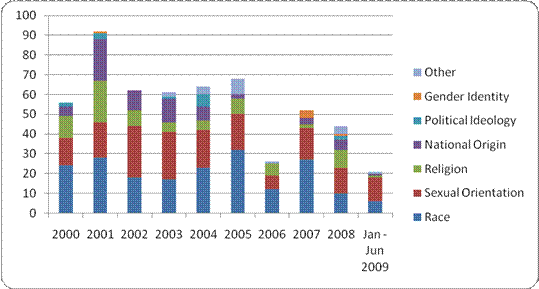
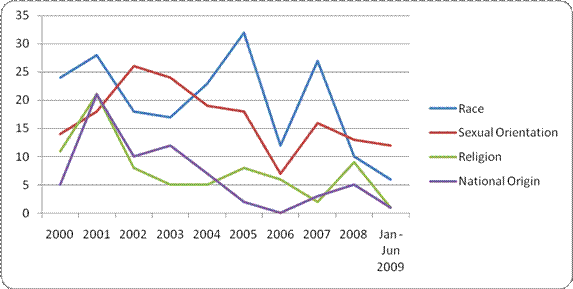
Categories of Bias Attacks Charts 1 and 2 below display bias attacks by the category of attack, and include data from the 2006 Molsberry report, our 2008 audit, and the data we gathered from SPD for January 2008 through June 2009. Chart 1 shows the subcategories as a portion of total attacks. Chart 1. Bias-Related Police Reports by Category by Year, 2000 June 2009 Source: Bias Crimes and Incidents in Seattle 2000 to 2005 by Ken Molsberry and Office of City Auditor analysis of SPD Bias Crimes data Both Chart 1 and Chart 2 show that, with the exception of 2001, the most frequent bias attacks concern a person's race or sexual orientation. Chart 2 below, shows individual data for each of the four most frequent categories of bias attack: race, sexual orientation, religion, and national origin. In 2001, following the September 11, 2001 terrorist attack, there were many bias attacks in Seattle on people thought to be of middle-eastern nationality or the Muslim religious faith. In other years shown on the chart many of the religion-based events (the third largest category in five of the ten years shown in the chart) were classified by SPD as property damage, primarily swastika graffiti. In 2006 there were three months of missing data,5 at least partially accounting for the marked drop in that year. Chart 2. Four Top Categories of Bias Crimes, January 2000 to June 2009 Source: Bias Crimes and Incidents in Seattle 2000 to 2005 by Ken Molsberry and Office of City Auditor analysis of SPD Bias Crimes data The numbers of General Offense (police) reports in the Bias Crimes Coordinator's records decreased in 2008 from 2007, and data for the first six months of 2009 was on track to be similar to 2008. However, for the first six months of 2009 the number of attacks based on sexual orientation was almost equal to all of 2008 (12 for the first six months of 2009 versus 13 for 2008), whereas the number of attacks based on race was about half the total for all of 2008 (6 in the first half of 2009 versus 10 for all of 2008). See Appendix 2 for a table showing the numbers behind Charts 1 and 2. How SPD Identifies Bias Attacks in Police Reports SPD officers are trained to identify bias-related cases by marking the "bias" field on the opening screen in the SPIDER system's General Offense Report and/or indicating malicious harassment or bias incident as one of the offenses. SPIDER captures this information and can be queried to produce reports. In our 2008 audit report we recommended that police officers receive annual training on bias crimes, and also recommended that the "bias" field on the General Offense report be a mandatory field (i.e., an officer is required to fill in this field before they can proceed with the rest of their reporting). SPD has implemented both of these recommendations (Recommendations 3 and 4). SPD has committed to annual training (Recommendation 9). In a memo to the Seattle City Council, dated May 19, 2009, SPD officials stated: Last May, an updated training video was created, which all sworn officers and commanders have reviewed. This was created in partnership with the King County Prosecutor's Office (Senior Deputy Prosecutor Mike Hogan).6 As a refresher, we've asked for a re-issuance of the training video, which will likely be distributed later this month or the first part of June. In a written statement to the Office of City Auditor, SPD stated: In June 2009 SPD made the "bias" field for the General Offense reports mandatory, in that an officer must make an entry in this field before they can proceed with their General Offense report (Recommendation 3). This may result in an over-count of bias attacks, because officers may identify an event that, under further analysis, turns out not to be a bias-related crime or incident. Complications in Identifying Bias Attacks Persist As with our 2008 audit, in our review of more recent data we found many anomalies in SPD's bias attack recording.7 To be considered a bias crime or incident, the primary motivation for the attack must be a personal characteristic of the victim such as race, sexual orientation, religion, or homelessness that is specified in Seattle or Washington State malicious harassment laws. In cases in which SPD officers are not certain whether a bias element is present, they are trained to err on the side of mentioning a bias element. These cases are reviewed by the officer's sergeant. If warranted, the sergeant then refers the case to the SPD Bias Crimes Coordinator, a trained professional who reviews the details of the incident to determine which category a reported event falls into: 1) it meets the definition of bias crime, 2) it is a non-criminal bias-related incident, or 3) it is neither of these. Among the incident reports we reviewed, there were some cases that did not meet the definition of a bias crime or incident. For example, there were two cases of fabricated bias attacks and several that were domestic violence.8 We also became aware of one well-publicized case of assault against a disabled teenager that was not referred to the Bias Crimes Coordinator even though the report included a malicious harassment offense and the bias field on the General Offense Report was completed. Similarly, in our 2008 audit we found six bias attack incident reports that were not referred to the Bias Crimes Coordinator as well as cases referred that, after analysis, were judged to not be bias attacks. SPIDER, SPD's new electronic incident reporting system, can generate counts of cases identified as bias-related. We requested a report from SPD showing all cases from January 2008 through June 2009 that an officer had either checked as bias-related or noted malicious harassment or bias incident as one of the offenses. While there were 65 cases in the Bias Crimes Coordinator's records for this period, there were 196 cases in the SPIDER system indicating bias by one or more of three methods: selecting an offense of malicious harassment or bias incident, or an entry in the bias field. Twelve of the 65 cases in the Bias Crimes Coordinator's records were not included in the SPIDER report we requested even though the bias field was checked or an offense category of malicious harassment or bias incident was included in the report. According to SPD, this could be because the cases were not yet closed, and SPD does not include open cases in its reporting. From the anomalies noted above we concluded that SPD's reporting of bias attack statistics continues to be an imperfect process yielding inconsistent results, as we found in our 2008 report. Bias Attack Reporting As noted above, the SPIDER system will permit SPD to gather three categories of data about bias attacks from General Offense Reports: 1) numbers of reports with the bias field checked, 2) reports with an offense noted as malicious harassment, and 3) reports with a bias incident offense. Tracking these gross numbers over time should give a rough indication of the prevalence of bias-related content in calls for SPD response. The primary benefit of regular reporting of bias attacks is to educate the public and police about the prevalence of bias in Seattle. However, at the present time SPD does not compile all this data for reporting purposes. The only reporting required of the City on bias attacks is a quarterly report to the FBI on bias crimes (not incidents) in four categories: race, religion, sexual orientation, and disability. Seattle's and Washington State's laws cover eight additional categories: ancestry, gender, gender identity, marital status, political affiliation, age, parental status, and homelessness. Reporting bias crimes to the federal government requires careful review, to ensure only those cases that meet the federal standard of a bias crime are included. SPD assigns this analysis and reporting to the Bias Crimes Coordinator. The numbers resulting from this careful review process are lower than the total number of events identified as bias-related, e.g., for 2008, they were half the number of SPD General Offense Reports with the bias field checked or a bias-related offense noted. The recent modifications to the SPIDER system should improve the accuracy of bias attack information. It would take additional resources to query the system for report data, analyze the data and write reports. In making a decision whether or not to commit to regular reporting on bias crimes, SPD management must weigh the benefits of more accurate reporting against the cost of both the resources required to track and report the statistics and the risks of inaccurate reporting. SPD has stated it will continue to count bias crimes according to the rules for reporting Uniform Crimes Reports to the FBI. According to SPD this will ensure consistent reporting and avoid releasing two sets of numbers. However, because the FBI does not collect data on some bias categories included in Seattle's laws, Seattle's submission for the FBI reports does not reflect all bias crimes that occurred in Seattle. Regular review of bias attack statistics and regular reporting on bias attacks is an important indicator of the quality of life in Seattle. It can serve an educational purpose, and provide warning of rising tensions in the community. Bias Crime Prosecution Few Bias Crimes Are Prosecuted When SPD believes there is sufficient evidence to file charges against a suspect in a bias crime case, the case is referred to one of two courts for prosecution: misdemeanors are referred to the Seattle Municipal Court, and felonies are referred to King County Superior Court. Table 3 below shows the number of incident reports annually from 2006 through June 2009, how many of these cases SPD referred for prosecution, how many cases had charges filed by the City's Law Department or the King County Prosecutors Office, and how many individuals were found guilty of a bias crime. Table 3 shows that SPD referred for prosecution between 19 percent (5 out of 27 in 2006) and 38 percent (8 out of 21 in Jan-June 2009) of General Offense reports we reviewed from January 2006 until June 2009. By the end of the prosecution process, 16 suspects were found guilty out of a total of 144 cases. There are many, varied reasons why a case does not result in a guilty verdict. For example, in the 65 case files we reviewed as part of this follow-up, 42 cases (65 percent) had problems that interfered with referral for prosecution. (These cases are included within the categories reflected in Table 3.) Specifically, the victim and police were unable to identify a suspect in at least 24 of the cases, 3 cases were not pursued because the victim refused to cooperate with the police as a witness, at least 7 cases were not bias crimes, 6 had juvenile suspects (so we were not able to reliably trace what happened through public records because juveniles are dealt with in Superior Court9), and 2 were false reports.
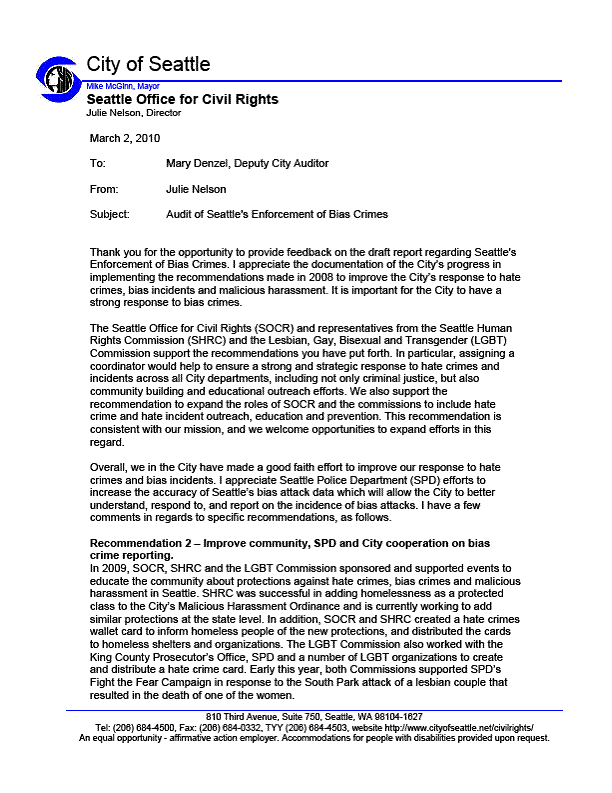
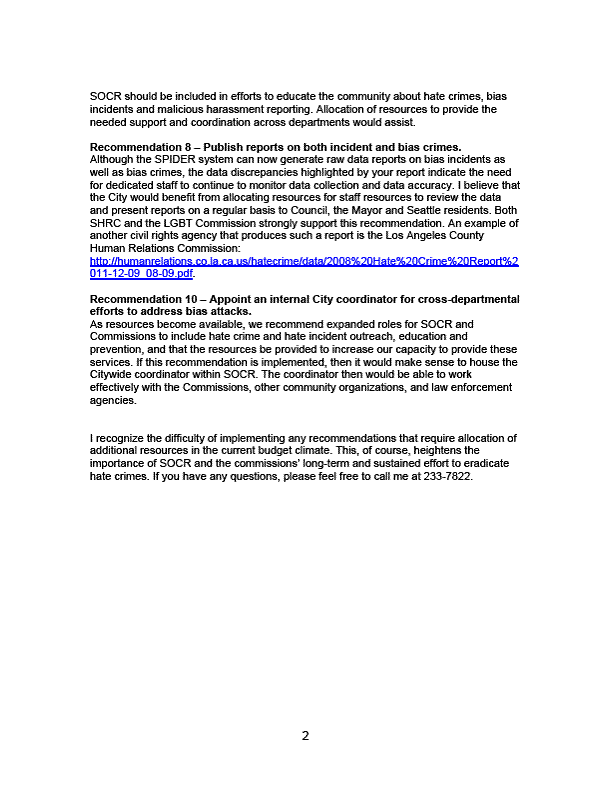
There were arrests in 30 (46 percent) of the 65 cases we reviewed from January 2008 through June 2009. Though only a small number of cases resulted in a guilty verdict, any contact with the judicial system has an impact on the individuals involved, and is evidence of a strong City response to bias attacks. Appendix 1. Details Regarding City Response to Audit Recommendations This appendix provides details on each recommendation and the Office of City Auditor's (Auditor) comment on its implementation status. 2008 Recommendation 1 Implemented: SPD should improve its system for identifying bias crimes and routing the reports to the Bias Crimes Coordinator for statistical recording and reporting. Auditor Follow-up Comment: In our 2008 audit, we recommended that SPD make bias a prominent feature of its new SPIDER electronic incident reporting system, and correct a cumbersome process for indicating a bias attack has occurred. The old (pre-SPIDER) system had a check-box on the front page of the SPD incident report that officers would check if a case was bias-related. During our 2008 audit, this was replaced by a field on the opening screen of the electronic system where an officer could check a box next to the word "bias." If the officer did nothing the field defaulted to "no bias." SPD has taken three important steps to improve the system for identifying bias attacks: 1. In June 2009, SPD converted the bias field to a mandatory field with a dropdown menu of bias categories. This greatly improves the system for identifying bias crimes, and increases the likelihood that cases with a bias element will be routed to the Bias Crimes Coordinator for statistical recording and reporting. 2. SPD has added a "bias incident" category to the reporting system. Biasmotivated events that don't reach the level of a crime are termed "bias incidents." The presence of this field in the General Offense report both reminds officers to consider the presence of bias as a primary motive in an event, and to distinguish whether the event reaches the threshold of a crime or not. 3. The offense category for a bias crime is "malicious harassment." Previously this offense was listed in alphabetical order under "h" for harassment, malicious. We recommended that this offense be listed under "m" for malicious. This is one of the changes SPD made in June 2009. 2008 Recommendation 2 Not Implemented: As bias crime victims may be reluctant to report these crimes to the Seattle Police Department, the City should continue working closely with community organizations to foster good relations with the police and encourage hate/bias crime reporting, including support for the Gay City website for online reporting of hate incidents and crimes. Auditor Follow-up Comment: The Gay City Health Project is a nonprofit organization that was proposing a website for online reporting of hate (bias) incidents and crimes in 2008. The website is not operating at this time. The Director of the City's Office for Civil Rights reports that neither the Office for Civil Rights nor the City's Lesbian, Gay, Bisexual, Transgender, and Queer/Questioning Commission had the resources to continue supporting this effort. SPD stated they met and discussed this issue with the Human Rights Commission; however, no decision was made on an additional reporting system. A member of the Human Rights Commission also noted that a separate, non-police reporting system could create a separate stream of testimony, which could complicate prosecution of bias crimes. SPD continues to support ten Demographic Advisory Councils to create and sustain communication with targeted communities. SPD stated: "SPD's continued outreach to demographic advisory councils has proven to have a positive effect on reporting crimes." 2008 Recommendation 3 Implemented: SPD should compare their experience with that of Sacramento (which requires marking of the bias crime box for every patrol officer report) after each city has had a year or two of experience with the new software. Auditor Follow-up Comment: In June 2009, SPD made the bias field mandatory. This recommendation has been implemented. 2008 Recommendation 4 Implemented: Train officers at least annually to consider including the malicious harassment offense category, when appropriate to the facts of the case, when they mark the bias field on the front page of the General Offense Report. Ensure Data Center Staff add the malicious harassment offense category in appropriate cases when they review patrol officer reports that fail to include it. Auditor Follow-up Comment: SPD stated they are providing annual training on bias crime reporting. According to the SPD Data Center manager, Data Center Staff do not have authority to change an event record regarding bias content unless directed to do so by the Bias Crimes Coordinator. SPD has made "bias" a mandatory field in the General Offense (GO) reports. This should increase the accuracy of bias attack reporting. SPD stated: "...since we have added the field "bias incident" to the bias crime check box field of the GO report and officers have much more familiarity with the SPIDER [computer system], this issue should be resolved." 2008 Recommendation 5 Implemented: Monitor the Data Center workload with the shift to National Incident Based Reporting System (NIBRS) reporting, and ensure adequate staffing for the Data Center's responsibility to classify crimes into NIBRS categories to prevent backlogs. Auditor Follow-Up Comment: The Data Center Manager reported they are no longer experiencing the backlog with the SPIDER system that occurred during initial implementation. This was a short-term issue. 2008 Recommendation 6 Implemented: Develop capacity in the SPIDER system to simplify the process for reporting bias incidents and crimes. Auditor Follow-up Comment: SPD reports that as of May 2009, they have been able to obtain data on bias crimes and incidents from the SPIDER system. With only one month of data with the added information, we have insufficient data to compare the results before and after the change. In the case records we reviewed, dated between January 1, 2008 and June 30, 2009, the check-box for bias on the first screen where officers enter report data was often not checked, even when officers cited a malicious harassment offense (which means a bias-related offense).10 SPD provided us with a SPIDER report of all cases between January 1, 2008 and June 30, 2009 that had one or more indicators of bias. In this data, 49 General Offense Reports listed malicious harassment as one of the offenses, 25 listed bias incident as an offense, and 122 had the bias field checked. This SPIDER report did not capture all cases that fell into these three categories. The Bias Crimes Coordinator provided us with case files from this period that had one of the three indicators of bias but weren't included in the SPIDER report. In June 2009, SPD made the bias field a mandatory check-off, which should increase officer and supervisor attention to the presence or absence of bias as a primary motivation for an event and increase the accuracy of the reports. If the City continues to review and report on bias attacks, this issue should be revisited after a year or more of experience with the mandatory bias field. 2008 Recommendation 7 Implemented: Seattle should collect data on hate incidents as well as crimes, including the elements found in other jurisdictions' reports, especially Chicago's. Ensure that officers are trained to create General Offense Reports for all bias incidents, as well as bias crimes, they respond to. Auditor Follow-up Comment: This recommendation has two parts data collection and training. The SPIDER system collects data according to categories provided in the system. Regarding data collection: As of June 2009, SPD made the bias field a mandatory check-off, with the options of categorizing the event as malicious harassment (a bias crime) or bias incident; therefore, SPIDER, as of that date, will be tracking both bias crimes and incidents. Officers are trained to err on the side of reporting an event as biasrelated when they are uncertain. All General Offense reports are reviewed by supervisors who can request that an officer add the bias category to the report if warranted. This should greatly increase the accuracy of bias incident reporting. Regarding training on bias crimes and incidents: After a patrol officer completes basic academy training, the training on bias crimes currently consists of a video about malicious harassment. In the video, officers are encouraged to err on the side of designating a case as a bias crime or incident, and leave the more refined investigation and analysis to detectives that follow up on the case. This is consistent with ensuring that even minor incidents are identified as bias incidents when bias is a primary motivation. SPD reported in its May 2009 briefing to the City Council's Public Safety, Human Services, and Education Committee that they showed this video to SPD patrol officers during roll call in 2008. They also reported that "the Bias Crimes Coordinator would work with the Training and Video Units to provide annual training updates on bias crime laws, policies, and procedures for the investigation of hate crimes." 2008 Recommendation 8 Partially Implemented: Seattle should publish reports on both hate incidents and hate crimes to raise awareness in the community where hate incidents or crimes occur and make this information available: * On the City's websites; * To the City's Office for Civil Rights; * To interested community organizations; and * To the general public. This effort does not need to use police resources. Seattle should work with Seattle's Office for Civil Rights and the City's Human Rights Commission and Lesbian, Gay, Bisexual, Transgender, and Queer/Questioning Commission to implement this recommendation. This data can provide a valuable source of information to guide intelligent responses by both City and non-government agencies and community groups. Auditor Follow-up Comment: At this time, neither SPD nor any other City department plans to publish bias incident data on a regular basis, although the City's Human Rights Commission has expressed willingness to work with the Seattle Office for Civil Rights and SPD to analyze bias attack reports and potentially create a report for public release. At the request of City Councilmember Tim Burgess's office, SPD presented a report on malicious harassment offenses to the City Council's Public Safety, Human Services, and Education Committee in May 2009. A copy of the briefing memo was not provided to councilmembers until Councilmember Licata requested a copy at the end of the briefing, indicating SPD did not intend to distribute it broadly. Regarding reporting on bias incidents, SPD stated that if a bias incident has little connection to public safety, SPD would not want to be the lead department in releasing the information to the public, since releasing aggregate numbers without further careful analysis and categorization could be misleading. For example, if a driver rolled down his or her window and yelled a racial epithet at a pedestrian, this would meet the definition of bias incident, since bias was the primary motivation, but the act itself is protected free speech and is not a crime. In our opinion, bias attack reports that simply give aggregate numbers of such incidents could be useful for analyzing trends over time and in different parts of the city. However, such reporting provides no information about the level of risk posed by the bias incidents. More careful review of the details of cases is required to put the numbers in context. SPD states they would coordinate with "the appropriate City department" that could conduct this review, provide the context for the numbers, and create the report. Whether the City wants to dedicate resources to this purpose is a policy and budget issue for the City's policy makers to consider. 2008 Recommendation 9 Implemented: The Seattle Police Department should provide refresher training in bias crime enforcement at least once a year at roll calls and additional training upon transfer to detective duty or upon promotion. Auditor Follow-up Comment: The SPD briefing memo provided to the City Council's Public Safety, Human Services, and Education Committee on May 19, 2009 stated: Last May, an updated training video was created, which all sworn officers and commanders have reviewed. This was created in partnership with the King County Prosecutor's Office (Senior Deputy Prosecutor Mike Hogan). [Emphasis added] In January 2010, SPD reported that the training video was released as a mandatory training and this will be done annually. 2008 Recommendation 10 Not Implemented: Assign an overall City coordinator for the efforts of all City agencies, non-governmental organizations, and community groups interested in addressing bias crimes and incidents. Auditor Follow-up Comment: The City function we found most promising for encouraging cooperation in responding to bias attacks is the SPD Demographic Advisory Council structure. While bias attacks are not the primary focus of these councils, they were established to create open communication between SPD officers and the communities most often affected by bias attacks. According to the SPD manager of the Demographic Advisory Councils, these councils still operate under the authority of SPD. The Director of the City's Office for Civil Rights (OCR) reported that the department's limited resources prevented OCR from providing additional coordination. However, OCR staff and a member of the City's Human Rights Commission have expressed willingness to work with SPD in responding to bias attacks. 2008 Recommendation 11 Partially Implemented: Increase efforts to coordinate with external City and community organizations that are willing to conduct outreach. Auditor Follow-up Comment: The Director of the Seattle Office for Civil Rights (OCR) reported that the department's limited resources prevented additional coordination. However, OCR staff stated that if one of the City's commissions expresses an interest in doing outreach on the issue of bias attacks, the OCR staff will assist in coordinating the effort. In January 2010, SPD stated: The Seattle Police Department does an excellent job meeting with concerned community groups to discuss any and all issues that affect our citizens. We continue to meet with the community as we always have. 2008 Recommendation 12 Implemented: Clarify responsibilities in the Seattle Police Department for addressing bias crimes by having the Bias Crimes Coordinator/Homicide Unit provide training and information on hate crimes as directed in the Seattle Police Department Policy Manual11 or changing the department's policy to reflect the actual practice of having multiple Seattle Police Department units do this work. Auditor Follow-up Comment: SPD has implemented this recommendation. At the time of our original audit work, the Seattle Police Department Policy Manual stated that the Bias Crimes Coordinator was responsible for providing training to officers regarding bias crimes. However, this task was often being performed by the former Bias Crimes Coordinator who was assigned to other duties. The language in the manual has been changed, and now reads as follows: The Bias Crimes Coordinator, with the assistance of the Training Unit and the precinct resources, provides information and training on "hate crimes" to the general public. The Bias Crimes Coordinator works with the Training Unit and others to provide annual training on bias crime laws, policies and procedures for the investigation of hate crimes. The updates are provided to Department commanders, supervisors, officers and victim advocates. [Seattle Police Department Policies and Procedures, Section 1.110 III A 1 a (5)] 2008 Recommendations 13 Partially Implemented: Convert the Seattle Police Department's Community Officer Liaison volunteer efforts to paidtime efforts, and have them deliver explicit information about addressing bias crimes within their communities. Auditor Follow-up Comment: With the approval of their immediate supervisor, SPD officers who volunteer as Liaison Officers may spend up to two paid hours per month attending Demographic Advisory Council meetings. As part of our original audit work we interviewed several Liaison Officers. These officers indicated that they dedicated more time to the duty than what was authorized for paid hours, volunteering some of their time. Bias attacks are not always the main focus of these meetings, so Liaison Officers don't necessarily focus on bias attacks unless it has been a particular problem in a specific community. According to the SPD manager for the Demographic Advisory Councils, the Officer Liaisons continue to attend the Demographic Advisory Council meetings using the two hours of paid time allowed. Occasionally Liaison Officers get approved for overtime to represent SPD at community celebrations or other events outside regularly assigned shifts. Ideally, SPD would authorize additional paid time for this liaison work with communities frequently targeted for bias crime. However, given the City's current economic difficulties we acknowledge it may not be possible to pay officers for this work. 2008 Recommendation 14 Not Implemented: Expand the roles of the Seattle Office for Civil Rights, the Seattle Lesbian, Gay, Bisexual, Transgender, and Queer/Questioning Commission, the Seattle Commission on Women's Rights, and the Seattle Human Rights Commission to include bias/hate crime and incident outreach, education and prevention efforts. Auditor Follow-up Comment: The scope of our 2008 audit included identifying best practices related to bias crimes and incidents. We found that Long Beach, California's human rights commissions perform bias/hate crime and incident outreach, education, and prevention efforts. The Director of the Seattle Office for Civil Rights (OCR) reports that neither her office nor the Seattle Lesbian, Gay, Bisexual, Transgender, and Queer/Questioning Commission has the resources to implement this recommendation. OCR staff and a member of the City's Human Rights Commission have expressed willingness to support outreach and education efforts if more resources are made available. 2008 Recommendation 15 Not Implemented: Make some level of victim assistance available to victims of bias incidents, not just bias crimes. Consider working with non-government agencies to provide some advocacy services on a voluntary basis using Chicago, Long Beach, and Los Angeles County as models. Auditor Follow-up Comment: SPD's resources for victim's assistance were not increased in the City's 2010 budget. There are no additional resources to fund this expansion of services. SPD provided the following comment on this recommendation: The Seattle Police Department provides victims assistance for the victims of crimes and their families. Our victim advocate staffing is taxed by our crime victim workload. Our victim advocate staffing could not reliably serve the expanded clientele. We agree that non-government agencies volunteering their time would benefit victims of bias incidents and could provide information to assist with avoiding conflict and reporting the bias incidents. It should be noted that SPD has official liaisons to the various demographic advisory councils to include sexual minorities. These liaisons are in a great position to field questions and make social service referrals. 2008 Recommendation 16: Not Implemented. Increase the amount of paid time for SPD Liaison Officers to support the Demographic Advisory Councils. Auditor Follow-up Comment: Because of budget shortfalls, the City is not able to increase resources to this effort at this time. 2008 Recommendation 17 Implemented: Provide more training and/or informational materials to SPD personnel about cultural norms in the various communities that exist within Seattle. This is especially important when officers become detectives or get promoted to supervisory positions. Auditor Follow-up Comment: SPD reports: New officers receive a six-hour block in the BLEA [Basic Law Enforcement Academy] academy on Cultural Diversity. David Ortega, an outside vendor who works for the academy, teaches the class. Additionally, as part of the City's Race and Social Justice Initiative, the Department began 'Perspectives on Profiling' training to all (Sworn and Civilian) employees. Per Chief Diaz, attendance at this 8-hour class is mandatory. While officers reportedly receive training in cultural diversity, SPD's Captain for Training cautioned that SPD must train officers to treat citizens equitably. He cited an example of the difficulty with any attempt to tailor police response to cultural norms: a citizen being contacted by SPD doesn't get to say they only want to talk with a male officer, a female officer, a Black officer or a White officer. He stated that permitting such a practice could create unnecessary complications in police work. APPENDIX 2. Bias-Related Police Reports by Category by Year, January 2000 June 2009
This page intentionally left blank APPENDIX 3. Scope and Methodology This follow-up audit was conducted from July 2009 to February 2010. During this follow-up audit we: * Reviewed quarterly Seattle Police Department (SPD) General Offense Reports tracked by the SPD Bias Crimes Coordinator from January 2008 through June 2009; * Interviewed relevant City staff in SPD and the Seattle Office for Civil Rights, and a member of the City's Human Rights Commission to determine whether they had implemented the 2008 audit recommendations; and. * Obtained necessary documents and evidence to corroborate and verify the status of our August 2008 audit recommendations. We conducted this performance audit in accordance with generally accepted government auditing standards. Those standards require that we plan and perform the audit to obtain sufficient, appropriate evidence to provide a reasonable basis for our findings and conclusions based on our audit objectives. We believe that the evidence obtained provides a reasonable basis for our findings and conclusions based on our audit objectives. This page intentionally left blank Appendix 4. Comment Letter from the Seattle Office for Civil Rights Page 1 of Appendix 4 Page 2 of Appendix 4 Appendix 5. Comment Letter from the Seattle Human Rights Commission Page 1 of Appendix 5 Page 2 of Appendix 5 Office of City Auditor City of Seattle Seattle Municipal Tower 700 5th Avenue Suite 2410 Seattle, Washington 98104 Mail Address: PO Box 94729 Seattle, Washington 98124-4729 Mail Stop: SMT 24-10 If you would like more information on the Office of city Auditor Or copies of past audit reports, Please call David Jones, City Auditor, at 206-233-1095. 1 We are using the term "bias attack" to include, in addition to bias crimes, bias incidents (which are events that do not constitute a crime, but contribute to an atmosphere of intolerance). Bias incidents most frequently involve hate speech that contains no threat. This form of speech is protected by the First Amendment to the U.S. Constitution. 2 SPIDER stands for Seattle Police Information, Dispatch, and Electronic Reporting. 3 This follow-up review covered the eighteen months before the Seattle Police Department made this change to its police reporting system. During that time, officers failed to check the bias field in the electronic system in 53 percent of bias cases we reviewed, which indicated the need for this improvement to the system. 4 The City Council requested our 2008 audit report in response to Bias Crimes and Incidents in Seattle, 2000 to 2005, a report prepared by Seattle citizen Ken Molsberry. This report summarized six years of Seattle Police Department data that showed bias crimes occur in every Seattle neighborhood and offered nine recommendations on how the City could better address bias crimes. 5 There were three months of 2006 for which the Bias Crimes Coordinator had no reports of bias crimes, but the East Precinct did have police reports of bias crimes in that time period. We were not able to determine the reason these reports were not forwarded to the Bias Crimes Coordinator. 6 Deputy King County Prosecutor Mike Hogan has placed a special emphasis on aggressive prosecution of bias crimes. 7 All but one month of data we reviewed was gathered before SPD changed the SPIDER system to make the bias field mandatory and added other improvements. 8 In almost all bias crimes cases the victim is unknown to the attacker. 9 In Superior Court records, we found evidence that two of the juveniles were prosecuted, but were unable to definitively link these prosecutions to the particular bias crimes we were investigating. 10 There are three ways that bias attacks are recorded in police reports: checking the bias field on the opening screen of the report, or indicating an offense category of "malicious harassment" or "bias incident." 11 In the version current at the time of our August 2008 audit, Section 1.049A.III.A.1. (5) of the Seattle Police Department Policy and Procedure Manual stated: "The Bias Crimes Coordinator will coordinate the Department's efforts against 'hate crimes' by handling directly or coordinating the follow-up investigation on all malicious harassment cases. This unit will compile and report on all hate crimes as required by state and federal statutes, and provide training and information on 'hate crimes' to Department staff, other law enforcement agencies, and the general public." |
|||||||||||||||||||||||||||||||||||||||||||||||||||||||||||||||||||||||||||||||||||||||||||||||||||||||||||||||||||||||||||||||||||||||||||||||||||||||||||||||||||||||||||||||||||||||||||||||||||||||||||||||||||||||||||||||||||||||||||||||||||||||||||||||||||||||||||||||||||||||||||||||||||||
Attachments |
|---|
![[TOP]](/netaicon/toppg.gif)